Topic 1.2 Notes – Markets and Competitive Advantage
What Markets Are and How Market Price Forms
A market is any physical or virtual space where buyers and sellers interact. That can be a local farmers market, a regional wholesale network, or a global online platform. So when you hear “market,” do not picture only a building. Think any place exchange happens.
A quick reminder from Topic 1.1 helps here. Businesses create value by offering goods or services, but this topic shifts your attention to where those exchanges happen and how rivalry affects price and performance.
Buyers and sellers
The labels depend on the transaction.
- Sellers offer goods or services.
- Buyers purchase them.
That sounds simple, but the role can switch:
- A restaurant is a buyer when it purchases ingredients.
- The same restaurant is a seller when it serves meals.
- In a labor market, workers sell labor and employers buy labor.
That last one shows up in business cases a lot, especially platform businesses.
Voluntary exchange
A transaction happens because both sides expect to benefit.
- The seller gets revenue, which is money from sales.
- The buyer gets value, such as:
- need fulfillment
- convenience
- quality
- time savings
- financial savings
Revenue vs profit
This is an easy test trap.
- Revenue = money brought in from sales
- Profit = revenue minus costs
A business can have high revenue and still lose money if its costs are too high.
Market price
Sellers usually want a higher price because that gives them more revenue per sale and maybe more profit. Buyers usually want a lower price because they want to save money. In a competitive market, those repeated interactions tend to create a prevailing market price.
That price is usually:
- a common price or narrow range
- not always one exact number
- shaped by actual transactions, not just by what one seller wants
Prices can still differ because of:
- quality
- features
- service
- location
- timing
- quantity purchased
Agricultural commodity markets make this easy to picture. On a commodity exchange board, many buyers and sellers respond to the same price information, so transactions tend to cluster around a common market price.
One scope note matters here. You need to understand price formation conceptually. Supply-and-demand graphing is not on the AP exam for this course.
What Makes a Market More or Less Competitive
Once a market exists, the next question is how intense the rivalry is inside it.
A competitive advantage is a business’s ability to outperform rivals in the same market. That can lead to higher market share, which means the business’s portion of total sales in that market.
Be careful here. Competitiveness and competitive advantage are different.
- Competitiveness = how intense rivalry is in the market
- Competitive advantage = how one business performs better than rivals
A business can gain market share and still fail to increase profit if it cuts prices too much or spends too heavily.
The three big factors
- Number of rivals and product offerings
- More rivals or more alternatives usually means tougher competition.
- Customers can switch more easily.
- Degree of product differentiation
- A product is differentiated when customers see it as meaningfully different.
- Differences can come from quality, design, convenience, reliability, service, or brand.
- The key test is whether customers value the difference.
- Rivals’ ability to offer similar products at lower prices
- Competition is stronger when rivals can sell similar value for less.
- Sustainable low prices usually come from low costs, scale, or strong operations.
Market definition matters
If you define the market badly, your whole analysis falls apart.
- Too broad: “food”
- Better: prepared lunch delivery to downtown office workers
That better definition tells you the product, the customer, and the likely rivals. If you define the market too narrowly, you can make a business look like it has no competition when it actually does.
Ways Businesses Gain Competitive Advantage
Businesses usually win in one of two broad ways.
- In standardized markets, they often compete through efficiency and low cost.
- In differentiated markets, they compete by offering superior value customers care about.
Commodity markets
A commodity is a standardized or interchangeable product.
Examples include:
- grain
- many agricultural goods
- other basic raw materials
Since products are similar, price matters a lot. That means the strongest strategy is often efficient production.
Ways a business can support low prices:
- reduce waste
- increase output from the same resources
- negotiate lower input costs
- streamline production and distribution
- operate at larger scale
The key idea is easy to miss. A low price is only a real advantage if the business can afford to sustain it.
Differentiation
Businesses can also stand out through:
- higher quality
- unique product features
- better customer service
- lower prices
- more effective marketing
For any of these, ask three questions:
- What is the specific difference?
- Do customers value it?
- Can the business actually deliver it?
A common weak answer says a business will offer the best quality, best service, and lowest price all at once. Usually that creates cost tension.
Incredible Health
Incredible Health is a good differentiation case.
It operates a virtual hiring marketplace focused on nurses. Its advantage is not just “it uses technology.” The real difference is its nurse-focused, employer-initiated matching process.
The comparison below makes that difference easy to see.
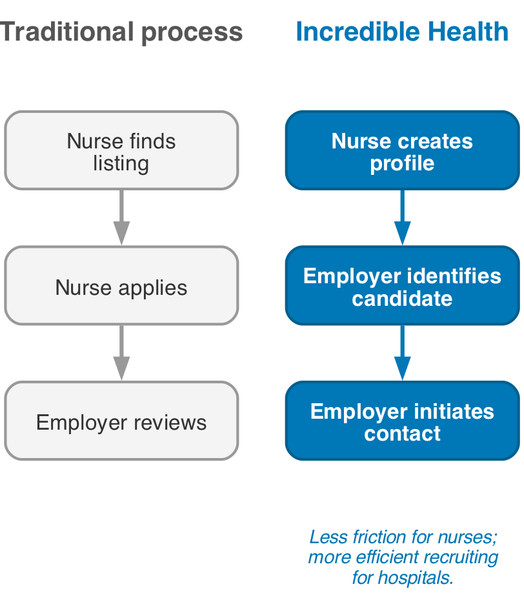
Traditional hiring vs. Incredible Health
- Hospitals get a more efficient recruiting process.
- Nurses face less friction finding opportunities.
If both sides prefer that process to traditional recruiting or broad job boards, Incredible Health can gain market share and potentially profits.
Barriers to Entry and Monopoly
A barrier to entry is anything that makes it hard for new firms to begin competing effectively.
Main barriers include:
- Intellectual property rights, especially patents
- Regulations such as licenses, approvals, quotas, or legal restrictions
- Limited access to suppliers or key resources
- High startup costs
- Scale-supported low prices
That last one matters a lot. Large firms can spread costs, get better supplier deals, and charge lower prices than a new entrant can match.
Barriers mostly block new entrants. They do not automatically remove current rivals.
A monopoly is a market with only one business providing a unique good or service. Strong barriers often help maintain that position.
Test caution here. A business is not a monopoly just because it has:
- a famous brand
- one unique version of a product
You have to define the relevant market correctly.
Building and Evaluating a Competitive Advantage Plan
Strong business answers connect the market, the action, and the result.
Building the plan
- Define the market
- product
- customers
- geographic or virtual reach
- real substitutes and rivals
- Assess competitiveness
- number of rivals
- degree of differentiation
- rivals’ ability to offer similar value at lower prices
- Choose the basis of advantage
- price, quality, features, service, convenience, reliability, or marketing
- Name the business actions
- what exactly the firm will do
- Explain the causal chain
- business action → customer benefit → customer preference → higher market share → potential profit
- Recognize risks and tradeoffs
- costs may rise
- lower prices may shrink margins
- features may not matter
- barriers may weaken over time
Evaluating the plan
A good evaluation asks:
- Is the market clearly defined?
- Does the strategy fit the actual level of competition?
- Is the difference meaningful to customers?
- Can the business deliver the claimed value?
- If low price is the strategy, can costs stay low enough?
- If barriers are the strategy, are they real and maintainable?
- Would more market share likely turn into profit?
Weak answers just label a strategy. Strong answers explain the full chain from market conditions to specific action to customer response to business results.
Key Takeaways
Market
Any physical or virtual space in which sellers interact with buyers
Voluntary Exchange
An exchange buyers and sellers choose because each expects to benefit
Revenue
The amount a business receives from sales; it is not the same as profit
Prevailing Market Price / Market Price
The price or narrow range of prices at which a product is commonly exchanged, emerging from repeated buyer-seller interactions
Market Competitiveness
The amount and nature of rivalry in a market, shaped by the number of rivals and offerings, product differentiation, and rivals’ ability to offer similar products at lower prices
Competitive Advantage
A business’s ability to outperform rivals in the same market, leading to increased market share and potentially increased profits
Market Share
The portion of total sales in a defined market accounted for by one business, measured consistently by units, customers, or revenue
Product Differentiation / Differentiated Product
Making a product meaningfully distinct from rival offerings through features or benefits customers value
Commodity
A standardized or largely interchangeable product for which buyers perceive little difference among qualified sellers
Barrier to Entry
An obstacle that makes it difficult for a new business to compete effectively, such as intellectual property rights, regulations limiting rivals, limited access to suppliers, high startup costs, or scale-supported low prices
Intellectual Property Rights
Enforceable legal rights that can restrict rivals from copying protected creations or inventions
Patent
An exclusive legal right to an invention for a limited period, subject to the patent’s terms
Monopoly
A market without competition in which one business is the sole provider of a unique good or service
Developing a Competitive Advantage Plan
Define the market, assess competition, identify a customer priority, select supporting actions, explain the expected outcome, and recognize costs and risks
Evaluating a Competitive Advantage Plan
Check whether the plan fits the market, creates a valued and deliverable difference, is financially sustainable, and can plausibly increase customer preference and market share
Notes
Market
Any physical or virtual space in which sellers interact with buyers
Voluntary Exchange
An exchange buyers and sellers choose because each expects to benefit
Revenue
The amount a business receives from sales; it is not the same as profit
Prevailing Market Price / Market Price
The price or narrow range of prices at which a product is commonly exchanged, emerging from repeated buyer-seller interactions
Market Competitiveness
The amount and nature of rivalry in a market, shaped by the number of rivals and offerings, product differentiation, and rivals’ ability to offer similar products at lower prices
Competitive Advantage
A business’s ability to outperform rivals in the same market, leading to increased market share and potentially increased profits
Market Share
The portion of total sales in a defined market accounted for by one business, measured consistently by units, customers, or revenue
Product Differentiation / Differentiated Product
Making a product meaningfully distinct from rival offerings through features or benefits customers value
Commodity
A standardized or largely interchangeable product for which buyers perceive little difference among qualified sellers
Barrier to Entry
An obstacle that makes it difficult for a new business to compete effectively, such as intellectual property rights, regulations limiting rivals, limited access to suppliers, high startup costs, or scale-supported low prices
Intellectual Property Rights
Enforceable legal rights that can restrict rivals from copying protected creations or inventions
Patent
An exclusive legal right to an invention for a limited period, subject to the patent’s terms
Monopoly
A market without competition in which one business is the sole provider of a unique good or service
Developing a Competitive Advantage Plan
Define the market, assess competition, identify a customer priority, select supporting actions, explain the expected outcome, and recognize costs and risks
Evaluating a Competitive Advantage Plan
Check whether the plan fits the market, creates a valued and deliverable difference, is financially sustainable, and can plausibly increase customer preference and market share
