Topic 1.8 Notes – Supply Chains
What Supply Chains Are
A supply chain is the network of people and businesses involved in getting a product or service to the customer. It connects three linked jobs:
- acquiring resources
- producing the good or service
- distributing or delivering it
A quick distinction helps here. Production is how the product is made or the service is provided. Supply chain is broader. It includes production, but also suppliers, transportation, storage, and delivery.
Why this matters is simple. A business’s operations have to match its customer promise.
- A company promising low prices cannot keep that promise with a costly, slow, wasteful chain.
- A company promising high quality cannot keep that promise with unreliable suppliers or weak quality control.
That is why supply-chain choices affect:
- costs
- risk
- profits
- competitive advantage
Supply chains can be local, regional, or global. None is automatically best. Each one creates tradeoffs in cost, quality, efficiency, convenience, and risk.
Production Processes and What Drives the Choice
Businesses need a production process, which means the organized way they create a good or provide a service. For goods, the two main approaches are artisan production and mass production.
Artisan production
Artisan production depends on skilled labor and attention to detail.
Customers tend to value this when they want:
- craftsmanship
- customization
- small-batch or unique products
- personal attention
Common tradeoffs:
- lower output
- slower production
- higher unit cost
- more dependence on worker skill
One test trap here is assuming artisan always means better. It does not automatically mean high quality. If the inputs are poor or the workers are inconsistent, artisan production can still produce weak results.
Mass production
Mass production uses technology, machinery, assembly lines, and standardization to make large quantities.
Customers tend to value this when they want:
- low prices
- consistency
- immediate availability
- large quantities
Common tradeoffs:
- high startup investment
- less flexibility
- less customization
- one mistake can affect many units
Another common mistake is thinking mass production means low quality. It does not. A business can mass-produce very high-quality goods if it uses precise systems and strong inputs.
What drives the choice
The best production process depends on three main things:
- Customer priorities
- What matters most to buyers: quality, price, or customization
- Core competencies
- What the business is especially good at
- Skilled craftspeople fit artisan production
- Strength in automation or logistics fits mass production
- Competitive landscape
- What rivals are doing on price, quality, features, and efficiency
Other practical factors also matter, including capacity, available technology, labor skills, consistency, speed, and the cost of changing output.
Parts of a Supply Chain
For a good, there is a common sequence from supplier to manufacturer to distribution and retail.
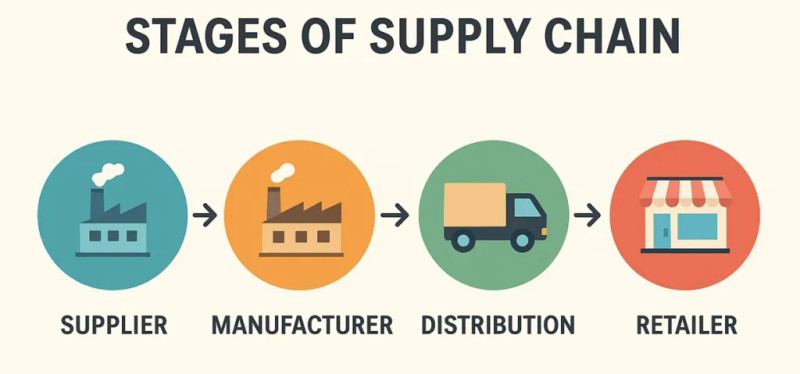
Basic goods supply chain
Goods supply chain
The full chain often looks like this:
- raw materials/component parts
- manufacturing facility
- warehouse if used
- distribution center, retail store, or direct delivery
- customer
Key terms you need to know:
- Raw materials are basic inputs such as cotton, timber, metal, or petroleum.
- Component parts are made inputs used inside another product. A common example is computer chips.
- Supplier provides materials, parts, equipment, or other resources.
- Manufacturing facility is where workers and equipment turn inputs into finished goods.
- Finished goods are completed products ready to sell.
- Warehouse stores goods.
- Distribution center sorts and redirects goods.
- Retailer sells to final customers.
- Logistics means the movement and coordination across the whole chain.
A few reminders matter on tests:
- Not every chain uses every stage.
- Some companies ship directly to customers.
- Upstream means closer to inputs.
- Downstream means closer to the final customer.
Service supply chain
Services do not usually move through raw materials, warehousing, and retail in the same way.
A service chain usually depends on:
- employees
- training and scheduling systems
- buildings, vehicles, tools, or equipment
- software, internet, and communication tech
- contractors
- booking, payment, and customer support systems
- in-person or virtual delivery
An online tutoring business is a good example. It needs tutors, scheduling software, a payment system, a video platform, and customer support.
Goods and services overlap
Some businesses use both kinds of chain.
- A restaurant needs ingredients and equipment, but also service staff and service delivery.
- A repair business needs replacement parts, but also labor, scheduling, and customer communication.
Building and Evaluating a Supply Chain Plan
A supply-chain plan should connect the business idea to how the product actually reaches customers.
- Identify the product and the customer promise.
- List needed inputs, employees, resources, and technology.
- Decide what the business does itself and what it outsources.
- Decide where and how production happens.
- Plan how inputs and finished goods move.
- Decide whether goods are stored, and where.
- Choose how the product reaches customers.
- Pick suppliers that fit the business best.
- Identify risks that could interrupt the chain.
- Check whether the whole plan supports competitive advantage.
Supplier selection criteria
Businesses compare suppliers using five factors:
| Factor | What it means |
|---|---|
| Cost | More than price. Includes transportation, storage, delays, defects, and replacement costs. |
| Quality | Whether inputs meet standards and avoid defects, returns, and reputation damage. |
| Efficiency | Getting the right inputs, in the right amount, at the right time. |
| Convenience | Ease of working together, including location, delivery speed, flexibility, communication, and system compatibility. |
| Risk | Chance of delay, interruption, higher costs, lower quality, or reputation harm. |
Risks and risk reduction
Know these supply-chain risks:
- natural disasters
- political instability
- resource shortages
- production errors
- supplier reputation
- transportation disruptions
- supplier failure
Businesses reduce risk with:
- backup suppliers
- less dependence on one source
- quality requirements
- supplier performance monitoring
- reserve inventory
- alternate transportation
That protection usually raises cost. That tradeoff shows up a lot in questions.
How Supply Chains Support Competitive Advantage
This section is the heart of the topic. Supply-chain choices should match strategy.
Low prices
A low-price strategy usually fits:
- mass production
- cheaper acceptable resources
- standardization
- automation
- high-volume suppliers
- streamlined distribution
Scaling means building a larger-capacity or more efficient chain so revenue rises more than costs.
High quality
A high-quality strategy usually fits:
- high-quality inputs
- reliable suppliers
- skilled labor or specialized producers
- error-checking systems
- transportation and storage that protect the product
This can use artisan or mass production.
Barriers to entry
Some businesses use supply-chain decisions to make competition harder.
- Exclusive or restrictive agreements may stop a supplier from selling parts to rivals.
- A distributor or retailer may be blocked from carrying rival products.
That creates a barrier to entry, meaning it is harder for competitors to get inputs or reach customers.
Customization and alignment
Customization is not its own strategy category here, but it strongly affects production and supplier choices. A business promising custom products needs flexibility and strong communication across the chain.
The AP-style best answer always shows alignment between:
- customer priorities
- production process
- supplier choice
- distribution plan
- risk management
- competitive advantage
Pearson 1860
Pearson 1860 is about evaluating supply-chain choices through cost, risk, and impact on competitive advantage. The main lesson is that the cheapest option is not always the best option.
A premium backpack or custom furniture company might choose artisan production and stronger suppliers to protect quality. A discount basics manufacturer would usually lean toward mass production and low-cost efficiency.
Key Takeaways
Production Process
The organized sequence of activities through which a business creates a good or provides a service
Artisan Production
A production process relying heavily on skilled labor, craftsmanship, and attention to detail, often for customized or small-batch products
Mass Production
The use of technology, machinery, assembly lines, and standardized procedures to produce large quantities of goods
Customer Priorities
The qualities customers value, especially quality, price, and customization, that a production process must support
Competitive Landscape
The prices, product features, quality levels, and production capabilities of a business’s rivals
Supply Chain
The connected individuals and businesses involved in acquiring inputs, producing a product, and delivering it to the final customer
Goods Supply Chain
A chain that moves raw materials and components through manufacturing, possible storage and distribution, and final delivery to customers
Raw Materials
Basic resources used to make products, such as cotton, timber, metal, or petroleum
Component Parts
Previously manufactured inputs incorporated into another product, such as chips, batteries, zippers, or tires
Supplier
An individual or business that provides raw materials, component parts, equipment, or other necessary resources
Manufacturing Facility
A location where workers and equipment transform inputs into finished goods
Finished Goods
Completed products ready for sale or distribution
Warehouse
A facility used primarily to store goods
Distribution Center
A facility that receives, organizes, sorts, and redirects goods toward retailers or customers
Retailer
A business that sells products to final customers
Logistics
The movement and coordination of resources and products through a supply chain
Upstream vs. Downstream
Upstream stages are closer to raw-material and component suppliers; downstream stages are closer to distribution, retail, and final customers
Service Supply Chain
A chain that acquires the employees, resources, technology, and delivery systems needed to provide a service in person or virtually
Supply-Chain Plan
A plan identifying needed inputs and suppliers, production and transportation methods, storage and distribution, risks, and alignment with competitive strategy
Supply-Chain Risk
The possibility that an event or condition will delay delivery, interrupt production, reduce quality, increase costs, or damage reputation
Local Supply Chain
A supply chain that obtains and moves resources within a relatively limited geographic area
Regional Supply Chain
A supply chain operating across a broader geographic region without the full reach and complexity of global sourcing
Global Supply Chain
A supply chain that crosses national borders to obtain resources, produce goods, or reach markets
Scaling Operations
Building higher-capacity or more efficient operations intended to produce an increase in revenue greater than the increase in costs
Exclusive Supplier Agreement
An agreement that prevents a supplier from selling a particular input or component to rival businesses
Exclusive Distribution Agreement
An agreement that prevents a retailer or distributor from carrying rival products
Cost
The total expense of using a supplier, including purchase price and costs from transportation, storage, delays, defects, and replacements
Quality
Whether a supplier’s inputs consistently meet the business’s required specifications and performance standards
Efficiency
How effectively a supplier uses resources and time to provide the correct inputs in needed quantities without unnecessary waste or delay
Convenience
How easily a business can work with a supplier, considering factors such as location, delivery speed, flexibility, communication, and system compatibility
Notes
Production Process
The organized sequence of activities through which a business creates a good or provides a service
Artisan Production
A production process relying heavily on skilled labor, craftsmanship, and attention to detail, often for customized or small-batch products
Mass Production
The use of technology, machinery, assembly lines, and standardized procedures to produce large quantities of goods
Customer Priorities
The qualities customers value, especially quality, price, and customization, that a production process must support
Competitive Landscape
The prices, product features, quality levels, and production capabilities of a business’s rivals
Supply Chain
The connected individuals and businesses involved in acquiring inputs, producing a product, and delivering it to the final customer
Goods Supply Chain
A chain that moves raw materials and components through manufacturing, possible storage and distribution, and final delivery to customers
Raw Materials
Basic resources used to make products, such as cotton, timber, metal, or petroleum
Component Parts
Previously manufactured inputs incorporated into another product, such as chips, batteries, zippers, or tires
Supplier
An individual or business that provides raw materials, component parts, equipment, or other necessary resources
Manufacturing Facility
A location where workers and equipment transform inputs into finished goods
Finished Goods
Completed products ready for sale or distribution
Warehouse
A facility used primarily to store goods
Distribution Center
A facility that receives, organizes, sorts, and redirects goods toward retailers or customers
Retailer
A business that sells products to final customers
Logistics
The movement and coordination of resources and products through a supply chain
Upstream vs. Downstream
Upstream stages are closer to raw-material and component suppliers; downstream stages are closer to distribution, retail, and final customers
Service Supply Chain
A chain that acquires the employees, resources, technology, and delivery systems needed to provide a service in person or virtually
Supply-Chain Plan
A plan identifying needed inputs and suppliers, production and transportation methods, storage and distribution, risks, and alignment with competitive strategy
Supply-Chain Risk
The possibility that an event or condition will delay delivery, interrupt production, reduce quality, increase costs, or damage reputation
Local Supply Chain
A supply chain that obtains and moves resources within a relatively limited geographic area
Regional Supply Chain
A supply chain operating across a broader geographic region without the full reach and complexity of global sourcing
Global Supply Chain
A supply chain that crosses national borders to obtain resources, produce goods, or reach markets
Scaling Operations
Building higher-capacity or more efficient operations intended to produce an increase in revenue greater than the increase in costs
Exclusive Supplier Agreement
An agreement that prevents a supplier from selling a particular input or component to rival businesses
Exclusive Distribution Agreement
An agreement that prevents a retailer or distributor from carrying rival products
Cost
The total expense of using a supplier, including purchase price and costs from transportation, storage, delays, defects, and replacements
Quality
Whether a supplier’s inputs consistently meet the business’s required specifications and performance standards
Efficiency
How effectively a supplier uses resources and time to provide the correct inputs in needed quantities without unnecessary waste or delay
Convenience
How easily a business can work with a supplier, considering factors such as location, delivery speed, flexibility, communication, and system compatibility
