Topic 4.3 Notes – Strategy and Decision Making
What Strategy Is
A goal is the result a business wants. A strategy is the overall plan for getting there. Tactics are the specific actions that carry out the strategy.
- “Increase profit by 15%” = goal
- “Grow institutional sales while keeping premium quality” = strategy
- “Hire a B2B salesperson” = tactic
That distinction shows up a lot in questions. If a choice is a single action, it is usually a tactic, not the strategy itself.
Businesses use strategy to do things like:
- build competitive advantage
- fulfill the mission
- increase revenue
- reduce costs
- increase profit
- respond to challenges, enter new markets, or improve long-term viability
A strategy is never one-size-fits-all. It depends on the business’s:
- capabilities and resources
- mission and values
- competitive position
- industry conditions
- customer needs
- broader market environment
So if a strategy worked for a giant company, that does not mean it fits a smaller business with less cash, fewer workers, or a different brand.
A clear strategy matters because it gives the business a shared direction. It helps managers decide what to do, and just as important, what not to do. That reduces conflict across departments and makes success more likely because resources are focused instead of scattered.
Those resources can include:
- Human resources such as employees, skills, managers, and time
- Financial resources such as cash, credit, and budgets
- Physical resources such as equipment, inventory, and facilities
- Intangible resources such as brand, reputation, intellectual property, and customer relationships
How Strategy Is Built and Used
Strategy is not just an idea someone likes. Good strategy is evidence-based and usually works as an ongoing cycle.
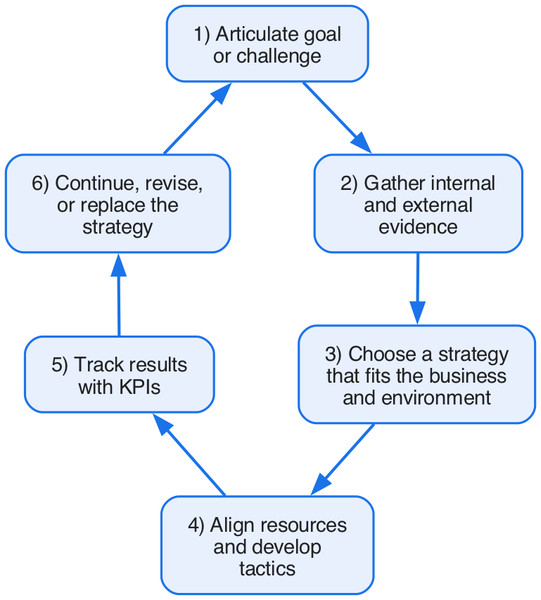
Strategy cycle
Here’s the cycle:
- Articulate a goal or challenge
- Gather evidence
- Choose a strategy
- Align resources and tactics
- Track results with KPIs
- Continue, revise, or replace the strategy
The evidence businesses track usually falls into four groups:
- Financial performance
- revenue, costs, profit, profit margins, cash flow
- Customer data
- needs, preferences, satisfaction, retention, purchasing behavior
- Competitor data
- products, prices, positioning, market share, likely responses
- Market trends
- technology, regulation, economy, social preferences, industry growth
This is where strategy guides decisions. There are two kinds of alignment you need to know:
- Vertical alignment
- tactics should support the strategy
- strategy should support the goal
- Cross-functional alignment
- marketing, operations, finance, and HR should support each other
If marketing promises fast delivery but operations cannot produce fast enough, the business is out of alignment.
Strategy is judged by more than whether it sounds smart. It has to be feasible, backed by evidence, and consistent with the business’s priorities. A common quiz move is giving you a KPI that doesn’t actually measure the strategy. If the strategy is about retention, the KPI should track retention, not just total revenue.
The PACED Decision Process
For major decisions, businesses often use PACED:
- P Define the problem
- A Develop alternatives
- C Establish criteria
- E Evaluate alternatives
- D Decide
Define the problem
You need the real decision, not just the symptom. “Sales are down” is a symptom. The actual decision might be whether to change price, change the product, enter a new market, or wait for more data.
A strong problem statement includes:
- the current situation
- the desired outcome
- the constraints
Develop alternatives
Alternatives should be realistic and meaningfully different. They can include:
- taking action
- delaying
- piloting
- keeping the current approach
Keeping the current approach is still an option, and students forget that.
Establish criteria
Criteria are the standards you use to judge options. They should be set before picking your favorite option.
Include both:
- costs and benefits
- quantifiable and intangible factors
Evaluate alternatives
Compare each option using the same criteria and use evidence, not guesses. A decision matrix can help, and strategic frameworks belong here as evaluation tools.
- Porter’s Five Forces
- SWOT analysis
You do not need to reteach those frameworks here. Just remember their role. They help compare options systematically against long-term goals and strategy by evaluating relevant internal and external variables.
Decide
The best option is the one with the strongest overall case. It is not always the one that wins on one number.
A strong recommendation includes:
- a clear choice
- evidence
- a link to strategy or goals
- major risks and tradeoffs
- a plan to monitor or reduce those risks
Decision Criteria and ROI
Decision criteria usually fit four categories:
| Category | What it includes |
|---|---|
| Financial | costs, revenue, profit, cash needs, ROI |
| Market | customer demand, competitiveness, differentiation |
| Operational | quality, capacity, technology, delivery, supply chain risk |
| Organizational | employee impact, management capacity, culture, stakeholder relationships |
Some criteria are quantifiable. You can measure them directly.
- production cost
- total sales
- profit
- staffing needs
- delivery time
Some are intangible. They matter even if they are harder to measure.
- reputation
- mission fit
- core values
- customer trust
- employee morale
- flexibility
ROI compares the additional profit from an investment to the cost of that investment.
Three reminders that get tested a lot:
- use profit, not revenue
- compare the same time period
- forecast ROI is still an estimate
ROI has limits. It does not show by itself:
- total dollars of profit
- timing of cash flows
- financing availability
- risk level
- customer or employee effects
- quality or reputation effects
- strategy or mission fit
So the highest ROI is not automatically the best choice.
Tradeoffs, Uncertainty, and the ExpressionMed Example
Real decisions are imperfect because managers deal with:
- conflicting criteria
- limited data
- uncertain forecasts
- changing conditions
A good decision uses the best available evidence and makes assumptions clear.
Managers can respond to uncertainty by:
- gathering more evidence
- testing with a pilot
- comparing multiple estimates
- creating contingency plans
- monitoring results after implementation
After the decision, they compare actual results to expected results and benchmarks. Then they may continue, modify, expand, or reverse the decision.
ExpressionMed helps make this concrete. The business uses evidence to make a strategic decision. The point is that customer demand matters, but so do financial feasibility, operational capacity, product quality, and brand trust. The recommendation has to explain why the option is best, not just name an option.
A classic expansion example works the same way:
- Buy equipment
- Outsource production
- Keep current capacity
Outsourcing may have higher ROI. Internal expansion may fit the long-term strategy better if quality control matters most. Keeping current capacity means no expansion. The best answer follows the business’s priorities, not one isolated number.
Key Takeaways
Strategy (Business Strategy)
A plan or broad approach for achieving a goal; it explains how a business will move toward a desired outcome and should fit its capabilities and environment
Tactics
Specific actions or approaches used to carry out and advance a strategy
Strategic Cycle
Set a goal, gather evidence, select a strategy, align resources and tactics, track results, and then continue, revise, or replace the strategy
Vertical Alignment
Consistency in which tactics advance the strategy and the strategy advances the goal
Cross-Functional Alignment
Consistency among decisions made in areas such as marketing, finance, operations, and human resources
Deliberative Process (PACED Model)
A structured decision process: define the Problem, develop Alternatives, establish Criteria, Evaluate alternatives, and Decide on the best approach
Decision-Making Criteria
Standards used to judge alternatives based on the business’s goals, strategy, constraints, and stakeholder concerns
Quantifiable vs. Intangible Costs and Benefits
Quantifiable costs and benefits can be expressed numerically; intangible ones are difficult to measure precisely but may still be important
Financial Considerations
Decision criteria involving costs, revenues, profit, cash needs, and return on investment
Market Considerations
Decision criteria involving customers, demand, competitors, differentiation, and competitiveness
Operational Considerations
Decision criteria involving production, quality, technology, delivery, capacity, and supply chain risk
Organizational Considerations
Decision criteria involving employees, management capacity, culture, skills, responsibilities, and stakeholder relationships
Decision Matrix
A table that organizes alternatives and criteria so their costs, benefits, tradeoffs, and assumptions can be compared
Strategic Framework
A tool for systematically evaluating relevant internal and external variables of an option against long-term goals and strategy
Return on Investment (ROI)
Additional profit generated by an investment ÷ investment cost; multiply by 100 to express it as a percentage
Notes
Strategy (Business Strategy)
A plan or broad approach for achieving a goal; it explains how a business will move toward a desired outcome and should fit its capabilities and environment
Tactics
Specific actions or approaches used to carry out and advance a strategy
Strategic Cycle
Set a goal, gather evidence, select a strategy, align resources and tactics, track results, and then continue, revise, or replace the strategy
Vertical Alignment
Consistency in which tactics advance the strategy and the strategy advances the goal
Cross-Functional Alignment
Consistency among decisions made in areas such as marketing, finance, operations, and human resources
Deliberative Process (PACED Model)
A structured decision process: define the Problem, develop Alternatives, establish Criteria, Evaluate alternatives, and Decide on the best approach
Decision-Making Criteria
Standards used to judge alternatives based on the business’s goals, strategy, constraints, and stakeholder concerns
Quantifiable vs. Intangible Costs and Benefits
Quantifiable costs and benefits can be expressed numerically; intangible ones are difficult to measure precisely but may still be important
Financial Considerations
Decision criteria involving costs, revenues, profit, cash needs, and return on investment
Market Considerations
Decision criteria involving customers, demand, competitors, differentiation, and competitiveness
Operational Considerations
Decision criteria involving production, quality, technology, delivery, capacity, and supply chain risk
Organizational Considerations
Decision criteria involving employees, management capacity, culture, skills, responsibilities, and stakeholder relationships
Decision Matrix
A table that organizes alternatives and criteria so their costs, benefits, tradeoffs, and assumptions can be compared
Strategic Framework
A tool for systematically evaluating relevant internal and external variables of an option against long-term goals and strategy
Return on Investment (ROI)
Additional profit generated by an investment ÷ investment cost; multiply by 100 to express it as a percentage
