Topic 3.9 Notes – Ethics and Financial Reporting
What ethical financial management and reporting are
This topic sits on top of the three main financial statements you already know: the income statement shows profit over a period, the balance sheet shows what a business owns and owes at a point in time, and the cash flow statement shows cash moving in and out. Stakeholders use those statements to make decisions, even though they usually cannot see the raw records underneath.
Ethical financial management means a business uses money and resources only for authorized purposes, records transactions accurately, follows laws and company rules, and makes decisions with stakeholders in mind.
Ethical financial reporting means the business tells the truth about its financial condition and performance.
Unethical conduct can show up in a few different ways:
- False statements such as made-up sales or fake expenses
- Concealing bad news such as hiding a debt
- Omitting transactions or obligations from the records
- Misleading with technically true information such as showing strong sales but hiding a major unpaid bill
- Unauthorized use of funds for personal or unrelated purposes
- Conflicts of interest that affect judgment
- Refusing to fix a known major error
A mistake is not automatically fraud. Fraud means intentional deception for gain or to make others act on false information. If someone discovers a major error and knowingly leaves it uncorrected, that can become unethical and even fraudulent.
Also, illegal and unethical are not the same thing. Many actions are both. Still, a person can break a professional code of conduct without committing a crime, and simply following the bare minimum law does not make something ethical.
Major unethical financial practices
Here are the six practices you need to know and be able to recognize in a scenario.
This overview gives you the big picture first, then the sections below break down what each one looks like in practice.
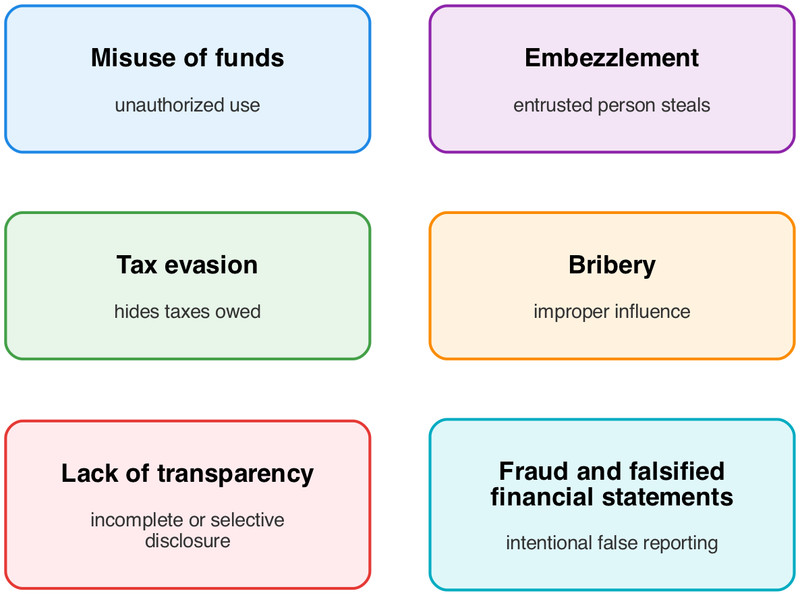
Six major unethical financial practices
Misuse of funds
Misuse of funds happens when business money is used for something other than its authorized business purpose.
Examples:
- personal travel charged to a company account
- an unauthorized loan to yourself
- using restricted funds for a different purpose
The key issue is authority. Having access to money does not mean you have permission to use it however you want.
Embezzlement
Embezzlement is theft or fraudulent appropriation by someone entrusted with the money or property.
That entrusted access is the big difference from ordinary theft.
Examples:
- false customer refunds
- fake vendor payments
- using business accounts to pay personal expenses
The Yardley case shows this clearly. An employee at a fictional business is tempted to act unethically for personal gain. The point is the difference between having access to company resources and having authority to use them personally.
Tax evasion
Tax evasion is illegally avoiding taxes that are actually owed.
Common signs:
- underreporting revenue
- hiding income
- inventing expenses
- keeping transactions off the books
Be careful here. Legal tax planning is allowed. Deception is what makes it evasion.
Bribery
Bribery means offering, giving, requesting, or receiving something of value to improperly influence a decision.
Examples:
- a supplier pays a purchasing manager for approval
- gifts or travel are offered to win favorable treatment
This destroys objectivity, because the choice is no longer based on what is best for the business.
Lack of transparency
Lack of transparency means relevant financial information is concealed, delayed, obscured, or selectively disclosed.
This is commonly tested because students think inaccurate numbers are required. They are not. The numbers can be individually correct and still create a misleading overall picture.
Fraud and falsified financial statements
This is intentional falsification or omission in the statements.
Common patterns include:
- reporting revenue not yet earned
- concealing expenses or liabilities
- overstating assets such as cash, inventory, or receivables
- understating what the business owes
A business may want to look:
- better than reality to raise stock price, attract investors, secure loans, get lower interest rates, or reassure suppliers, customers, and employees
- worse than reality to reduce taxes or other obligations
Why people and businesses do it
Most unethical conduct comes from incentive + opportunity.
- Incentive means a reason to benefit
- Opportunity means access, authority, or weak oversight that makes it possible
Personal incentives
A person may be driven by:
- direct personal gain
- job protection
- pressure for a bonus, promotion, or reputation
- personal financial problems
- rationalizations such as “I’m just borrowing it” or “I deserve it”
Organizational incentives
A business may mislead stakeholders to look stronger and:
- support or raise stock price
- attract investors
- get a higher valuation
- persuade lenders
- get better loan terms
- hide poor performance
Or it may look weaker to reduce taxes or other obligations.
Access and weak controls
Risk is highest when one person can both handle money and control the records. That is why separation of duties matters so much.
If one employee receives money, records it, authorizes payments, and reviews the account, that person can both commit and hide misconduct.
Who gets harmed
Unethical conduct can hurt:
- investors
- lenders
- suppliers
- employees
- government and taxpayers
- honest competitors
- the business itself through fines, lawsuits, reputation damage, higher borrowing costs, stock drops, bankruptcy, or shutdown
How laws, audits, codes, and internal controls discourage unethical behavior
Laws make misconduct punishable. Misuse of funds, tax evasion, embezzlement, bribery, and fraud are illegal in most countries, though penalties vary.
In the United States, publicly held corporations must submit annual financial records for an independent external audit by independent accounting firms. Financial market regulations are designed to ensure that investors have access to accurate information and are protected from fraud.
Think of financial reporting as protected by several layers of oversight, not just one check.
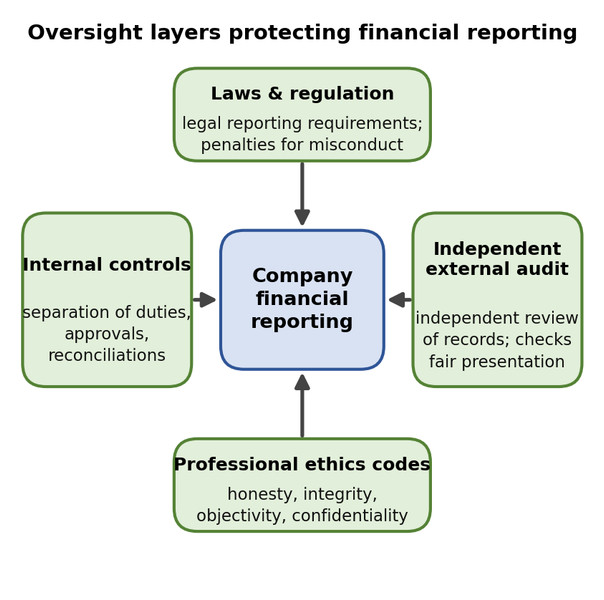
Oversight layers protecting financial reporting
An independent audit is one of those layers. It:
- reviews records and evidence
- checks whether statements fairly present the business’s condition
- increases the chance major misstatements are found
- does not guarantee every fraud or error will be caught
Professional organizations for accountants and financial managers maintain professional ethics codes for their members. Those codes emphasize:
- honesty for truthful records and statements
- integrity for acting ethically under pressure
- transparency for clearly sharing relevant facts
- objectivity for evidence-based decisions free from conflicts
- confidentiality for protecting private information, though never as an excuse to hide fraud
Internal safeguards reduce opportunity:
- Codes of conduct cover recordkeeping, conflicts of interest, gifts, use of company property, confidentiality, and reporting concerns.
- Audit requirements increase oversight through internal and external reviews.
- Cash-handling and payment controls include separation of duties, multiple approvals for large payments, limited access to cash and systems, receipts, reconciliations, review of refunds and vendor changes, and confidential reporting channels.
Separation of duties is one of the most testable controls. Different people should receive money, record transactions, authorize payments, and review accounts.
How to analyze a scenario on the test
Use this order in your head when reading a case:
- Identify the unethical practice.
- Identify the incentive.
- Identify the opportunity or weak control.
- Decide whether the business is being shown as better or worse than reality.
- Identify which stakeholders are misled or harmed.
- Name the law, audit, professional principle, or internal control that could prevent or detect it.
Fast anchors:
- employee diverts company money with authorized access = embezzlement
- company hides income from the government = tax evasion
- supplier offers personal benefit for approval = bribery
- management omits liabilities or overstates revenue/assets = financial statement fraud
- incomplete or selective disclosure = lack of transparency
- company money used for unauthorized purposes = misuse of funds
Key Takeaways
Ethical Financial Management
Using financial resources only for authorized purposes, recording transactions accurately, obeying relevant laws, and meeting responsibilities to stakeholders
Ethical Financial Reporting
Presenting a business’s financial condition and performance completely, accurately, and truthfully rather than manipulating the information
Illegal vs. Unethical Conduct
Illegal conduct violates law, while unethical conduct may instead violate professional or internal standards; merely obeying the law does not prove conduct is ethical
Misuse of Funds
Using money for a purpose other than its authorized business purpose, even if the money is not permanently stolen
Embezzlement
The theft or fraudulent appropriation of money or property by someone who was entrusted with access to or control over it
Tax Evasion
The illegal use of deception or concealment to avoid taxes owed, unlike lawful tax planning or tax avoidance
Bribery
Offering, giving, requesting, or receiving something of value to influence a decision improperly
Transparency / Lack of Transparency
Transparency provides entitled stakeholders relevant financial information clearly, completely, and promptly; lack of transparency conceals, delays, obscures, or selectively discloses it
Fraud
Intentional deception intended to produce an improper benefit or cause another party to act in reliance on false information
Financial Statement Fraud / Falsified Financial Statements
Intentionally falsifying financial-statement information or omitting significant information to portray a business as better or worse than it really is
Incentive and Opportunity
An incentive supplies a reason to benefit from misconduct, while an opportunity supplies the access, authority, or weak oversight needed to commit or conceal it
Personal Incentives
Individual motives for misconduct, such as stealing money, receiving a bribe, earning a bonus, protecting a job, or avoiding personal loss
Organizational Incentives
Business motives for misrepresentation, such as supporting stock price, attracting investors, obtaining better loan terms, concealing poor performance, or reducing taxes
Financial Market Regulation
Rules intended to give investors accurate financial information and protect them from fraud, supporting confidence in investment markets
Independent External Audit
An examination by an independent accounting firm of records and evidence to assess whether financial statements fairly present the business’s condition and performance
Professional Ethics Code
Standards maintained by a professional organization that establish ethical expectations for members and may exceed minimum legal requirements
Honesty
Providing truthful records, statements, and communications and correcting known false information
Integrity
Acting consistently with ethical and professional responsibilities, including resisting pressure to participate in deceptive conduct
Objectivity
Making judgments from evidence rather than personal gain, favoritism, pressure, or conflicts of interest
Confidentiality
Protecting private information and sharing it only with authorized parties or as required by law, without using secrecy to conceal fraud
Internal Controls / Internal Business Safeguards
Business mechanisms that reduce opportunities for misconduct, clarify authority, create evidence, and increase the chance of detection
Business Code of Conduct
An internal statement of expected employee and manager behavior, including rules for records, conflicts, gifts, business property, confidentiality, and reporting concerns
Cash-Handling and Payment Controls
Processes that limit unsupervised access to money through restricted access, approvals, documentation, reconciliations, and review of unusual transactions
Separation of Duties
Assigning receipt, recording, authorization, payment, and review tasks to different people so one person cannot both commit and conceal misconduct
Audit Requirements
Required internal or external independent reviews that increase the likelihood that altered records, diverted funds, or other misconduct will be detected
Notes
Ethical Financial Management
Using financial resources only for authorized purposes, recording transactions accurately, obeying relevant laws, and meeting responsibilities to stakeholders
Ethical Financial Reporting
Presenting a business’s financial condition and performance completely, accurately, and truthfully rather than manipulating the information
Illegal vs. Unethical Conduct
Illegal conduct violates law, while unethical conduct may instead violate professional or internal standards; merely obeying the law does not prove conduct is ethical
Misuse of Funds
Using money for a purpose other than its authorized business purpose, even if the money is not permanently stolen
Embezzlement
The theft or fraudulent appropriation of money or property by someone who was entrusted with access to or control over it
Tax Evasion
The illegal use of deception or concealment to avoid taxes owed, unlike lawful tax planning or tax avoidance
Bribery
Offering, giving, requesting, or receiving something of value to influence a decision improperly
Transparency / Lack of Transparency
Transparency provides entitled stakeholders relevant financial information clearly, completely, and promptly; lack of transparency conceals, delays, obscures, or selectively discloses it
Fraud
Intentional deception intended to produce an improper benefit or cause another party to act in reliance on false information
Financial Statement Fraud / Falsified Financial Statements
Intentionally falsifying financial-statement information or omitting significant information to portray a business as better or worse than it really is
Incentive and Opportunity
An incentive supplies a reason to benefit from misconduct, while an opportunity supplies the access, authority, or weak oversight needed to commit or conceal it
Personal Incentives
Individual motives for misconduct, such as stealing money, receiving a bribe, earning a bonus, protecting a job, or avoiding personal loss
Organizational Incentives
Business motives for misrepresentation, such as supporting stock price, attracting investors, obtaining better loan terms, concealing poor performance, or reducing taxes
Financial Market Regulation
Rules intended to give investors accurate financial information and protect them from fraud, supporting confidence in investment markets
Independent External Audit
An examination by an independent accounting firm of records and evidence to assess whether financial statements fairly present the business’s condition and performance
Professional Ethics Code
Standards maintained by a professional organization that establish ethical expectations for members and may exceed minimum legal requirements
Honesty
Providing truthful records, statements, and communications and correcting known false information
Integrity
Acting consistently with ethical and professional responsibilities, including resisting pressure to participate in deceptive conduct
Objectivity
Making judgments from evidence rather than personal gain, favoritism, pressure, or conflicts of interest
Confidentiality
Protecting private information and sharing it only with authorized parties or as required by law, without using secrecy to conceal fraud
Internal Controls / Internal Business Safeguards
Business mechanisms that reduce opportunities for misconduct, clarify authority, create evidence, and increase the chance of detection
Business Code of Conduct
An internal statement of expected employee and manager behavior, including rules for records, conflicts, gifts, business property, confidentiality, and reporting concerns
Cash-Handling and Payment Controls
Processes that limit unsupervised access to money through restricted access, approvals, documentation, reconciliations, and review of unusual transactions
Separation of Duties
Assigning receipt, recording, authorization, payment, and review tasks to different people so one person cannot both commit and conceal misconduct
Audit Requirements
Required internal or external independent reviews that increase the likelihood that altered records, diverted funds, or other misconduct will be detected
