Topic 5.3 Notes – Saving and Investing for Education, Housing, and Retirement Goals
What Long-Term Financial Planning Is
Long-term planning is just turning a future goal into a money plan you can actually carry out. Instead of saying “I want to buy a house someday,” you pin down what that goal will likely cost, when you’ll need the money, and how you’ll build toward it over time.
A workable plan includes all of these pieces:
- specific goal
Example: $36,000 for a down payment, or college costs for yourself or a dependent. - estimated cost
You need a number, even if it gets revised later. - time horizon
How long until the money is needed. - amount already saved
- contribution per paycheck
- where the money will be held
Savings account, CD, stocks, bonds, mutual funds, or some mix. - expected return and risk
- fees, taxes, and inflation
- review and adjustment process
Plans change because income, family needs, health, interest rates, and goals change.
Seen as a sequence, those pieces form a simple planning process.
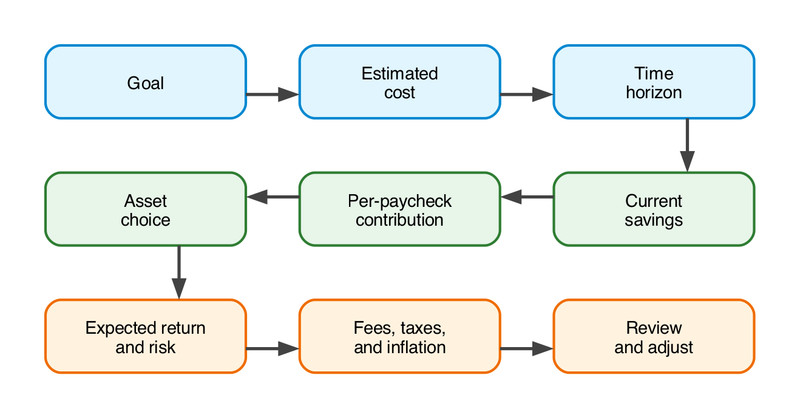
Long-term financial planning process
The biggest idea here is that the plan starts with the goal, not with “What’s the best investment?” A 3-year college bill and a 30-year retirement goal should not use the same strategy.
Trade-offs are built into planning:
- More money toward a house down payment may mean less for retirement.
- Delaying retirement saving gives up years of compounding.
- A family with combined finances, including a two-income married couple, lowers conflict when they agree on priorities, contribution amounts, and acceptable risk.
Financial technology helps people follow through:
- automated savings plans move money on schedule
- payroll deduction sends part of your check into retirement accounts
- pay yourself first means saving before the money gets spent elsewhere
The Major Long-Term Goals and How They’re Funded
These four goals show up again and again because they are expensive, long-term, and usually need a mix of saving and investing.
Education goals
Postsecondary education means education or training after high school. The decision is not just “Which school?” It also includes what to study, your career goals, and how much funding is available.
Costs include more than tuition:
- housing
- food
- fees
- books
- supplies
- transportation
- possible forgone earnings if you could have been working instead
Funding usually comes from a combination of:
- savings
- scholarships
- grants
- work-study programs
- current earnings
- student loans
A common test trap is looking only at sticker price or total “aid.” What matters is net cost, plus how much of the package is borrowing.
Loan basics:
- Federal student loans may have lower interest rates, better repayment terms, and may be subsidized.
- Private student loans often have fewer protections.
Time horizon matters here too. Money needed for tuition next year usually belongs in safer places than money for a child who won’t start college for 15 years.
Housing goals
Housing decisions include:
- where to live
- whether to rent or buy
- what is affordable
Renting gives flexibility and lower upfront cost.
Buying can build equity, which is the value you own in the home, but it brings more costs than many students remember.
Buying costs include:
- down payment
- mortgage
- property taxes
- homeowners insurance
- maintenance and repairs
- association fees
- transaction and closing costs
A mortgage is a loan secured by the home. Approval depends on income, debt, credit history, the property, and the down payment.
Mortgage types:
- fixed-rate mortgage
interest rate stays the same - adjustable-rate mortgage
may start lower, but payments can rise later
Payment relationships to know:
- bigger loan or higher interest rate = higher monthly payment
- longer term = lower monthly payment but more total interest
- larger down payment = less borrowed and lower payment
Retirement and charitable giving
Retirement income often comes from a mix of:
- Social Security
- employer-sponsored retirement plans
- personal savings and investments
- continued earnings
Retirement choices depend on:
- when to retire
- where to live
- health and longevity
- expected expenses
- available funding
Retirement usually has the longest time horizon, which is why early saving matters so much.
Charitable giving is also part of a financial plan. You choose nonprofit organizations based on mission and impact and on how that mission fits your own goals, and you can give through:
- one-time gifts
- recurring donations
- legacy contributions
Tax deduction reminder: a charitable deduction reduces taxable income, not your tax bill dollar-for-dollar.
Financial Assets and the Risk Return Tradeoff
Different goals use different assets because assets differ in risk, return, and liquidity.
The asset types together
| Asset | What it is | Strength | Limitation |
|---|---|---|---|
| Savings account | Bank deposit account | Liquid, low risk, federally insured if eligible | Low expected return |
| CD | Deposit for a fixed term | Safer, stated rate, federally insured if eligible | Early withdrawal penalty |
| Stock | Ownership in a company | Higher expected long-term return | High risk and price swings |
| Bond | Loan to a government or business | Interest income, usually less volatile than stocks | Still has risk |
| Mutual fund | Pooled money invested in many securities | Easy diversification | Still has market risk and fees |
Risk, return, liquidity, and compounding
Risk means actual return can differ from expected return, including loss.
Liquidity means how easily you can turn an asset into cash without major loss.
The general pattern is simple:
- lower risk usually means lower expected return
- some assets are low risk because they are government insured or provide guaranteed income
- higher expected return usually means more uncertainty
- individual stocks are higher risk because the value of the asset depends on the success of the business
Compounding is one of the most important ideas in personal finance. Returns earn returns over time. That is why saving early for retirement usually beats waiting and trying to catch up later.
What Reduces Return and How to Build a Smart Plan
What lowers the return you actually keep
The return you see is not always the return you keep.
- Fees
- transaction fees
- management fees
- advisory fees
- Brokerage choice
- individuals cannot purchase stocks or bonds without a broker
- full-service firms charge more and give more advice
- discount firms charge less and give less advice
- Taxes
- interest
- dividends
- capital gains
- investors often consider whether taxes must be paid and, if so, at what rate when choosing financial assets
- Inflation
- reduces purchasing power over time
- investors typically consider both nominal returns and inflation-adjusted returns when choosing financial assets
- Behavioral biases
- overconfidence can lead to excessive risk, excessive trading, or too much money in one investment
- loss aversion can cause investors to sell too soon during downturns, sometimes prematurely at a loss
How to recommend a saving and investment plan
A good recommendation pulls the whole topic together. You look at:
- amount needed
- deadline
- amount already saved
- amount available each pay period
- risk tolerance
- time horizon
- suitable assets
- whether the plan is likely to be enough
Here’s the common household example. Notice how the asset choice changes as the time horizon gets longer:
- 3-year education goal → safer assets like insured savings or CDs because you may need to liquidate during a downturn, which could result in losses or lower than expected returns
- 8-year down payment goal → still fairly safe, maybe limited market exposure depending on risk tolerance
- 30-year retirement goal → more room for diversified stock and bond mutual funds because you can wait for assets to regain value after a downturn
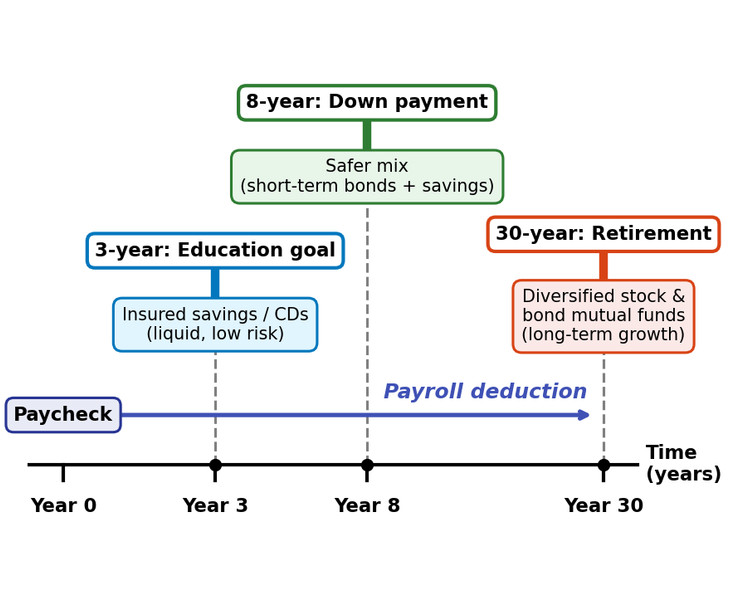
Matching investment choices to time horizon
Diversification means spreading money across different assets and securities. It reduces concentration risk, though it does not remove all risk, and it allows investors to seek higher long-term returns without taking on excessive risk.
Benchmarks matter too. Compare a stock investment to an appropriate stock index, and a bond investment to an appropriate bond index. The benchmark should match the asset type and purpose.
If a household wants help from an advisor, the main things to check are licensing, certifications, education, experience, services, and cost.
Key Takeaways
Long-Term Financial Planning
Connecting present saving, investing, and spending decisions to the costs, deadlines, risks, and priorities of future goals
Saving vs. Investing
Saving uses relatively safe, liquid assets for stability and near-term needs; investing accepts more risk for greater potential long-term growth
Time Horizon
The length of time before money will be needed for a financial goal
Automated Savings Plan
An arrangement that regularly transfers a specified amount into a savings or investment account
Payroll Deduction
An automatic transfer of part of each paycheck directly to an account, such as an employer-sponsored retirement plan
Paying Yourself First
Setting aside money for saving or investing before using income for other spending
Postsecondary Education
Education or training pursued after high school
Cost of Attendance
The full cost of education, including tuition, housing, food, fees, books, supplies, transportation, and possible forgone earnings
Net Cost of Education
The full cost of attendance minus grants and scholarships that do not have to be repaid
Scholarship
Education funding that generally does not require repayment and is often awarded for merit or other eligibility criteria
Grant
Education funding that generally does not require repayment and is often based on financial need or program requirements
Work-Study Program
A program through which an eligible student earns money by working while enrolled
Federal vs. Private Student Loans
Both finance education and require repayment, but federal loans may have lower rates, better repayment terms, and more borrower protections than private loans
Subsidized Federal Student Loan
A federal student loan for which the government pays interest during specified periods when the borrower is not responsible for it
Renting vs. Buying
Renting generally offers flexibility and lower initial costs, while buying can build equity but requires more money upfront and adds ownership costs
Down Payment
The portion of a home's purchase price paid from the buyer's savings rather than borrowed through a mortgage
Mortgage
A loan secured by a home and used to finance the portion of its purchase price not covered by the down payment
Fixed-Rate Mortgage
A mortgage whose stated interest rate remains unchanged for the loan term, making principal-and-interest payments predictable
Adjustable-Rate Mortgage
A mortgage whose interest rate can change according to its terms, causing future payments to rise or fall
Retirement Planning
Planning when to reduce or stop work and how retirement expenses will be funded from Social Security, employer plans, investments, and possible earnings
Employer-Sponsored Retirement Plan
A workplace retirement plan that commonly accepts employee contributions through payroll deduction and may include employer contributions
Charitable Giving
Providing one-time, recurring, or legacy support to nonprofits whose missions and impact align with the donor's goals
Legacy Contribution
A charitable gift arranged through an estate or another long-term plan to support an organization after the donor's death
Tax Deduction
An eligible amount that reduces taxable income rather than reducing the tax bill dollar for dollar
Savings Account
A generally liquid, interest-paying deposit account that may be federally insured and usually offers a low expected return
Certificate of Deposit (CD)
A deposit held for a stated term that generally pays a specified interest rate; eligible CDs are federally insured, and early withdrawal may incur a penalty
Stock
An ownership interest in a business that may provide dividends and capital gains but can lose value with the business or market
Bond
An asset representing money lent to an issuer that promises payments according to the bond’s terms, generally including interest and repayment of principal
Mutual Fund
A pooled investment that uses money from many investors to hold a portfolio of stocks, bonds, or both
Risk
The possibility that an investment's actual return will differ from its expected return, including the possibility of loss
Expected Return
The return anticipated from an asset based on its characteristics and available information, not a guaranteed result
Risk–Return Relationship
Lower-risk assets generally offer lower expected returns, while higher expected returns usually require accepting more uncertainty and potential loss
Liquidity
The ease and speed with which an asset can be converted to cash without a substantial loss in value
Risk Tolerance
An individual's or household's willingness to accept uncertainty, fluctuations, and possible investment losses
Compounding
Growth that occurs when returns remain invested and earn additional returns along with the original principal
Transaction Fee
A charge for buying or selling a financial asset that reduces the investor's return
Management Fee
A charge for operating and managing a pooled investment such as a mutual fund
Advisory Fee
A charge paid for professional investment advice or portfolio management
Discount vs. Full-Service Brokerage Firm
A discount firm generally charges lower fees and provides less individualized advice; a full-service firm generally provides more advice and services and charges more
Interest
A payment received for the use of money
Dividend
A distribution made by a business to its shareholders
Capital Gain
The gain that occurs when an asset is sold for more than its cost
Nominal Return vs. Real Return
Nominal return is unadjusted for inflation; real return measures purchasing-power growth, exactly: real return = (1 + nominal return)/(1 + inflation rate) − 1
Overconfidence
A bias in which investors overestimate their knowledge or predictive ability, encouraging excessive risk, trading, or concentration
Loss Aversion
A bias in which the pain of a loss outweighs the benefit of an equal gain, potentially causing premature selling during declines
Asset Allocation
The division of a portfolio among categories such as savings and cash, bonds, and stocks
Diversification
Allocating money among varied assets, issuers, or industries to reduce dependence on any one investment without eliminating all risk
Benchmark
A standard, such as an appropriate stock or bond index, against which an investment's performance is evaluated
Financial Advisor
A professional who helps evaluate saving and investment options and should be assessed by licensing, certifications, education, experience, services, and cost
Inflation
A reduction in money’s purchasing power over time that lowers an investment’s real return
Broker
A person or firm investors use to purchase stocks and bonds
Notes
Long-Term Financial Planning
Connecting present saving, investing, and spending decisions to the costs, deadlines, risks, and priorities of future goals
Saving vs. Investing
Saving uses relatively safe, liquid assets for stability and near-term needs; investing accepts more risk for greater potential long-term growth
Time Horizon
The length of time before money will be needed for a financial goal
Automated Savings Plan
An arrangement that regularly transfers a specified amount into a savings or investment account
Payroll Deduction
An automatic transfer of part of each paycheck directly to an account, such as an employer-sponsored retirement plan
Paying Yourself First
Setting aside money for saving or investing before using income for other spending
Postsecondary Education
Education or training pursued after high school
Cost of Attendance
The full cost of education, including tuition, housing, food, fees, books, supplies, transportation, and possible forgone earnings
Net Cost of Education
The full cost of attendance minus grants and scholarships that do not have to be repaid
Scholarship
Education funding that generally does not require repayment and is often awarded for merit or other eligibility criteria
Grant
Education funding that generally does not require repayment and is often based on financial need or program requirements
Work-Study Program
A program through which an eligible student earns money by working while enrolled
Federal vs. Private Student Loans
Both finance education and require repayment, but federal loans may have lower rates, better repayment terms, and more borrower protections than private loans
Subsidized Federal Student Loan
A federal student loan for which the government pays interest during specified periods when the borrower is not responsible for it
Renting vs. Buying
Renting generally offers flexibility and lower initial costs, while buying can build equity but requires more money upfront and adds ownership costs
Down Payment
The portion of a home's purchase price paid from the buyer's savings rather than borrowed through a mortgage
Mortgage
A loan secured by a home and used to finance the portion of its purchase price not covered by the down payment
Fixed-Rate Mortgage
A mortgage whose stated interest rate remains unchanged for the loan term, making principal-and-interest payments predictable
Adjustable-Rate Mortgage
A mortgage whose interest rate can change according to its terms, causing future payments to rise or fall
Retirement Planning
Planning when to reduce or stop work and how retirement expenses will be funded from Social Security, employer plans, investments, and possible earnings
Employer-Sponsored Retirement Plan
A workplace retirement plan that commonly accepts employee contributions through payroll deduction and may include employer contributions
Charitable Giving
Providing one-time, recurring, or legacy support to nonprofits whose missions and impact align with the donor's goals
Legacy Contribution
A charitable gift arranged through an estate or another long-term plan to support an organization after the donor's death
Tax Deduction
An eligible amount that reduces taxable income rather than reducing the tax bill dollar for dollar
Savings Account
A generally liquid, interest-paying deposit account that may be federally insured and usually offers a low expected return
Certificate of Deposit (CD)
A deposit held for a stated term that generally pays a specified interest rate; eligible CDs are federally insured, and early withdrawal may incur a penalty
Stock
An ownership interest in a business that may provide dividends and capital gains but can lose value with the business or market
Bond
An asset representing money lent to an issuer that promises payments according to the bond’s terms, generally including interest and repayment of principal
Mutual Fund
A pooled investment that uses money from many investors to hold a portfolio of stocks, bonds, or both
Risk
The possibility that an investment's actual return will differ from its expected return, including the possibility of loss
Expected Return
The return anticipated from an asset based on its characteristics and available information, not a guaranteed result
Risk–Return Relationship
Lower-risk assets generally offer lower expected returns, while higher expected returns usually require accepting more uncertainty and potential loss
Liquidity
The ease and speed with which an asset can be converted to cash without a substantial loss in value
Risk Tolerance
An individual's or household's willingness to accept uncertainty, fluctuations, and possible investment losses
Compounding
Growth that occurs when returns remain invested and earn additional returns along with the original principal
Transaction Fee
A charge for buying or selling a financial asset that reduces the investor's return
Management Fee
A charge for operating and managing a pooled investment such as a mutual fund
Advisory Fee
A charge paid for professional investment advice or portfolio management
Discount vs. Full-Service Brokerage Firm
A discount firm generally charges lower fees and provides less individualized advice; a full-service firm generally provides more advice and services and charges more
Interest
A payment received for the use of money
Dividend
A distribution made by a business to its shareholders
Capital Gain
The gain that occurs when an asset is sold for more than its cost
Nominal Return vs. Real Return
Nominal return is unadjusted for inflation; real return measures purchasing-power growth, exactly: real return = (1 + nominal return)/(1 + inflation rate) − 1
Overconfidence
A bias in which investors overestimate their knowledge or predictive ability, encouraging excessive risk, trading, or concentration
Loss Aversion
A bias in which the pain of a loss outweighs the benefit of an equal gain, potentially causing premature selling during declines
Asset Allocation
The division of a portfolio among categories such as savings and cash, bonds, and stocks
Diversification
Allocating money among varied assets, issuers, or industries to reduce dependence on any one investment without eliminating all risk
Benchmark
A standard, such as an appropriate stock or bond index, against which an investment's performance is evaluated
Financial Advisor
A professional who helps evaluate saving and investment options and should be assessed by licensing, certifications, education, experience, services, and cost
Inflation
A reduction in money’s purchasing power over time that lowers an investment’s real return
Broker
A person or firm investors use to purchase stocks and bonds
