Topic 3.1 Notes – Saving for Future Purchases
What Saving Is
Saving means setting aside income instead of using it for current spending. Most people get income from wages or salary paid by a business, nonprofit, or government employer. Income can also come from self-employment, rental income, government programs, investments, or retirement accounts.
That saved money becomes a personal asset. It matters because it can:
- help pay for future purchases
- reduce the need to borrow later
- earn interest and grow over time
Saving is a tradeoff between present consumption and future consumption. If you save $100 today, you cannot spend that same $100 today, but you may be able to handle a bigger need later.
People save for three main reasons:
- Major future purchases
- car
- down payment on a home
- college tuition or other education expenses
- travel
- furniture, appliances, or technology
- starting or supporting a business
- Emergencies and uncertainty
- job loss
- illness
- medical expenses
- emergency travel
- vehicle or home repairs
- Retirement income
- money to live on after work income stops or shrinks
Interest is one reason saving is rewarded. For a one-year simple interest calculation,
If you save $4,000 at 4% for one year, interest is:
If interest compounds, the interest gets added to the balance and can earn more interest later.
For the same $4,000 at 4%, monthly compounding ends slightly above simple interest after one year, as the graph shows.
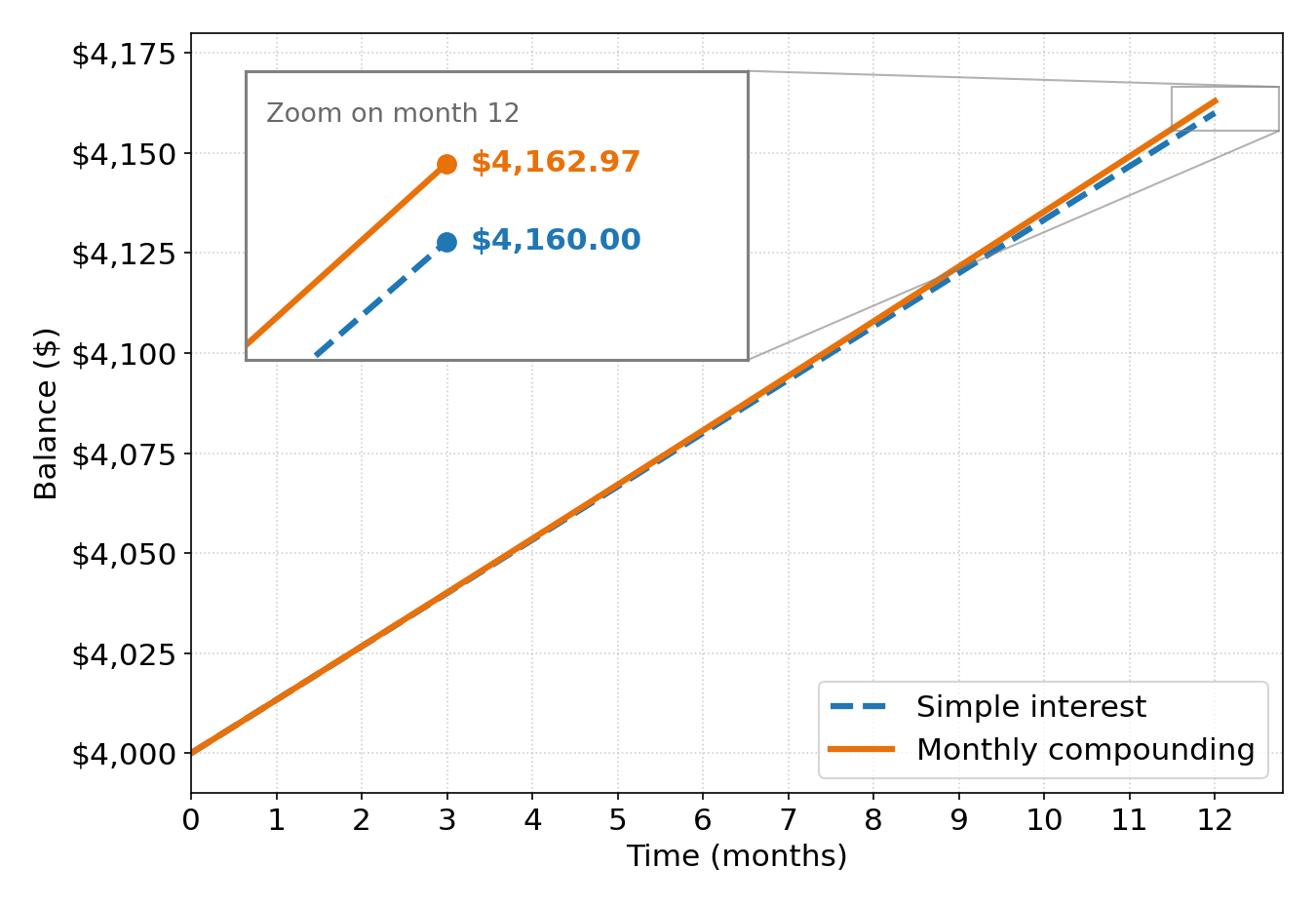
Simple interest vs. monthly compounding on $4,000 at 4% over one year. The zoom shows the $2.97 gap at month 12.
APY matters because it includes compounding, so it helps you compare accounts more fairly. Also watch fees. An account can earn interest and still be a bad deal if fees eat up the gain.
Saving Incentives and Barriers
People usually save more successfully when saving happens automatically and the goal is clear.
Saving incentives include:
- Automated savings plans
- a set amount moves to savings every pay period
- this can happen by payroll allocation or automatic transfer
- it helps because money is saved before you are tempted to spend it
- Tax-advantaged accounts
- retirement savings plans
- health savings accounts
- childcare or other designated accounts
- these encourage saving by lowering or delaying taxes, though they may limit how money is used or withdrawn
Barriers to saving often show up in both math and behavior.
- Income and expense barriers
- recurring necessary expenses may equal or exceed income
- inconsistent income makes regular saving harder, especially with irregular hours, seasonal work, or self-employment
- Psychological barriers
- instant gratification means choosing a smaller reward now over a larger benefit later
- lifestyle inflation means spending rises as income rises
- impulse buying means unplanned purchases shrink the money left for goals
- Technology and spending convenience
- mobile payment balances are easy to spend, which can make impulse purchases more common
A common test idea is that defined goals + automation + keeping savings separate from spending money usually improves saving behavior.
PESTEL Factors That Affect Saving
This topic uses PESTEL mostly through economic, political, and legal forces.
Economic factors
The economy affects employment, income, hours worked, interest rates, and cost of living.
- In a weak economy, layoffs or lower income can make saving harder, and people may need to use existing savings.
- In a strong economy, higher income can help saving, but rising living costs can still leave less money to save.
- Interest rates in the economy also affect how rewarding savings accounts feel.
Inflation and purchasing power
Inflation is a rise in prices of goods and services. It reduces purchasing power, which means your money buys less later.
If something costs $4,000 now and prices rise 5%, it will cost $4,200 next year. If your account grows to $4,160, your balance went up, but your buying power for that item still fell.
That is the distinction between:
- nominal value = the number of dollars in the account
- real value = what those dollars can actually buy
This gets tested a lot. Savings can grow in dollar terms and still lose ground in real terms if inflation is higher than the account return. The expected loss of purchasing power can also discourage saving.
Political factors
Government tax policy can encourage saving through accounts for:
- retirement
- health care
- childcare
- other designated purposes
The tax break is the incentive. The tradeoff is that these accounts often come with rules on use or withdrawal.
Legal factors
Financial institutions are regulated for consumer protection and stability. Covered deposits are federally insured up to $250,000 as of 2024.
- FDIC covers insured banks
- NCUA covers federally insured credit unions
Insurance protects against the institution failing. It does not protect against inflation, fees, or losses in uninsured or speculative assets.
Savings Vehicles and Where Money Is Kept
Here’s how the common options differ:
| Vehicle | Main idea | Liquidity | Interest | Insurance |
|---|---|---|---|---|
| Savings account | deposit account for saved money | high | yes | yes, if qualifying institution |
| Money market account | like savings, often with higher requirements | fairly high | often higher | yes |
| CD | fixed-term deposit | low until maturity | usually higher | yes |
| Checking account | for frequent transactions | very high | little or none | yes |
| Cash | physical money | very high | none | no |
| Mobile payment account | easy-to-spend balance | very high | usually none | usually no |
| Cryptocurrency account | speculative digital asset | varies | usually none | no |
A few details matter a lot:
- Savings accounts are often good for emergency funds and short-term goals because they are liquid.
- Money market accounts may offer higher interest, but often require higher minimum deposits or balances and may charge higher fees and provide easier access to cash.
- CDs usually pay more, but early withdrawal commonly brings a penalty. They fit money you will not need before the maturity date, and the restriction period is usually one month to five years.
- Checking accounts are for day-to-day spending, not for growing savings.
- Cash can be lost or stolen and earns no interest.
- Mobile payment balances are convenient but easy to spend and usually do not pay interest.
- Cryptocurrency can rise or fall in value and is not the same as an insured deposit account.
When choosing an institution or account, compare:
- interest rate or APY
- fees
- minimum deposit or balance
- risk
- insurance
- liquidity and access
- ATM or branch access
- online/mobile convenience
- reputation and customer service
How to Build and Evaluate a Savings Plan
A savings plan connects a goal to actual numbers. One simple way to think about it is as a step-by-step process from setting the goal to monitoring your progress.
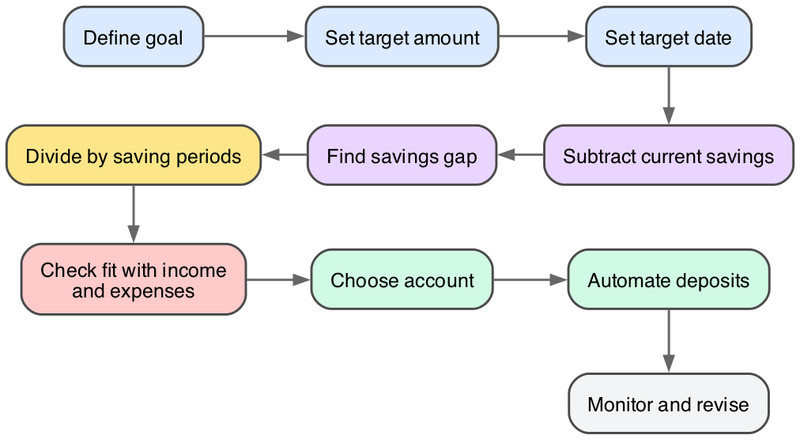
Savings plan process
The basic steps are:
- Define the goal.
- Set the target amount.
- Set the target date.
- Subtract what is already saved.
- Find the savings gap.
- Divide by the number of saving periods.
- Check if that amount fits income and expenses.
- Choose an account that matches timeline, access needs, and risk.
- Automate deposits if possible.
- Monitor and revise.
The basic formula is:
This is the calculation built into the middle of the process. It tells you how much you need to save each period to close the gap by your deadline.
A good plan is:
- specific
- realistic
- adjusted for likely future prices
- workable even with inconsistent income if that applies
- matched to the right account
- protected from fees that wipe out interest
- able to meet minimum balance rules
- insured when deposit safety matters
If the plan does not work, the fixes are straightforward:
- extend the deadline
- reduce the goal cost
- cut expenses
- increase income
- save more during higher-income periods
The exam often frames this as a decision question. The best answer explains why one savings vehicle fits the goal better than another, based on purpose, amount needed, time frame, liquidity, fees, and risk.
Key Takeaways
Saving
Retaining part of current income instead of spending it, creating a personal asset for future purchases, emergencies, or living expenses
Emergency Savings
Money reserved for unexpected expenses or income interruptions, such as illness, repairs, or job loss
Interest
Compensation a financial institution pays for using deposited funds; it increases the value of the saver’s asset
One-Year Interest Calculation
I = P × r, where I is interest, P is the deposited principal, and r is the annual interest rate
Compound Interest
Interest added to the balance so it can earn interest later; A = P(1 + r/n)^(nt), where P is principal, r is the annual rate, n is compounding periods per year, and t is years
Annual Percentage Yield (APY)
The annual yield of a deposit account after accounting for compounding, used to compare account returns
Liquidity
How easily and quickly an asset can be converted into spendable cash
Automated Savings Plan
A plan that directs a predetermined amount of income to savings each pay period through payroll allocation or automatic transfer
Retirement Savings Plan
A designated plan that may reduce or postpone taxes on eligible money saved for retirement
Health Savings Account
A designated account offering tax advantages to eligible individuals who save for qualified health-related expenses
Instant Gratification
The tendency to prefer an immediate reward over a larger or more valuable future benefit
Lifestyle Inflation
The tendency for spending to rise as income rises, which can prevent increased income from producing greater savings
Impulse Buying
An unplanned purchase made with limited consideration of its effect on other financial priorities
PESTEL Analysis
Analysis of political, economic, social, technological, environmental, and legal forces in the external environment
Inflation
An increase in the prices of goods and services that reduces the purchasing power of money
Purchasing Power
The quantity of goods and services that a given amount of money can buy
Federal Deposit Insurance
Government protection of covered deposits, generally up to 250,000 dollars as of 2024, if an insured financial institution fails
Federal Deposit Insurance Corporation (FDIC)
The federal agency that generally provides deposit insurance for covered accounts at insured banks
National Credit Union Administration (NCUA)
The federal agency that generally provides comparable deposit insurance for covered accounts at federally insured credit unions
Savings Account
A typically interest-paying, federally insured deposit account with substantial liquidity, though fees and minimum requirements may apply
Money Market Account
A federally insured deposit account that may offer higher interest and convenient cash access but require a larger balance or higher fees than a savings account
Certificate of Deposit (CD)
A federally insured deposit account that usually pays higher interest in exchange for leaving funds deposited for a set term; early withdrawal commonly results in a penalty or lost interest
Checking Account
A federally insured deposit account designed for frequent transactions that usually pays little or no interest and may charge fees
Mobile Payment Account
An account used to store money for convenient sending or spending that typically pays no interest and may lack federal deposit insurance
Cryptocurrency Account
An account holding volatile digital assets that typically pay no deposit interest and are not protected by federal deposit insurance
Savings Plan
A goal connected to a feasible target amount, target date, regular contribution schedule, and suitable savings vehicle, with progress monitored and the plan revised as conditions change
Periodic Savings Calculation
Periodic savings = (target amount − current savings) ÷ number of saving periods
Tax Incentive
Favorable tax treatment for qualifying savings that encourages consumers to save for designated purposes such as retirement or health care
Notes
Saving
Retaining part of current income instead of spending it, creating a personal asset for future purchases, emergencies, or living expenses
Emergency Savings
Money reserved for unexpected expenses or income interruptions, such as illness, repairs, or job loss
Interest
Compensation a financial institution pays for using deposited funds; it increases the value of the saver’s asset
One-Year Interest Calculation
I = P × r, where I is interest, P is the deposited principal, and r is the annual interest rate
Compound Interest
Interest added to the balance so it can earn interest later; A = P(1 + r/n)^(nt), where P is principal, r is the annual rate, n is compounding periods per year, and t is years
Annual Percentage Yield (APY)
The annual yield of a deposit account after accounting for compounding, used to compare account returns
Liquidity
How easily and quickly an asset can be converted into spendable cash
Automated Savings Plan
A plan that directs a predetermined amount of income to savings each pay period through payroll allocation or automatic transfer
Retirement Savings Plan
A designated plan that may reduce or postpone taxes on eligible money saved for retirement
Health Savings Account
A designated account offering tax advantages to eligible individuals who save for qualified health-related expenses
Instant Gratification
The tendency to prefer an immediate reward over a larger or more valuable future benefit
Lifestyle Inflation
The tendency for spending to rise as income rises, which can prevent increased income from producing greater savings
Impulse Buying
An unplanned purchase made with limited consideration of its effect on other financial priorities
PESTEL Analysis
Analysis of political, economic, social, technological, environmental, and legal forces in the external environment
Inflation
An increase in the prices of goods and services that reduces the purchasing power of money
Purchasing Power
The quantity of goods and services that a given amount of money can buy
Federal Deposit Insurance
Government protection of covered deposits, generally up to 250,000 dollars as of 2024, if an insured financial institution fails
Federal Deposit Insurance Corporation (FDIC)
The federal agency that generally provides deposit insurance for covered accounts at insured banks
National Credit Union Administration (NCUA)
The federal agency that generally provides comparable deposit insurance for covered accounts at federally insured credit unions
Savings Account
A typically interest-paying, federally insured deposit account with substantial liquidity, though fees and minimum requirements may apply
Money Market Account
A federally insured deposit account that may offer higher interest and convenient cash access but require a larger balance or higher fees than a savings account
Certificate of Deposit (CD)
A federally insured deposit account that usually pays higher interest in exchange for leaving funds deposited for a set term; early withdrawal commonly results in a penalty or lost interest
Checking Account
A federally insured deposit account designed for frequent transactions that usually pays little or no interest and may charge fees
Mobile Payment Account
An account used to store money for convenient sending or spending that typically pays no interest and may lack federal deposit insurance
Cryptocurrency Account
An account holding volatile digital assets that typically pay no deposit interest and are not protected by federal deposit insurance
Savings Plan
A goal connected to a feasible target amount, target date, regular contribution schedule, and suitable savings vehicle, with progress monitored and the plan revised as conditions change
Periodic Savings Calculation
Periodic savings = (target amount − current savings) ÷ number of saving periods
Tax Incentive
Favorable tax treatment for qualifying savings that encourages consumers to save for designated purposes such as retirement or health care
