Topic 4.4 Notes – Strategic Frameworks: Porter’s Five Forces and SWOT Analysis
What Porter’s Five Forces Is
Porter’s Five Forces is a strategy tool for judging the competitive intensity, attractiveness, and profit potential of a market. Businesses use it when deciding things like whether to enter a market, launch a product, stay in a market, or price aggressively.
The big idea is simple:
- Strong forces squeeze profits and make the market less attractive
- Weak forces leave more room for profit and make the market more attractive
That idea is what the Five Forces model is meant to capture.
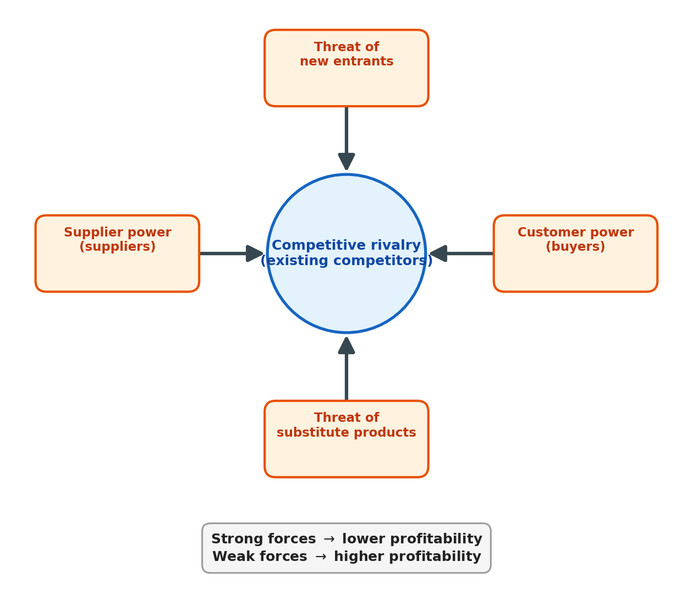
Porter’s Five Forces model
In this topic, market attractiveness means profit potential for businesses. It does not mean customers like the product.
A good Five Forces analysis uses a specific competitive environment. “Food” is way too broad. “Subscription-based prepared lunches for midsize employers in one city” is much better because you can actually identify the rivals, buyers, suppliers, entrants, and substitutes.
The Five Forces
These five forces all describe pressure on a business’s ability to compete successfully.
Existing competitive rivalry
This is competition among businesses already in the market. These are direct competitors, meaning they sell similar products to similar customers.
Rivalry is stronger when:
- there are many rivals
- products are similar
- businesses have little pricing power
Rivalry is weaker when:
- there are fewer rivals
- products are meaningfully differentiated
- businesses can raise prices without losing too many customers
One thing students mix up a lot is rival vs substitute. A rival is the same kind of seller. A substitute solves the same customer problem in a different way.
Threat of new entrants
This force asks how easy it is for new businesses to enter the market. That depends on barriers to entry.
Common barriers include:
- startup capital requirements
- specialized knowledge or technology
- patents and other intellectual property
- licenses and regulation
- economies of scale
- strong brand loyalty
- access to suppliers or distribution
- time, training, and infrastructure
The exam trap here is very common:
- low barriers = strong threat of entry
- high barriers = weak threat of entry
Threat of substitute products
A substitute is a different product or service that meets the same need.
Strong substitutes happen when customers have alternatives that are:
- cheaper
- easier to access
- higher quality
- more convenient
For prepared lunch providers, other prepared lunch providers are rivals. Restaurants, cafeterias, grocery-store meals, delivery apps, or bringing lunch from home are substitutes.
Customer power
Customer power means buyers can pressure the business to lower prices or give better terms.
Look at:
- number of customers
- importance of each customer
- customer acquisition costs
- switching costs
Switching costs include both:
- monetary costs like fees, setup costs, retraining
- psychological costs like uncertainty or loss of familiarity
Customer power is strong when there are few customers, each one matters a lot, replacing them is expensive, and switching costs are low.
Supplier power
Supplier power is the ability of suppliers to raise input costs-the prices they charge for raw materials and component parts-or impose worse terms.
Look at:
- number of suppliers
- switching costs between suppliers
- how competitive the supply market is
Supplier power is strong when there are few qualified suppliers and switching is costly, risky, or slow.
How to Apply Five Forces
A full Five Forces answer usually moves in this order:
- Define the market clearly
- Find evidence for each force
- Decide whether each force is strong or weak
- Explain how that affects profitability
- Make an overall judgment about market attractiveness
Don’t just count how many forces are strong. One force can dominate the whole market.
A good scenario example is a teacher case like subscription meal providers in one city. Evidence might look like this:
- annual bidding for contracts suggests strong rivalry and strong customer power
- shared kitchens lower startup costs, so entrant threat gets stronger
- restaurants, cafeterias, and meal prep at home create strong substitutes
- only a few qualified distributors create stronger supplier power
That same style of analysis shows up when discussing Crepes & Waffles and Square Meal Feeds. The point is always the same. Use specific evidence, classify the force correctly, then connect it to profits.
What SWOT Analysis Is
SWOT evaluates a specific business, not just the market. It asks whether that business has what it needs to reach its goals and stay competitive.
The four parts are:
- Strengths
- Weaknesses
- Opportunities
- Threats
The split you need to keep straight is:
- strengths and weaknesses = internal
- opportunities and threats = external
This grid is the quick visual to remember that split.
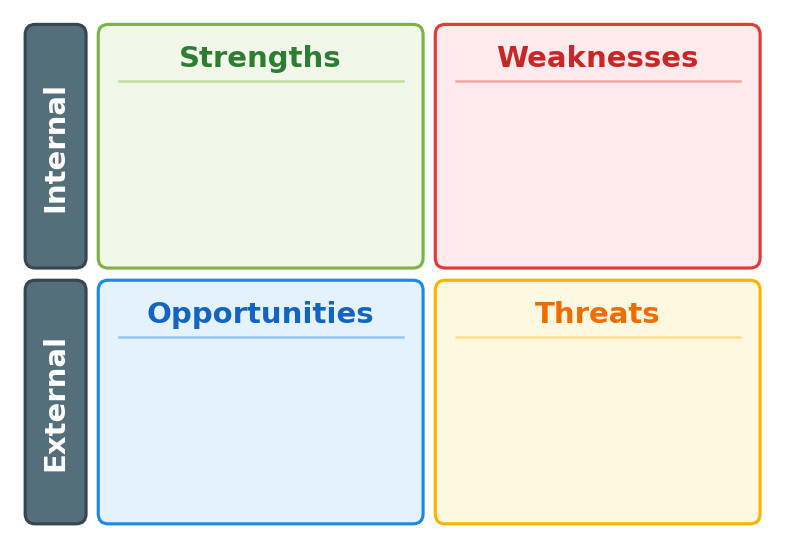
SWOT analysis grid
Strengths
These are internal advantages, such as:
- core competencies
- brand recognition
- intellectual property
- product quality
- ample funds
- skilled employees
- supply chain efficiency
- reputation
- superior technology
Weaknesses
These are internal disadvantages, such as:
- missing core competencies
- low brand recognition
- product flaws
- limited funds
- inability to staff skilled employees
- poor customer service
- outdated technology
- supply chain risks
- inefficient operations
Opportunities
These are favorable external factors beyond the business’s control, such as:
- market growth
- reduced competition
- technological advances
- favorable regulation
- new customer segments
- shifts in customer preferences that increase demand
A classic mistake is calling a plan an opportunity. “We will launch an app” is a strategy choice, not an opportunity. A new technology that makes that app more effective could be an opportunity.
Threats
These are unfavorable external factors, such as:
- rising input costs
- natural disasters
- unfavorable regulation
- changing customer preferences
- new competition
- disruptive innovation
Disruptive innovation changes how customers meet the need. It is more than a normal product improvement.
How to Apply SWOT and Connect It to Strategy
A solid SWOT answer follows this path:
- State the business and the decision
- Identify internal capabilities
- financial resources
- physical resources
- human resources
- intangible assets like brand, reputation, and IP
- Classify them as strengths or weaknesses
- Identify external conditions
- market size
- customer preferences
- PESTEL factors
- Porter’s Five Forces
- Classify them as opportunities or threats
- Turn the analysis into action
That action should sound like this:
- build on strengths
- reduce weaknesses
- capitalize on opportunities
- respond to threats
SWOT works best when you compare the business against:
- rivals
- benchmarks
- past performance
- external factors
- what the strategy requires
This is where Crepes & Waffles and Square Meal Feeds fit. You are judging both the outside environment and the business’s own capabilities.
The relationship between the two frameworks matters a lot:
- Five Forces = market structure
- SWOT = this business’s position
So, few suppliers in Five Forces can become a threat in SWOT. Strong brand loyalty in a market can be a barrier to entry in Five Forces, while your own brand can be a strength in SWOT.
Key Takeaways
Michael Porter’s Five Forces
Framework for evaluating a market’s competitive intensity, attractiveness, and potential profitability through rivalry, new entrants, substitutes, customer power, and supplier power
Market Attractiveness
A market’s potential for businesses to earn profits; strong competitive forces reduce attractiveness, while weak forces increase it
Existing Competitive Rivalry
Intensity of competition among current direct competitors, shaped by their number, product differentiation, and pricing power
Pricing Power
Ability to set or raise prices without losing enough customers to make the change unprofitable
Threat of New Entrants
Risk that new businesses can easily enter a market and compete for market share; the threat is strong when barriers to entry are low
Barriers to Entry
Conditions that make market entry difficult or costly, such as capital requirements, patents, regulations, economies of scale, or established brand loyalty
Threat of Substitute Products
Risk from different types of goods or services that meet the same customer need; the threat is strong when many attractive alternatives are available
Customer Power (Buyer Power)
Buyers’ ability to pressure a business to lower prices or improve terms, strengthened by few significant customers, high acquisition costs, and low customer switching costs
Customer Acquisition Cost
The cost of gaining a customer; high acquisition costs increase the incentive to retain existing customers and strengthen customer power
Switching Costs
Monetary and psychological costs a customer incurs when changing the product or brand purchased
Supplier Power
Resource providers’ ability to raise input costs or impose unfavorable terms, strengthened by few qualified providers and high costs of switching suppliers
SWOT Analysis
Framework for evaluating the internal strengths and weaknesses and external opportunities and threats affecting a business’s goals, competitiveness, and viability
Strengths (SWOT)
Internal advantages that help a business achieve its goals or compete successfully, such as valuable competencies, resources, reputation, or intellectual property
Weaknesses (SWOT)
Internal disadvantages, missing capabilities, or poorly performing resources that impede performance or make a business more vulnerable
Opportunities (SWOT)
Favorable external factors beyond the business’s direct control that it may capitalize on to improve its success
Threats (SWOT)
Unfavorable external factors beyond the business’s direct control that may harm it or interfere with its goals
Notes
Michael Porter’s Five Forces
Framework for evaluating a market’s competitive intensity, attractiveness, and potential profitability through rivalry, new entrants, substitutes, customer power, and supplier power
Market Attractiveness
A market’s potential for businesses to earn profits; strong competitive forces reduce attractiveness, while weak forces increase it
Existing Competitive Rivalry
Intensity of competition among current direct competitors, shaped by their number, product differentiation, and pricing power
Pricing Power
Ability to set or raise prices without losing enough customers to make the change unprofitable
Threat of New Entrants
Risk that new businesses can easily enter a market and compete for market share; the threat is strong when barriers to entry are low
Barriers to Entry
Conditions that make market entry difficult or costly, such as capital requirements, patents, regulations, economies of scale, or established brand loyalty
Threat of Substitute Products
Risk from different types of goods or services that meet the same customer need; the threat is strong when many attractive alternatives are available
Customer Power (Buyer Power)
Buyers’ ability to pressure a business to lower prices or improve terms, strengthened by few significant customers, high acquisition costs, and low customer switching costs
Customer Acquisition Cost
The cost of gaining a customer; high acquisition costs increase the incentive to retain existing customers and strengthen customer power
Switching Costs
Monetary and psychological costs a customer incurs when changing the product or brand purchased
Supplier Power
Resource providers’ ability to raise input costs or impose unfavorable terms, strengthened by few qualified providers and high costs of switching suppliers
SWOT Analysis
Framework for evaluating the internal strengths and weaknesses and external opportunities and threats affecting a business’s goals, competitiveness, and viability
Strengths (SWOT)
Internal advantages that help a business achieve its goals or compete successfully, such as valuable competencies, resources, reputation, or intellectual property
Weaknesses (SWOT)
Internal disadvantages, missing capabilities, or poorly performing resources that impede performance or make a business more vulnerable
Opportunities (SWOT)
Favorable external factors beyond the business’s direct control that it may capitalize on to improve its success
Threats (SWOT)
Unfavorable external factors beyond the business’s direct control that may harm it or interfere with its goals
