Topic 2.2 Notes – Consumer Behavior
What Consumer Buying Decisions Are
A need is something necessary or important. A want is the preferred way to satisfy that need.
If you need transportation, you might want the option that is fastest, cheapest, most private, or most convenient. That is why many different products can compete for the same customer.
A rival good is a different product that meets the same or a similar need or want. Businesses care about rival goods because different customer groups choose differently, even when the underlying need is the same.
Transportation rivals
| Need | Rival goods | Why one might win |
|---|---|---|
| Transportation | car | privacy, speed, flexibility |
| Transportation | public transportation | lower cost, no parking |
| Transportation | bicycle | exercise, low cost |
| Transportation | rideshare | convenience, no ownership |
| Transportation | walking | free, nearby destinations |
Transportation is a good example because one need can be met in many ways.
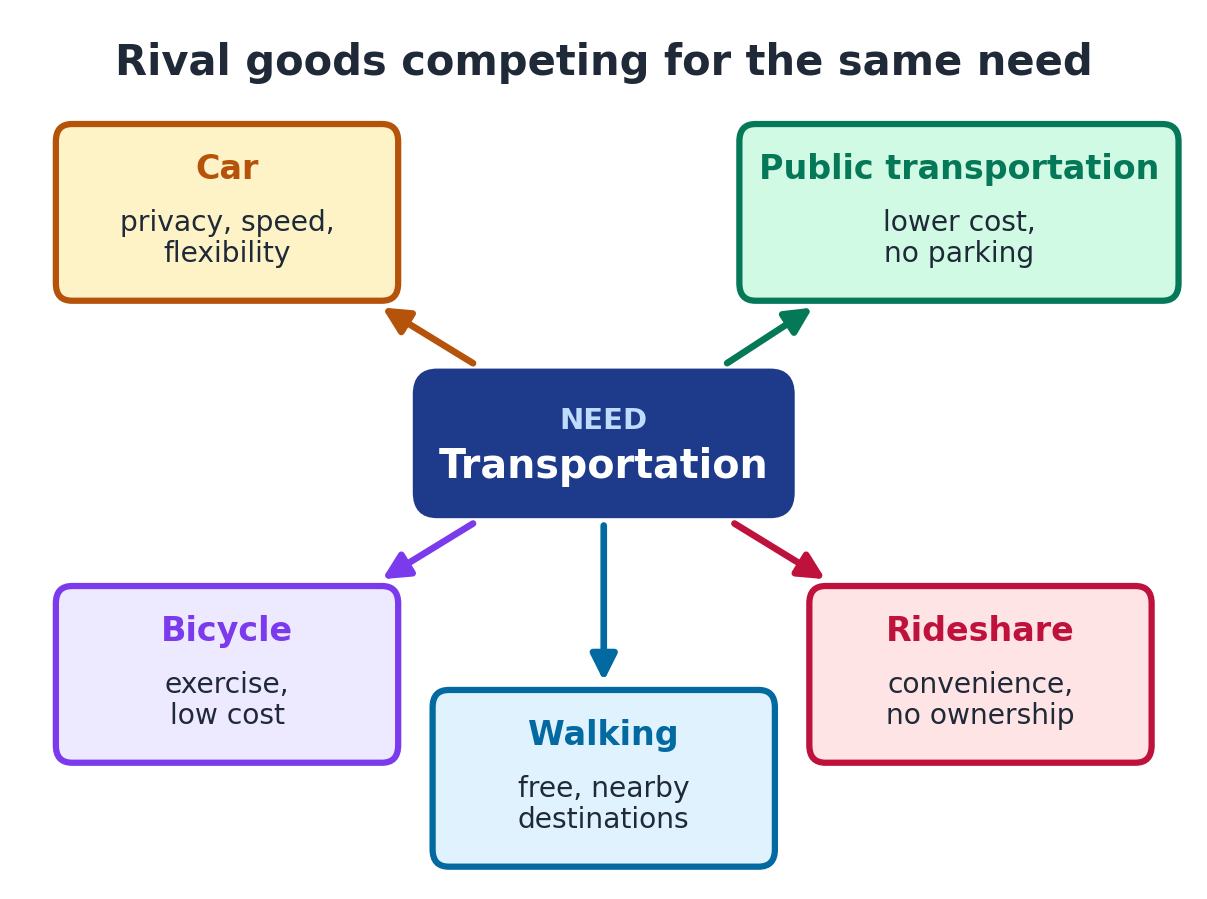
One need, five rival goods: each option competes for the same customer for a different reason
When consumers choose among rival goods, four influences show up again and again:
Price
What the consumer must give up to buy it. Price matters, but it does not decide everything by itself.Differentiated product features
These are qualities that make one product different from another, such as quality, design, reliability, size, convenience, customization, and customer service.Availability
Whether the product is there at the right place and time. A great option that is out of stock often loses.Advertising
Advertising creates awareness, shapes perception, and can make a product more desirable or easier to remember.
Gong cha works as a clean example. A customer might choose Gong cha or another drink seller based on price, flavor options, toppings, convenience, location, speed, advertising, and prior experience. That list tells you something important for the test. Consumers may choose a higher-priced option if it feels better, faster, safer, more trusted, or easier to get.
Types of Consumer Decision Making
Some decisions are slow and systematic. Others are repeated with almost no thought. Most test questions want you to tell which pattern fits the scenario.
Rational decision making
This shows up more with purchases that are expensive, unfamiliar, risky, consequential, or hard to reverse.
The process usually looks like this:
- Identify the need or problem
- Set constraints and criteria
- Gather information
- Compare alternatives
- Choose and purchase
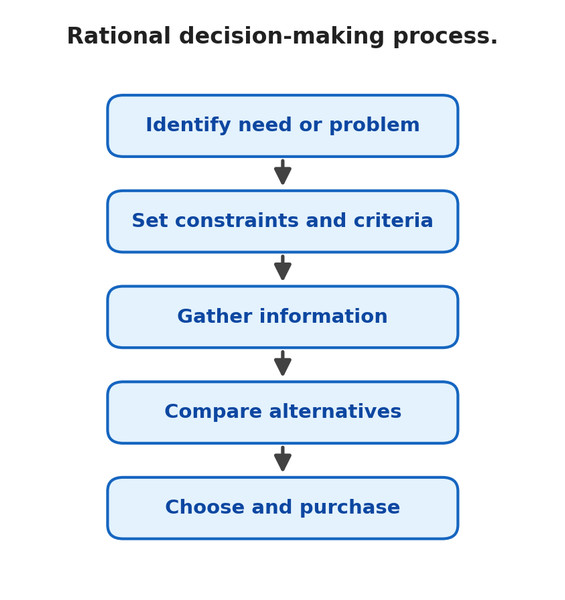
Rational decision-making process
A used car is a classic example of moving through those steps. So is a home purchase. You might set a budget, require certain features, compare choices, read reviews, and check reliability.
What makes this “rational” is the systematic comparison, not perfect knowledge. Students often miss that. Rational decision making still has costs:
- time
- effort
- incomplete information
- conflicting information
Its benefit is a better fit with your needs, wants, and budget.
Habitual or routine decision making
This fits small, frequent, familiar purchases. Think buying coffee on the way to work or ordering the same Gong cha drink from your usual location.
Routine choices happen because they save mental effort and often come from prior satisfactory experience or convenience.
Routine buying can lead to:
- loyalty for the business
- stable demand
- missed better alternatives for the consumer
Routine is not automatically irrational. If the search costs are bigger than the likely benefit, repeating the same choice can make sense.
A decision can move along a continuum. If prices rise, income changes, or new quality or safety information appears, a routine decision can become much more rational and deliberate.
What Shapes Consumer Choices
Test questions love asking you to classify why a customer made a choice. These four categories are the key.
Personal factors
These are about who the consumer is and what they can afford.
- Age
- Sex
- Education
- Income level
- Budget
- Occupation
- Lifestyle
One easy distinction matters here. Income is money received. Budget is the spending plan built from income, obligations, savings, and priorities. Two people with the same income can make very different choices because their budgets differ.
Psychological factors
These are internal.
- Values and beliefs
- Perceptions
- Learning from prior experience
- Individual motivations
The same ad can affect two people differently because perception differs. A positive prior experience with a product can create a learned preference. That is why prior experience matters so much in scenarios.
Social and cultural factors
These come from other people and shared norms.
- Peers
- Family
- Social status
- Cultural norms
- Media
If a friend recommends a drink, that is social. If media makes a product feel trendy or acceptable, that also fits here.
Situational influences
These are temporary conditions around the purchase.
- Store design such as noise, lighting, organization
- Timing
- Product availability
A long line, a rushed lunch break, a missing topping, or a well-designed store can change the choice in that moment.
Gong cha examples by category
- Personal: budget, lifestyle
- Psychological: positive memory from a prior drink
- Social/cultural: friend recommendation, social media trend
- Situational: long line, time of day, missing topping, store atmosphere
Purchasing Patterns and What Changes Them
A purchasing pattern is a consumer’s typical routine for making purchases. It includes:
- Timing = when purchases happen
- Frequency = how often they happen
- Quantity = how much is bought at one time
These patterns are shaped by where someone lives and works, income level, family routines, and friends’ routines.
Legal and technological changes can shift those patterns fast.
Legal influences affect what consumers can buy and when or where they can buy it. Examples include age restrictions, sales through licensed providers, rules about times or places of sale, and bans on unsafe or prohibited products or materials. Consumer protection laws also help prevent fraudulent or unsafe purchases. If access is restricted, consumers may switch to substitute products.
Technological influences change access to products, information, payment, delivery, and entertainment. The internet in the 1990s expanded online search and shopping and created new ways to access entertainment. Smartphones in the 2010s made shopping, ordering, comparing, paying, and accessing entertainment possible almost anywhere.
Technology can change all three parts of a purchasing pattern. It can make timing more flexible, frequency higher, and quantity different because delivery and fast fulfillment change what is convenient. Reviews and comparison tools can support rational choices, but one-click ordering and notifications can also increase routine or impulse buying.
Cialdini’s Principles and Sales Tactics
These are psychological tendencies, developed by psychologist Robert Cialdini, that make people more likely to comply with a request.
The seven principles are:
Scarcity
Limited-time offer, only one left, limited edition, countdown to create a sense of urgencyAuthority
Experts, doctors, licenses, certifications, credentialsConsensus
Reviews, testimonials, bestseller claims, “most customers choose”Liking
Relatable or well-liked people, friendly rapportReciprocity
Free trials, samples, gifts, helpful information that make the recipient feel obligated or compelled to buy something in returnConsistency
Appeals to identity or small prior commitmentsUnity
Shared membership, brand community, cocreation, exclusive groups
The tricky distinctions:
- Authority means expertise
- Liking means relatability or affection
- Consensus means many others approve
- Unity means “we are part of the same group”
To evaluate a tactic, connect five things:
- the exact tactic
- the matching principle
- how it works psychologically
- why it fits the target customer and purchase type
- any weakness, bad fit, pressure, deception, or trust risk
Gong cha examples line up well:
- seasonal limited drinks = scarcity
- reviews = consensus
- samples = reciprocity
- relatable ads = liking
- community or cocreation = unity
- health or customization identity messaging = consistency
Key Takeaways
Consumer Behavior
Why consumers buy goods and services, how they choose among alternatives, and why their purchasing routines change
Need
Something a consumer considers necessary or important
Want
A particular way a consumer would prefer to satisfy a need or improve their circumstances
Rival Goods
Products that compete to meet the same or similar consumer need or want
Differentiated Product Features
Characteristics such as quality, design, reliability, convenience, or service that distinguish a product from its rivals
Rational Decision Making
Systematically identify the need and criteria, gather information, compare alternatives, and select the best fit
Habitual or Routine Decision Making
Making repeated purchases through habit or a simple rule with little comparison, saving time and mental effort
Personal Factors
Individual characteristics and circumstances, such as age, income, budget, occupation, and lifestyle, that shape needs, wants, and affordability
Psychological Factors
Internal attitudes and thought processes, including values, beliefs, perceptions, learning, and motivations, that shape willingness to buy
Values
Principles or priorities that a consumer considers important
Beliefs
Ideas that a consumer accepts as true
Perception
The way a consumer notices, interprets, and gives meaning to information
Learning
Associations and expectations developed through prior experience that influence future buying behavior
Motivation
The internal drive to satisfy a need or pursue a goal
Social and Cultural Factors
Influences from peers, family, status, cultural norms, and media that shape what consumers consider acceptable or desirable
Situational Influences
Temporary, context-specific conditions such as store design, timing, and product availability that encourage or discourage buying
Purchasing Pattern
A consumer’s typical purchasing routine, including when, how often, and how much the consumer buys
Legal Influences on Purchasing Patterns
Laws that change what consumers may buy or when and where they may buy it, sometimes encouraging substitutes
Consumer Protection Laws
Laws intended to help consumers avoid fraudulent or unsafe products through standards, disclosures, warnings, or remedies
Substitute Product
An alternative product or method that addresses the same or a similar need or want
Technological Influences on Purchasing Patterns
Technology and innovation change product access, information search, payment, delivery, and the timing, frequency, or quantity of purchases
Cialdini’s Principles of Influence
Seven psychological tendencies that cause people to comply with requests and that marketers use to motivate purchases
Sales Tactic
A specific action or message used to encourage a sale
Scarcity Principle
The rarer or more limited an item seems, the more people tend to want it
Authority Principle
People tend to follow authority figures, so relevant expertise, credentials, or professional status can make a recommendation persuasive
Consensus Principle (Social Proof)
People tend to follow social-group norms and treat others’ behavior or approval as evidence that a choice is appropriate
Liking Principle
People are more likely to be influenced by individuals they like or to whom they relate
Reciprocity Principle
People feel obligated to return something when they receive something of value
Consistency Principle
People tend to act in ways that align with their self-image, prior commitments, and past behavior
Unity Principle
People are more likely to be influenced by those they perceive as members of the same group
Notes
Consumer Behavior
Why consumers buy goods and services, how they choose among alternatives, and why their purchasing routines change
Need
Something a consumer considers necessary or important
Want
A particular way a consumer would prefer to satisfy a need or improve their circumstances
Rival Goods
Products that compete to meet the same or similar consumer need or want
Differentiated Product Features
Characteristics such as quality, design, reliability, convenience, or service that distinguish a product from its rivals
Rational Decision Making
Systematically identify the need and criteria, gather information, compare alternatives, and select the best fit
Habitual or Routine Decision Making
Making repeated purchases through habit or a simple rule with little comparison, saving time and mental effort
Personal Factors
Individual characteristics and circumstances, such as age, income, budget, occupation, and lifestyle, that shape needs, wants, and affordability
Psychological Factors
Internal attitudes and thought processes, including values, beliefs, perceptions, learning, and motivations, that shape willingness to buy
Values
Principles or priorities that a consumer considers important
Beliefs
Ideas that a consumer accepts as true
Perception
The way a consumer notices, interprets, and gives meaning to information
Learning
Associations and expectations developed through prior experience that influence future buying behavior
Motivation
The internal drive to satisfy a need or pursue a goal
Social and Cultural Factors
Influences from peers, family, status, cultural norms, and media that shape what consumers consider acceptable or desirable
Situational Influences
Temporary, context-specific conditions such as store design, timing, and product availability that encourage or discourage buying
Purchasing Pattern
A consumer’s typical purchasing routine, including when, how often, and how much the consumer buys
Legal Influences on Purchasing Patterns
Laws that change what consumers may buy or when and where they may buy it, sometimes encouraging substitutes
Consumer Protection Laws
Laws intended to help consumers avoid fraudulent or unsafe products through standards, disclosures, warnings, or remedies
Substitute Product
An alternative product or method that addresses the same or a similar need or want
Technological Influences on Purchasing Patterns
Technology and innovation change product access, information search, payment, delivery, and the timing, frequency, or quantity of purchases
Cialdini’s Principles of Influence
Seven psychological tendencies that cause people to comply with requests and that marketers use to motivate purchases
Sales Tactic
A specific action or message used to encourage a sale
Scarcity Principle
The rarer or more limited an item seems, the more people tend to want it
Authority Principle
People tend to follow authority figures, so relevant expertise, credentials, or professional status can make a recommendation persuasive
Consensus Principle (Social Proof)
People tend to follow social-group norms and treat others’ behavior or approval as evidence that a choice is appropriate
Liking Principle
People are more likely to be influenced by individuals they like or to whom they relate
Reciprocity Principle
People feel obligated to return something when they receive something of value
Consistency Principle
People tend to act in ways that align with their self-image, prior commitments, and past behavior
Unity Principle
People are more likely to be influenced by those they perceive as members of the same group
