Topic 2.6 Notes – Place and Channels
What Place Is
Place means where and how customers access a product. That includes physical and nonphysical access.
It can include:
- retail stores like supermarkets or independent shops
- company-owned stores run by the producer itself
- a company website where customers order directly
- a third-party online marketplace
- subscription or membership access
- distributor delivery
A common mistake is treating place like it only means location. It is broader than that: it is about availability and access.
Place also connects to the rest of marketing:
- it must fit the target customer
- it must fit the brand image
- it must fit the product type
- it must fit the price strategy
A premium product might need a channel that feels high-quality and gives strong service. A convenience product usually needs wide, easy access.
Marketing channel and distribution channel
Here, marketing channel and distribution channel mean the same thing. They mean the route a finished product takes to the final customer.
That route is the last stage of the supply chain. Quick reminder: the supply chain includes getting inputs, producing goods, and moving them toward market. The channel is the final part that gets the finished product to the buyer.
The diagram below shows the main B2C routes a product can take, from a direct path to longer channels that include retailers, wholesalers, or agents.
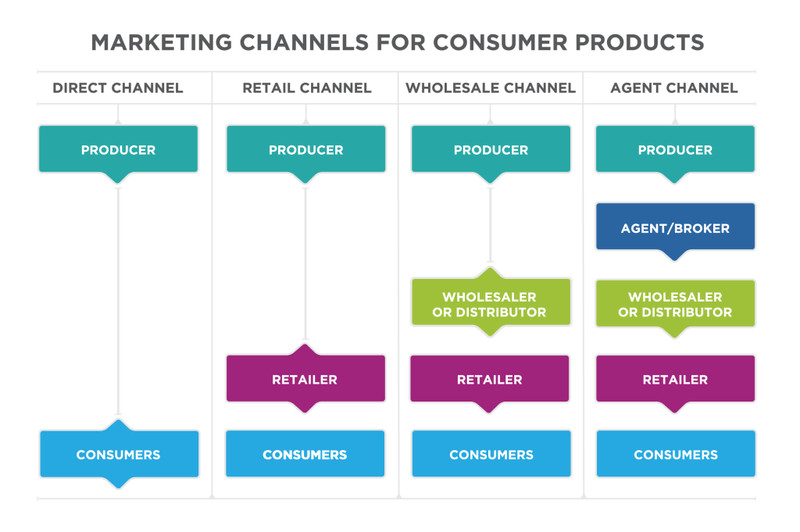
Common B2C marketing channels
One distinction gets tested a lot. A promotional channel is not automatically a distribution channel.
- A social media ad communicates
- A website where customers place orders communicates and distributes
Types of Marketing Channels
There are two separate ways to classify channels:
- B2C vs B2B tells you who the customer is
- Direct vs indirect tells you the route to the customer
Because these are separate, a business can be:
- B2C direct
- B2C indirect
- B2B direct
- B2B indirect
B2C channels
B2C means business-to-consumer. The final customer is an individual or household buying for personal use.
Common B2C channels:
- company website
- company-owned store
- independent retailer
- supermarket
- warehouse club
- consumer online marketplace
B2B channels
B2B means business-to-business. The final customer is an organization.
That organization may buy for:
- operations
- resale
- use as an input
Common B2B channels:
- producer’s own sales team
- industrial distributor
Direct channels
A direct channel has no sales intermediary between producer and customer.
Examples:
- company-owned website or app
- company-owned retail store
- direct orders taken by the business
- business’s own sales force
- company-run subscription or membership system
Two quick classifications students mix up:
- company-owned store = direct
- company-owned transactional website = direct
Indirect channels
An indirect channel uses one or more intermediaries.
Main intermediaries:
- wholesaler or distributor
- moves products to other businesses
- may hold inventory, transport goods, and connect producers to retailers
- industrial distributor
- B2B version with more specialized service or knowledge
- retailer
- sells to final consumers
Key examples:
- independent retailer = indirect
- third-party marketplace or independent retailer website = generally indirect
- warehouse club = indirect if independently owned
Common channel paths:
- Producer → consumer
- Producer → retailer → consumer
- Producer → wholesaler/distributor → retailer → consumer
- Producer → business customer
- Producer → industrial distributor → business customer
Legally required channels
Some products cannot use just any channel. Prescription medications are the main example. They must go through authorized prescribers and licensed pharmacies.
This also matters for products with health, safety, or age restrictions. Legal compliance comes before cost or convenience.
Direct and Indirect Tradeoffs
No channel is automatically best. The decision is about tradeoffs.
Direct channel strengths
Direct channels give more control over:
- pricing
- presentation
- customer service
- returns
- brand experience
They also:
- keep more of the selling price per unit
- build a direct customer relationship
- give better access to customer data
Direct channel weaknesses
Direct channels can be expensive and hard to run. The business may need:
- website or store setup
- staffing
- payment processing
- inventory storage
- fulfillment
- shipping
- returns management
- customer acquisition
- sales and distribution expertise
Reach may also be limited. A company website does not automatically have traffic.
Indirect channel strengths
Indirect channels can help because partners already have:
- store traffic
- online traffic
- geographic coverage
- industry relationships
That can reduce setup burden, lower some costs, and increase sales volume.
Indirect channel weaknesses
Indirect channels mean less control over:
- display
- pricing or discounting
- stocking
- brand environment
The producer also shares revenue with intermediaries. Another big point is access is not guaranteed. Shelf space may already be controlled by rivals, and distributors may prefer established suppliers.
Combined channel strategy
A business can use more than one channel at once. That can create:
- broader availability
- access to different customer buying preferences
It can also create problems:
- inventory coordination
- keeping a consistent brand experience
- channel conflict, especially when the producer undercuts retail partners on price
How Businesses Evaluate Channel Options
Businesses weigh three criteria:
- costs and potential profitability
- customer experience
- ability to deliver the product to target customers
A strong evaluation usually works like this:
- Identify the target customer and how they want to buy.
- Rule out illegal or unrealistic channels.
- Check delivery ability. Can the product arrive in the right condition?
- Estimate reach and sales volume.
- Compare costs and profitability.
- setup costs
- ongoing operating costs
- per-unit revenue kept
- expected sales volume
- total expected profit
- Compare customer experience and control.
- convenience
- service quality
- delivery speed and reliability
- information or demonstrations
- returns process
- fit with brand
- Check feasibility.
- Can the business run a direct channel well?
- Can it get accepted by the partner in an indirect channel?
A classic test trap is thinking highest per-unit revenue = best channel. That is false. A direct website may keep more per unit, but a national retailer may still create higher total profit because volume is much larger.
Product traits matter too. Channels have to fit products that are:
- bulky
- fragile
- perishable
- technical
- regulated
Broad reach is useless if it reaches the wrong customer.
Choosing the Best Channel
The best channel is the one that best fits target customer + profitability + experience + feasibility.
Stanley case
Stanley is the business example tied to this topic. The Quencher became popular with a much wider market than Stanley’s older outdoor and work-focused audience.
That changed channel logic:
- direct e-commerce gave Stanley more control over launches, assortment, branding, and the online experience
- retail partners gave more traffic, easier physical access, broader reach, and exposure to new customers
That is the main lesson from Stanley. Businesses often use direct + indirect together because different customers buy in different ways.
Key Takeaways
Place
Where and how customers access, purchase, and receive a product
Marketing Channel / Distribution Channel
The route, including all required individuals and businesses, through which a finished product reaches the final customer; the final stage of the supply chain
Business-to-Consumer (B2C) Marketing Channel
A channel whose final customer is an individual or household buying for personal use
Business-to-Business (B2B) Marketing Channel
A channel whose customer is an organization buying for operations, resale, or use as an input
Direct Channel
A channel connecting the producer directly to the customer without a sales intermediary; it provides greater control but may be costly to establish, limited in reach, and demanding of sales and distribution expertise
Indirect Channel
A channel containing one or more intermediaries between the producer and customer; partners can provide expertise, reduce costs, and expand access, but the producer gives up some control and revenue and may have difficulty obtaining channel access
Wholesaler / Distributor
An intermediary that obtains products from producers and supplies them to other businesses, often holding inventory, transporting goods, and providing network access
Industrial Distributor
A B2B intermediary that supplies business customers and may provide specialized knowledge, inventory, sales assistance, support, and delivery
Retailer
An intermediary that sells products to final consumers through stores, websites, or other consumer-facing outlets
Legally Required Distribution Channel
A distribution route mandated by law, usually requiring regulated products to pass through licensed or authorized sellers
Channel-Selection Process
Identify customer needs and legal options; assess delivery, reach, sales, costs, profitability, experience, control, capabilities, and partner access; then select and justify the channel or combination
Notes
Place
Where and how customers access, purchase, and receive a product
Marketing Channel / Distribution Channel
The route, including all required individuals and businesses, through which a finished product reaches the final customer; the final stage of the supply chain
Business-to-Consumer (B2C) Marketing Channel
A channel whose final customer is an individual or household buying for personal use
Business-to-Business (B2B) Marketing Channel
A channel whose customer is an organization buying for operations, resale, or use as an input
Direct Channel
A channel connecting the producer directly to the customer without a sales intermediary; it provides greater control but may be costly to establish, limited in reach, and demanding of sales and distribution expertise
Indirect Channel
A channel containing one or more intermediaries between the producer and customer; partners can provide expertise, reduce costs, and expand access, but the producer gives up some control and revenue and may have difficulty obtaining channel access
Wholesaler / Distributor
An intermediary that obtains products from producers and supplies them to other businesses, often holding inventory, transporting goods, and providing network access
Industrial Distributor
A B2B intermediary that supplies business customers and may provide specialized knowledge, inventory, sales assistance, support, and delivery
Retailer
An intermediary that sells products to final consumers through stores, websites, or other consumer-facing outlets
Legally Required Distribution Channel
A distribution route mandated by law, usually requiring regulated products to pass through licensed or authorized sellers
Channel-Selection Process
Identify customer needs and legal options; assess delivery, reach, sales, costs, profitability, experience, control, capabilities, and partner access; then select and justify the channel or combination
