Topic 3.5 Notes – Financial Capital
What Financial Capital Is and Why Businesses Need It
Financial capital means money provided to a business. That money can be used to buy resources, cover costs, or pay for growth.
A couple distinctions matter a lot here:
- Financial capital is not the same as assets
- If a business raises cash and buys an espresso machine, the cash raised is financial capital and the machine is a fixed asset.
- Financial capital is not revenue
- Revenue comes from selling goods or services.
- A loan or money from investors is capital coming in, not sales revenue.
Businesses can fund themselves in two broad ways:
- Internal funding
- owner contributions
- retained profits
- bootstrapping, which means using personal savings or personal resources
- External funding
- money from outside lenders or investors
New businesses often need outside capital because personal savings may not cover:
- startup costs like licenses, equipment, and inventory
- early operating costs like rent, payroll, insurance, and marketing
- losses before the business reaches break-even
- a cash reserve for delays or surprise costs
- cash-flow timing problems when money from customers comes in later than expenses go out
That is exactly the kind of decision DK Coffee Lab, Part 2 deals with. The entrepreneur compares how much cash is needed, looks at possible sources, and decides whether outside funding is necessary.
Break-even as a funding checkpoint
Break-even helps you estimate how many units must be sold in a period to cover costs.
In the example below, total revenue and total cost meet at 250 units, which is the break-even point.
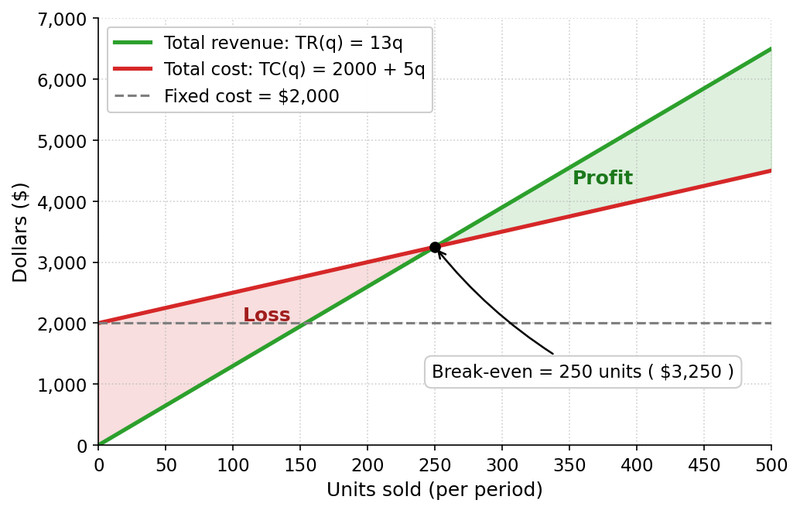
Break-even chart
What students mix up all the time:
- Break-even tells period sales needed to cover costs
- It does not tell total startup cash needed
- It does not guarantee enough cash is on hand when bills are due
An established business may also seek outside capital, even if it already has revenue. Common reasons include:
- developing a new product
- replacing or expanding fixed assets
- entering a new market
- increasing production, sales volume, and revenue
- handling cash-flow timing problems when money from customers comes in later than expenses go out
Main Sources of Financial Capital
Most outside capital comes from debt financing or equity financing.
Debt financing
Debt financing is borrowed money that must be repaid.
Key terms:
- principal = amount borrowed
- interest = cost of borrowing
What it means for the business:
- interest is a business expense
- larger loans or higher interest rates increase total borrowing cost
- owners keep ownership and control
- required payments still must be made even if profits are low
Typical pattern:
- Businesses under about two years old often use personal loans, personal credit, or loans from friends and family
- Businesses with at least two years of operating history and proven repayment ability are more likely to qualify for business bank loans
Equity financing
Equity financing means selling ownership shares.
That makes the investor a part owner. In return:
- there is no scheduled loan repayment
- there is no interest payment
- existing owners give up some control
- existing owners give up some future profits
This is common for newer or unproven businesses that may not qualify for loans, including issuing ownership shares to friends and family or to outside investors.
Corporation-specific sources
For corporations, two major sources are:
- Bonds
- A corporation borrows from investors
- A bondholder is a lender, not an owner
- Bondholders receive interest
- Stock
- A corporation sells ownership shares
- A stockholder or shareholder is an investor and owner
- Stock may be sold privately or publicly
The tradeoff is simple and testable. Debt preserves control but adds payment risk. Equity lowers payment pressure but dilutes control and future profits.
What Lenders and Investors Get Back
When people provide capital, they receive financial assets such as:
- loans
- bonds
- shares of stock
These can often be resold in a secondary market.
- Original issue means the business receives the money
- Secondary market sale means one investor sells to another, and the business usually gets no new capital
- Buying a corporate bond in the secondary market makes the buyer a lender to the business, and buying a share of stock in the secondary market makes the buyer an investor and shareholder in the business
Ways funders earn returns
- Interest income
- paid to lenders and bondholders
- Dividends
- paid to shareholders as a share of profits
- not guaranteed
- some businesses reinvest earnings instead
- Capital gains
- earned when an asset sells for more than its purchase price
If the result is negative, that is a capital loss.
Annual rate of return
Use the original purchase price in the denominator. Income means:
- interest for lenders and bondholders
- dividends for stockholders
This return can be negative if losses are bigger than income.
Bond and stock prices change because of:
- business performance
- investor demand
- PESTEL forces, which are political, economic, social, technological, environmental, and legal factors
Risk, Return, and Risk Tolerance
Both lenders and investors can lose money if the business performs poorly.
Lender risk
The main lender risk is default, which means the business fails to make interest or principal payments.
Lenders pay close attention to:
- revenue
- cash flow
- debt load
- assets
- capacity to repay
Investor risk
Investor risk is more tied to uncertain profits and changing asset value. If profits drop:
- dividends may shrink or disappear
- stock demand may fall
- stock price may fall
- the investor may take a capital loss
- the investor may lose the entire stake if the business fails
Risk tolerance means willingness to accept financial risk. Some consumers and institutional lenders and investors have higher risk tolerance and may fund newer or more volatile businesses. Lower-risk-tolerance funders prefer stability.
The exam loves this relationship: riskier assets usually need a higher expected return. That higher expected return is compensation for more risk, not a promise of better actual results.
Building and Evaluating a Funding Pitch
A funding pitch is a concise, polished argument for why a lender or investor should provide capital.
A strong pitch includes:
- business and value proposition
- customer need or problem
- target market and market research
- evidence of product-market fit
- marketing strategy
- specific amount requested
- planned use of funds
- financial reports if the business is established
- financial projections and assumptions
- break-even estimate
- risks and risk-management plan
- leadership team qualifications
- proposed return to lender or investor
- mission or value alignment when relevant
Valuation
Valuation is an estimate of what the business is worth.
It helps:
- investors judge what an ownership share may be worth
- lenders judge repayment capacity
It is based on things like financial statements, trends in revenue and profit, assets, liabilities, cash flow, projections, comparable businesses, competitive conditions, and PESTEL forces.
How funders evaluate a pitch
Funders usually walk through the same logic:
- Does the amount requested match documented uses?
- Is product-market fit real?
- Are projections supported by evidence?
- Do break-even and cash-flow assumptions make sense?
- Can the business repay debt, or is the ownership offer reasonable?
- Is the team qualified, and does the mission fit the funder?
- Does the expected return justify the risk?
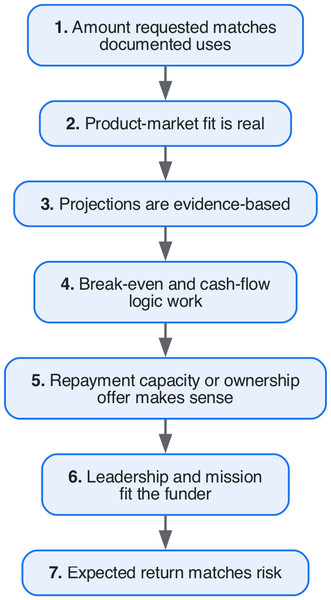
Funding pitch evaluation flow
For established businesses, actual financial reports plus projections and industry data make the request much stronger.
Key Takeaways
Financial Capital
Money provided to a business to acquire resources, operate, or grow; unlike revenue, it is not earned from sales
Bootstrapping
Funding a business with the entrepreneur’s personal savings or other personal resources
Break-Even Point
The point at which revenue for a period equals all costs for that period, producing neither profit nor loss
Unit Contribution Margin
The amount each unit contributes toward fixed costs and profit: selling price per unit − variable cost per unit
Break-Even Quantity
The units needed to break even: fixed costs ÷ (selling price per unit − variable cost per unit), rounded up to a whole unit
Debt Financing
Capital obtained through loans or bonds that must be repaid with interest but does not give the lender ownership
Principal
The original amount borrowed, which the borrower must repay
Interest
The cost of borrowing to the business and income received by the lender
Equity Financing
Raising capital by selling ownership shares, giving investors a claim on future value and profits and possibly some control
New Businesses vs. Established Businesses
New businesses typically operate for under two years and often use personal, friends-and-family, or equity funding; established businesses typically have at least two years of proven performance and better access to bank loans
Bond
A financial asset representing a loan from an investor to a corporation, which pays interest to the bondholder
Stock
An ownership share in a corporation that may be sold privately or publicly; its holder is an investor and shareholder
Financial Asset
A loan, bond, or ownership share held because it may produce income or be resold
Secondary Market
A market where current owners sell existing financial assets to other buyers, usually without providing new capital to the business
Dividend
A distribution of a corporation’s profits to shareholders; it is not guaranteed because earnings may be reinvested
Capital Gain
The gain from selling an asset for more than its purchase price: selling price − purchase price
Annual Rate of Return
The yearly gain relative to the original asset price: (income + capital gain) ÷ purchase price × 100%.
Default
A borrower’s failure to make required interest or principal payments
Risk Tolerance
A person’s or institution’s willingness to accept financial risk
Business Valuation
An evidence-based estimate of a business’s economic value, used to assess ownership shares and repayment capacity
Funding Pitch
A polished, concise presentation that uses evidence from a business plan to persuade lenders or investors to meet a specific funding request
Product-Market Fit
Evidence that a defined market wants a product enough to support viable sales
Notes
Financial Capital
Money provided to a business to acquire resources, operate, or grow; unlike revenue, it is not earned from sales
Bootstrapping
Funding a business with the entrepreneur’s personal savings or other personal resources
Break-Even Point
The point at which revenue for a period equals all costs for that period, producing neither profit nor loss
Unit Contribution Margin
The amount each unit contributes toward fixed costs and profit: selling price per unit − variable cost per unit
Break-Even Quantity
The units needed to break even: fixed costs ÷ (selling price per unit − variable cost per unit), rounded up to a whole unit
Debt Financing
Capital obtained through loans or bonds that must be repaid with interest but does not give the lender ownership
Principal
The original amount borrowed, which the borrower must repay
Interest
The cost of borrowing to the business and income received by the lender
Equity Financing
Raising capital by selling ownership shares, giving investors a claim on future value and profits and possibly some control
New Businesses vs. Established Businesses
New businesses typically operate for under two years and often use personal, friends-and-family, or equity funding; established businesses typically have at least two years of proven performance and better access to bank loans
Bond
A financial asset representing a loan from an investor to a corporation, which pays interest to the bondholder
Stock
An ownership share in a corporation that may be sold privately or publicly; its holder is an investor and shareholder
Financial Asset
A loan, bond, or ownership share held because it may produce income or be resold
Secondary Market
A market where current owners sell existing financial assets to other buyers, usually without providing new capital to the business
Dividend
A distribution of a corporation’s profits to shareholders; it is not guaranteed because earnings may be reinvested
Capital Gain
The gain from selling an asset for more than its purchase price: selling price − purchase price
Annual Rate of Return
The yearly gain relative to the original asset price: (income + capital gain) ÷ purchase price × 100%.
Default
A borrower’s failure to make required interest or principal payments
Risk Tolerance
A person’s or institution’s willingness to accept financial risk
Business Valuation
An evidence-based estimate of a business’s economic value, used to assess ownership shares and repayment capacity
Funding Pitch
A polished, concise presentation that uses evidence from a business plan to persuade lenders or investors to meet a specific funding request
Product-Market Fit
Evidence that a defined market wants a product enough to support viable sales
