Topic 2.4 Notes – Product
What a Product Is
A product is a good, service, or bundle of benefits that solves a customer problem, need, or want. That means product decisions are never just about the object itself.
They also include:
- who it serves
- what problem it solves
- what features and quality it has
- how customers experience it
- how it differs from alternatives
- what identity customers associate with it
Three connected ideas shape this topic:
- product development
- branding
- product life cycle
Market research runs through all three. Businesses keep testing whether the product is desirable to customers, feasible to make and deliver, and viable enough to earn profit.
The Six Stages of Product Development
Product development is the process of creating or improving a product through research and iteration. The six typical stages are:
- ideation
- validation
- design
- messaging
- production
- launch
This usually moves in that order, but it’s iterative. Feedback can send a business backward to fix the idea, the design, or the message.
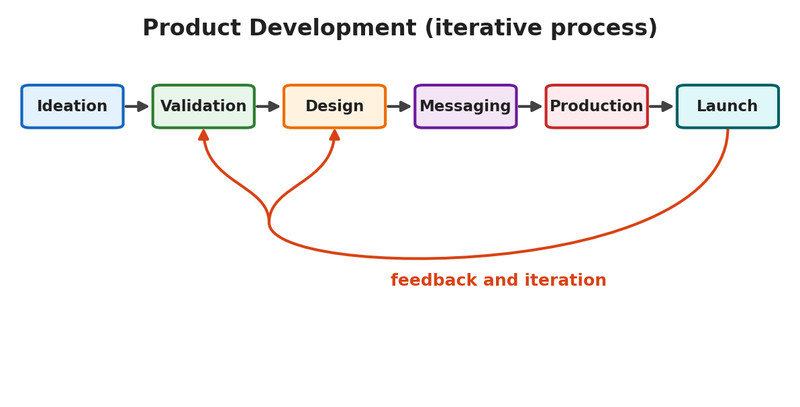
Product development cycle
Ideation
Ideation is where product ideas are generated. Sources include:
- market research showing unmet needs
- customer complaints or behavior
- R&D and technical discoveries
- new technology or materials
- brainstorming
- changes in the business environment
The key point is that ideation gives you a hypothesis, not proof. A founder thinking “people would love this” is still just an idea until customers respond.
Validation
Validation tests whether the idea works in the market.
Questions here include:
- Do customers actually have this problem?
- Does this solution solve it?
- Will enough customers pay for it?
An MVP is a minimum viable product. It is a basic but usable version with only the essential features needed to test the core value.
A prototype is different. It tests design or function. An MVP tests customer demand and market assumptions.
Product-market fit means customer demand is strong enough to generate profit. Students often miss the profit part. People liking a product is not enough.
Design
In design, the business turns the validated idea into a real product plan.
Main decisions include:
- materials and other inputs
- prototypes
- production and delivery cost estimates
- functionality
- user experience
- size, color, appearance, and quality
Prototype feedback helps the business refine:
- features
- likely buyers
- tradeoffs between cost and customer value
A product can function correctly and still fail if the user experience is annoying.
Messaging
Messaging creates the product’s overall marketing strategy.
Value proposition
A value proposition explains, based on market research insights:
- who the product serves
- what problem or need it addresses
- how it is better than alternatives
It is not just a slogan. “Best yogurt ever” is not a value proposition because it doesn’t identify the customer, the problem, or the difference.
Product positioning
Product positioning is how the business wants customers to perceive the product relative to rivals.
Common positioning angles:
- convenience
- quality
- affordability
- style
- specialization
- sustainability
A positioning map can help show where a product sits compared with competing options.
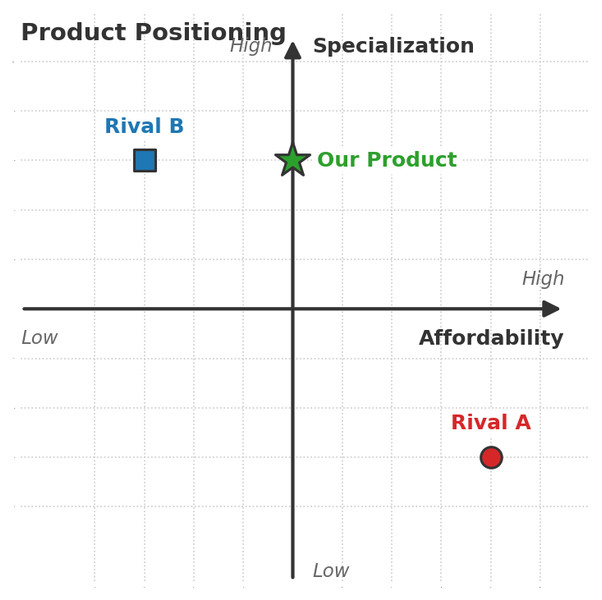
Product positioning map
Production
Production is about making the product consistently and at a workable cost, incorporating feedback received during the design stage.
Key decisions include:
- production process
- suppliers and supply chain
- quality standards
- production quantity
The business tries to match output to demand.
- Too little production leads to stockouts, delays, and lost sales.
- Too much production creates excess inventory, storage costs, and discounting pressure.
Launch
Launch is when the business begins taking orders and distributing the final product.
Typical launch actions:
- making the product available in chosen channels
- starting promotion
- fulfilling orders
- monitoring sales and feedback
- fixing early problems
Launch does not end development. Customer response can restart the cycle.
siggi’s
siggi’s shows the whole process well. The entrepreneur saw a gap in the U.S. yogurt market and developed a less-sweet, Icelandic-style yogurt. The business refined the recipe, texture, packaging, and messaging, then launched with a clear point of difference in a crowded market.
Branding and Brand Identity
Branding is creating an identity for a business or product so customers can distinguish it from competitors, recognize it, and become loyal to it.
A brand identity can be conveyed through a:
- name
- idea
- term
- symbol
- design
- combination of these
Strong branding should connect to the product’s:
- vision
- value proposition
- target customer
- intended positioning
For example, a business that promises quick delivery might build a brand identity that suggests movement or urgency.
A good brand review test asks:
- Does it fit the target customer?
- Does it reinforce the value proposition?
- Does it stand out from competitors?
- Is it recognizable and usable?
- Can it be protected?
A trademark gives legal protection to distinctive brand elements and helps prevent confusing imitation.
Branded and generic products compete differently:
| Type | Main appeal |
|---|---|
| Branded | identity, awareness, loyalty, perceived difference |
| Generic | lower cost |
Generic products exist because some customers care more about savings than branding. Still, branding only helps if the product delivers actual value.
The Product Life Cycle and Marketing Strategy
The product life cycle describes how demand changes over time. The four stages are:
- introduction
- growth
- maturity
- decline
One easy thing to confuse is this: launch is part of development, but introduction is the first life cycle stage after launch.
This graph tracks both sales and profits across the cycle, including the product development period before the four life cycle stages begin.
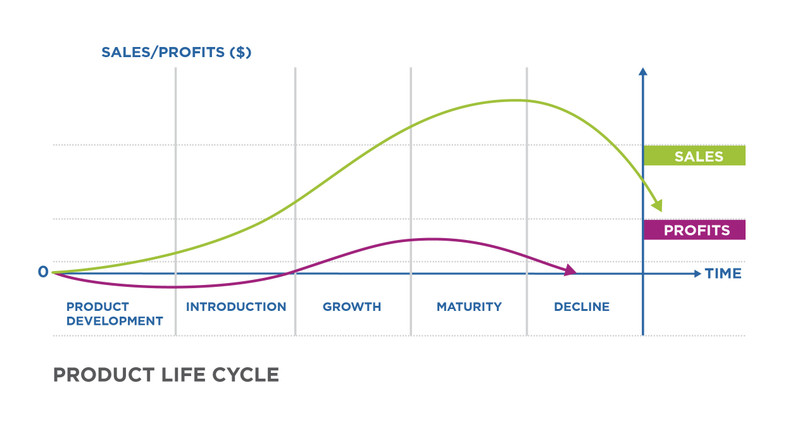
Product life cycle graph
Introduction
Sales and revenue are usually low. The challenge is generating initial demand.
Marketing focus:
- raise brand awareness
- explain the value proposition
- reach early customers
- demonstrate unfamiliar features
Growth
Sales and revenue rise at an increasing rate. Production often increases, and competitors enter.
Marketing focus:
- differentiation
- product quality improvements
- brand promotion
- advertising to sustain growth
siggi’s can fit here too, since it entered a crowded yogurt market and had to stand out.
Maturity
Sales and revenue flatten. The market is saturated, so the challenge is keeping market share.
Marketing focus:
- continued differentiation
- lower prices
- innovation
- brand loyalty
A common comparison here is generic store brands vs. national brands. When lots of similar options exist, branding and price matter a lot.
Decline
Sales and revenue fall as customers switch to rivals or substitutes.
Marketing focus:
- cut costs
- redesign if viable
- narrow to loyal segments
- discontinue if necessary
A classic example is standalone GPS devices losing demand as people switched to smartphone navigation.
How to Diagnose the Stage and Choose the Right Response
On scenario questions, do three things in your head:
- identify the stage from the evidence
- name the competitive challenge
- choose a marketing action that fits that challenge
Fast clues:
- low awareness and low sales = introduction
- accelerating sales and more rivals = growth
- flat sales and saturated market = maturity
- falling sales and substitutes = decline
The common mistake is giving an introduction strategy for a maturity or decline problem. If awareness is already high, “run ads so people know it exists” is usually weak.
The best answer aligns product features, value proposition, branding, and life-cycle strategy with what customers want now and what competitors are doing now.
Key Takeaways
Product
A good, service, or combination of benefits offered to address a customer problem, need, or want
Product Development
The process of creating or improving a product through research and iteration
Six Stages of Product Development
Ideation, validation, design, messaging, production, and launch, typically in that order
Ideation Stage
Generating ideas for new or improved products through market research, R&D, and brainstorming
Validation Stage
Testing a product idea with potential customers to determine whether the problem, solution, and demand are sufficient
Minimum Viable Product (MVP)
A basic but usable product with the minimum features needed to test key market assumptions with potential customers
Product-Market Fit
The condition in which customer demand for a product is sufficient to generate profit
Prototype
A preliminary model used to explore or test whether and how a product design works
Design Stage
Sourcing inputs, refining prototypes, estimating costs, and determining the product’s functionality, user experience, and attributes
Functionality
How a product works and what it enables the customer to do
User Experience
What it is like for a customer to obtain, understand, use, and interact with a product
Messaging Stage
Creating the product’s overall marketing strategy, including its value proposition and positioning
Value Proposition
An explanation of whom a product serves, what problem or need it addresses, and how it is superior to alternatives
Product Positioning
A strategy for influencing how potential customers perceive a product relative to rivals and substitutes
Production Stage
Building the product, incorporating design feedback, establishing production and supply-chain processes, and matching output to demand
Launch Stage
Taking orders, distributing the final product, and beginning marketing to the target segment
Branding
The process of developing an identity for a business or product to distinguish it, raise awareness, and generate loyalty
Brand (Brand Identity)
The identity of a business or product, conveyed through a name, idea, term, symbol, design, or combination of elements
Trademark
A name, term, symbol, design, or combination used in commerce to legally identify the source of goods or services and protect brand identity
Generic Product
A product that places less emphasis on a distinctive brand identity and is commonly associated with cost savings
Product Life Cycle
The stages a product passes through as demand changes over time: introduction, growth, maturity, and decline
Introduction Stage
The product-life-cycle stage with a new launch and typically low sales and revenue; marketing emphasizes awareness and initial demand
Growth Stage
The stage when sales and revenue grow at an increasing rate and competitors enter; marketing emphasizes differentiation, quality, brand promotion, and advertising
Maturity Stage
The stage when sales and revenue flatten in a saturated market; marketing emphasizes loyalty, differentiation, lower prices, and innovation
Decline Stage
The stage when sales and revenue fall as customers choose rivals or substitutes; businesses cut costs, redesign, narrow focus, or discontinue the product
Notes
Product
A good, service, or combination of benefits offered to address a customer problem, need, or want
Product Development
The process of creating or improving a product through research and iteration
Six Stages of Product Development
Ideation, validation, design, messaging, production, and launch, typically in that order
Ideation Stage
Generating ideas for new or improved products through market research, R&D, and brainstorming
Validation Stage
Testing a product idea with potential customers to determine whether the problem, solution, and demand are sufficient
Minimum Viable Product (MVP)
A basic but usable product with the minimum features needed to test key market assumptions with potential customers
Product-Market Fit
The condition in which customer demand for a product is sufficient to generate profit
Prototype
A preliminary model used to explore or test whether and how a product design works
Design Stage
Sourcing inputs, refining prototypes, estimating costs, and determining the product’s functionality, user experience, and attributes
Functionality
How a product works and what it enables the customer to do
User Experience
What it is like for a customer to obtain, understand, use, and interact with a product
Messaging Stage
Creating the product’s overall marketing strategy, including its value proposition and positioning
Value Proposition
An explanation of whom a product serves, what problem or need it addresses, and how it is superior to alternatives
Product Positioning
A strategy for influencing how potential customers perceive a product relative to rivals and substitutes
Production Stage
Building the product, incorporating design feedback, establishing production and supply-chain processes, and matching output to demand
Launch Stage
Taking orders, distributing the final product, and beginning marketing to the target segment
Branding
The process of developing an identity for a business or product to distinguish it, raise awareness, and generate loyalty
Brand (Brand Identity)
The identity of a business or product, conveyed through a name, idea, term, symbol, design, or combination of elements
Trademark
A name, term, symbol, design, or combination used in commerce to legally identify the source of goods or services and protect brand identity
Generic Product
A product that places less emphasis on a distinctive brand identity and is commonly associated with cost savings
Product Life Cycle
The stages a product passes through as demand changes over time: introduction, growth, maturity, and decline
Introduction Stage
The product-life-cycle stage with a new launch and typically low sales and revenue; marketing emphasizes awareness and initial demand
Growth Stage
The stage when sales and revenue grow at an increasing rate and competitors enter; marketing emphasizes differentiation, quality, brand promotion, and advertising
Maturity Stage
The stage when sales and revenue flatten in a saturated market; marketing emphasizes loyalty, differentiation, lower prices, and innovation
Decline Stage
The stage when sales and revenue fall as customers choose rivals or substitutes; businesses cut costs, redesign, narrow focus, or discontinue the product
