Topic 5.1 Notes – Taxes, Net Income, and Budgeting
What Net Income Is and Why It Matters
Net income or net pay is the money you actually receive after deductions come out of your paycheck. Gross income is the total pay you earned before anything is taken out.
The core relationship is:
That gives you the full chain:
- earn income
- subtract taxes and other payroll deductions
- receive net pay
- build your budget from that number
One easy trap here is vocabulary. In this topic, net income means personal take-home pay. It does not mean business net income from an income statement.
Why it matters is simple. A budget is supposed to reflect money you can actually use. If your salary says $48,000 but taxes and benefits reduce each paycheck, you do not have the full $48,000 available to spend.
Common mistakes:
- using gross pay as budget income
- subtracting payroll deductions again after you already used net pay
- treating a tax refund like extra money, when it is just your own overpayment being returned
The Main Taxes Individuals Pay
Individuals can pay taxes to federal, state, and local governments. The exact taxes and rates depend on where you live and your situation.
The full set to know is:
- income taxes on income
- capital gains taxes on profit from selling an asset
- payroll taxes tied to earnings from work
- property taxes on property value
- sales taxes on purchases
Income taxes
Income tax is a tax based on an individual’s or household’s income. For employees, the employer usually withholds part of each paycheck and sends it to the government.
That withholding is a prepayment, not always the exact final amount you owe. At tax time, your return compares what you truly owed with what was already paid.
If you are self-employed, you are responsible for sending in your own income tax payments.
Capital gains taxes
A capital gain happens when you sell a capital asset for more than its cost basis. Cost basis usually means what you paid for it.
If you buy an investment for $1,000 and sell it for $1,300, the gain is $300. The tax applies to the $300 gain, not the full $1,300 selling price.
Capital gains get reported on your income tax return, but they may be taxed at a different, often lower, rate than ordinary income.
Payroll taxes
Payroll taxes come out of earnings from work and help fund specific programs:
- Social Security
- Medicare
- Medicaid
- unemployment benefits
For employees, these are withheld from paychecks. Employers usually pay half of certain payroll taxes, and employees pay the other half. If you are self-employed or a contract worker, you generally pay the full amount yourself.
Students often mix up payroll taxes and income taxes because both appear on a pay stub. They are separate taxes.
Property taxes
Property taxes are based on the value of property, including:
- houses
- land
- cars
They may be paid annually, semi-annually, or monthly through mortgage escrow.
Sales taxes
Sales tax is based on the item’s sales price.
The business collects it at the point of sale and sends it to the government. Rates and taxable items vary by state and locality.
Why People Owe Different Amounts of Federal Income Tax
Two households can have different federal income tax bills for three main reasons:
- different income levels
- progressive tax rates
- different deductions and credits
Progressive tax rates
The U.S. federal income tax is progressive, and some state income taxes are progressive too. Higher income levels face higher marginal tax rates.
Here is the key idea students miss all the time. Entering a higher tax bracket does not mean all your income gets taxed at that higher rate. Only the income in that bracket does.
- Marginal tax rate means the rate on your last dollars earned
- Effective tax rate means total tax paid divided by taxable income
A common mistake is multiplying all taxable income by the top bracket rate.
Tax deductions
A tax deduction lowers taxable income.
Examples you need to recognize:
- home mortgage interest
- contributions to retirement accounts
- charitable donations
- state and local taxes paid
- some medical expenses
A deduction does not reduce your tax bill dollar-for-dollar. It reduces the amount of income that gets taxed.
Tax credits
A tax credit directly reduces the taxes you owe.
Examples:
- child tax credit
- child or dependent care tax credit
- education tax credit
- credits for specific purchases
Deductions vs credits
This distinction matters a lot on tests.
| Term | What it reduces |
|---|---|
| Deduction | taxable income |
| Credit | tax owed |
A $1,000 credit is usually more powerful than a $1,000 deduction.
Reading a Pay Stub
A pay stub shows how gross pay turns into net pay. This example also shows one of the easiest test mistakes to avoid, which is mixing up the current-period and year-to-date columns.
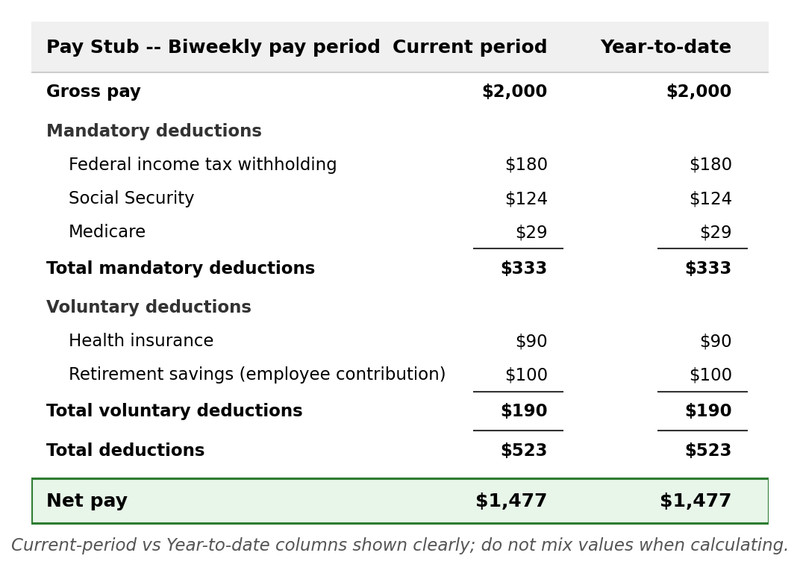
Sample biweekly pay stub
The main parts to identify are:
- gross pay
- mandatory deductions
- voluntary deductions
- net pay
- current-period amounts
- year-to-date amounts
Gross pay
Gross pay is total income earned during the pay period before deductions. It can come from:
- annual salary divided across pay periods
- hourly wages
- contract amount
- bonuses, commissions, or tips when given
Common pay schedules:
- weekly = 52
- biweekly = 26
- semimonthly = 24
- monthly = 12
Biweekly means every two weeks. Semimonthly means twice per month. Those are not the same.
Mandatory deductions
These are required by law. They usually include:
- federal income tax
- state income tax where applicable
- local income tax where applicable
- Social Security tax
- Medicare tax
Voluntary deductions
These are chosen or authorized by the employee, such as:
- health insurance
- health savings or dependent care plans
- life insurance
- retirement savings
- union dues
Pretax and after-tax deductions
Pretax deductions reduce taxable income before taxes are calculated. That can lower tax liability and can be an incentive to save.
After-tax deductions still reduce your paycheck, but they do not reduce taxable income.
Keep these two ideas separate:
- payroll deduction means money removed from your paycheck
- tax deduction means something that reduces taxable income
Net pay and pay-stub traps
Net pay is what remains after all deductions. In the sample pay stub, gross pay is $2,000 and total deductions are $523, so net pay is $1,477. Also, never mix current amounts with year-to-date amounts in the same calculation.
From Net Income to a Budget
Your budget starts with net income, because that is the money actually available.
Planned outflows can include:
- housing
- utilities
- food
- transportation
- insurance
- debt payments
- saving
- flexible spending
If the result is positive, you have a surplus. If it is negative, you have a deficit.
Irregular bills need to be converted into the budget period. If your property tax or insurance bill is annual, divide by 12 to turn it into a monthly budget amount.
That gives you the full logic of the topic. Taxes, deductions, and withholding determine take-home pay. Take-home pay determines the budget.
Key Takeaways
Income Tax
A tax based on an individual’s or household’s income and paid to a federal, state, or local government
Income Tax Withholding
The portion of an employee’s paycheck that an employer sends to the government as a prepayment toward the employee’s income tax liability
Income Tax Return
An annual filing that reports income, deductions, credits, taxes already paid, and final income tax liability
Tax Liability
The total amount of tax a taxpayer is legally required to pay
Tax Refund
The return of an overpayment when taxes already paid exceed final tax liability
Progressive Income Tax
An income-tax system in which higher portions of taxable income are taxed at higher rates
Marginal Tax Bracket
A range of taxable income to which a particular tax rate applies
Marginal Tax Rate
The tax rate applied to the last portion of a taxpayer’s taxable income, not to all income
Effective Tax Rate (Average Tax Rate)
Total tax divided by total taxable income
Taxable Income
The amount of income on which income tax is calculated after applicable adjustments and deductions
Tax Deduction
An allowable amount that reduces taxable income rather than directly reducing tax owed
Tax Credit
An allowable amount that directly reduces the tax owed
Capital Gain (Realized Capital Gain)
The amount by which an asset’s selling price exceeds its cost basis when the asset is sold
Capital Gains Tax
A tax on a realized capital gain, generally reported with an income tax return and often charged at a different rate from ordinary income
Payroll Tax
A tax associated with earnings from work that supports specified government insurance and benefit programs
Property Tax
A tax based on the taxable or assessed value of property such as a house, land, or car
Sales Tax
A tax based on the sales price of a taxable item or service, collected from the customer by the seller and submitted to the government
Pay Stub
A record of an employee’s gross pay, deductions, and net pay for a pay period, often including year-to-date totals
Gross Income (Gross Pay)
Total compensation earned during a pay period before any deductions
Biweekly Pay vs. Semimonthly Pay
Biweekly pay occurs every two weeks, usually 26 times per year; semimonthly pay occurs twice each month, or 24 times per year
Payroll Deduction
An amount removed from an employee’s gross pay before net pay is received
Mandatory Deduction
An amount an employer is legally required to withhold, commonly including income-tax withholding and employee payroll taxes
Voluntary Deduction
An employee-authorized deduction for a benefit or arrangement such as insurance, retirement saving, or union dues
Pretax Deduction vs. After-Tax Deduction
A pretax deduction reduces applicable taxable pay before taxes are calculated; an after-tax deduction reduces the paycheck after applicable taxes are calculated
Net Income (Net Pay or Take-Home Pay)
The amount an employee receives after all mandatory and voluntary deductions are subtracted from gross pay
Year-to-Date (YTD) Amount
The cumulative amount earned, deducted, or paid from the beginning of the calendar year through the current paycheck
Notes
Income Tax
A tax based on an individual’s or household’s income and paid to a federal, state, or local government
Income Tax Withholding
The portion of an employee’s paycheck that an employer sends to the government as a prepayment toward the employee’s income tax liability
Income Tax Return
An annual filing that reports income, deductions, credits, taxes already paid, and final income tax liability
Tax Liability
The total amount of tax a taxpayer is legally required to pay
Tax Refund
The return of an overpayment when taxes already paid exceed final tax liability
Progressive Income Tax
An income-tax system in which higher portions of taxable income are taxed at higher rates
Marginal Tax Bracket
A range of taxable income to which a particular tax rate applies
Marginal Tax Rate
The tax rate applied to the last portion of a taxpayer’s taxable income, not to all income
Effective Tax Rate (Average Tax Rate)
Total tax divided by total taxable income
Taxable Income
The amount of income on which income tax is calculated after applicable adjustments and deductions
Tax Deduction
An allowable amount that reduces taxable income rather than directly reducing tax owed
Tax Credit
An allowable amount that directly reduces the tax owed
Capital Gain (Realized Capital Gain)
The amount by which an asset’s selling price exceeds its cost basis when the asset is sold
Capital Gains Tax
A tax on a realized capital gain, generally reported with an income tax return and often charged at a different rate from ordinary income
Payroll Tax
A tax associated with earnings from work that supports specified government insurance and benefit programs
Property Tax
A tax based on the taxable or assessed value of property such as a house, land, or car
Sales Tax
A tax based on the sales price of a taxable item or service, collected from the customer by the seller and submitted to the government
Pay Stub
A record of an employee’s gross pay, deductions, and net pay for a pay period, often including year-to-date totals
Gross Income (Gross Pay)
Total compensation earned during a pay period before any deductions
Biweekly Pay vs. Semimonthly Pay
Biweekly pay occurs every two weeks, usually 26 times per year; semimonthly pay occurs twice each month, or 24 times per year
Payroll Deduction
An amount removed from an employee’s gross pay before net pay is received
Mandatory Deduction
An amount an employer is legally required to withhold, commonly including income-tax withholding and employee payroll taxes
Voluntary Deduction
An employee-authorized deduction for a benefit or arrangement such as insurance, retirement saving, or union dues
Pretax Deduction vs. After-Tax Deduction
A pretax deduction reduces applicable taxable pay before taxes are calculated; an after-tax deduction reduces the paycheck after applicable taxes are calculated
Net Income (Net Pay or Take-Home Pay)
The amount an employee receives after all mandatory and voluntary deductions are subtracted from gross pay
Year-to-Date (YTD) Amount
The cumulative amount earned, deducted, or paid from the beginning of the calendar year through the current paycheck
