Topic 1.7 Notes – Organization, Roles, and Responsibilities
What Business Organization Means
A business has to answer two different questions.
Who owns, controls, and is liable for the business?
This is the business’s legal organization.Who does the work, and how is that work divided?
This is the business’s internal structure.
Those are connected, but they are not the same thing. A business can be an LLC legally and still have a CEO, managers, and departments inside. A corporation is also just a legal form. It does not automatically mean “huge company.”
When you compare business forms, keep coming back to the same trade-offs:
- control over decisions
- control over profits
- personal liability for debts
- access to funding
- ability to grow
That same comparison shows up again and again in quiz scenarios.
Major Types of Business Organization
There are four major forms.
Sole proprietorship
A sole proprietorship has one owner.
- The owner keeps direct control over decisions and profits.
- The owner is personally liable for all business debts and obligations.
- Funding is often limited, so growth can be limited too.
Best memory phrase: maximum control, maximum personal risk
Partnership
A partnership has two or more owners.
- Partners keep substantial control over decisions and profits.
- They often divide work based on strengths and interests.
- Partners are personally liable for business debts and obligations.
- They usually have more owner resources than a sole proprietorship, but still less funding access than a corporation.
Best memory phrase: shared control and shared work, but also shared personal risk
Limited liability company
A limited liability company, or LLC, can have one or more owners.
- Owners keep substantial control over decisions and profits.
- Owners avoid personal liability for business debts. The company is liable.
- LLCs usually have less access to funding than corporations.
Best memory phrase: small-business control with liability protection
Corporation
A corporation works differently because ownership is through shareholders.
- Shareholders elect a board of directors.
- The board oversees executive leadership.
- Founders and owners give up some direct control.
- The corporation controls profits and is liable for business debts.
- Corporations usually have the best access to funding and the strongest growth potential.
Best memory phrase: less direct owner control, more funding and growth
Fast comparison
- Most direct owner control
Sole proprietorship, partnership, LLC - Least direct owner control
Corporation - Personal liability
Sole proprietorship and partnership - Limited liability
LLC and corporation - Best access to funding and growth
Corporation
A classic scenario is two founders launching a rechargeable lantern business.
- A partnership fits shared ownership, but both founders are personally liable.
- An LLC fits shared control plus liability protection.
- A corporation makes more sense if major outside funding and large-scale expansion become the main goal.
How Owners and Leaders Divide Responsibility
In a very small business, the owners often do almost everything themselves.
Sole proprietors
A sole proprietor has primary responsibility for all aspects of the business and may act as:
- CEO for overall direction
- marketer to attract customers
- product developer to improve the good or service
- financial manager to handle money
- operations manager to oversee production or service delivery
Even if employees are hired, the owner still has ultimate responsibility.
Partners
Partners also have primary responsibility for the whole business, but they usually divide roles.
- One partner might handle product development and operations
- Another might handle sales, customer relationships, and finances
That division helps the business use each partner’s strengths, but it does not remove shared responsibility for the whole business.
As businesses grow, that owner-managed setup gets harder to maintain. More customers, employees, products, and locations create a need for a clearer structure.
Specialized Departments and What They Do
Businesses create departments because specialization improves efficiency and effectiveness.
In a larger business, these departments fit into a broader chain of authority and responsibility.
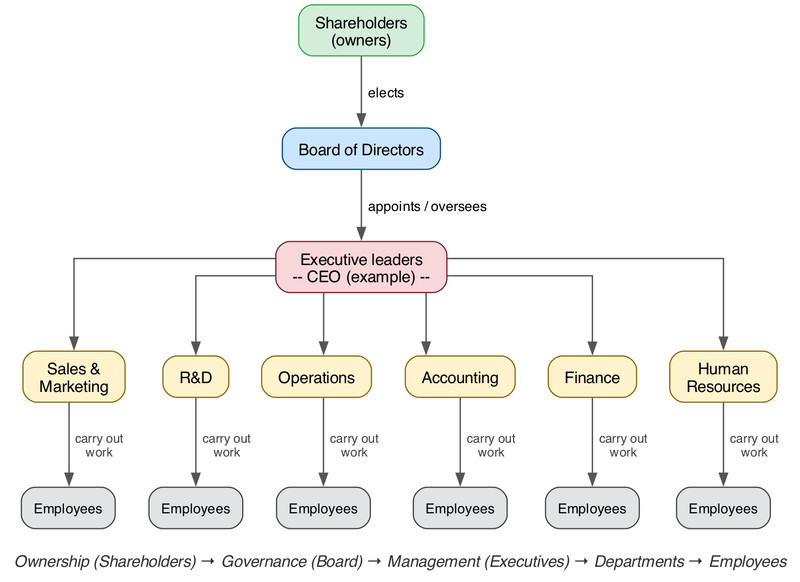
Typical business organizational structure
Sales and marketing
This department helps attract and retain customers.
- conducts market research
- develops sales strategies
- manages brands
- builds customer relationships
Research and development
R&D innovates around new and existing goods, services, and processes.
- creates or improves offerings
- helps the business better meet customer needs and wants
Operations
Operations manages the technical process of making goods or delivering services.
- handles production or service delivery
- gets products to customers
Accounting
Accounting records what happened financially.
- tracks expenditures and earnings
- prepares financial statements
- helps monitor financial health
Finance
Finance makes decisions about money.
- secures and manages funds
- uses financial data to recommend strategies that improve performance
The distinction students miss a lot is this. Accounting records. Finance decides.
Human resources
Human resources, or HR, manages the workforce.
- recruits employees
- trains employees
- oversees employee evaluation
HR makes sure the business has workers with the knowledge, skills, and abilities it needs to produce and provide the product, market to customers, make sales, and manage finances.
How Growth Changes Structure
As a business grows, one owner or a few partners cannot manage every task well.
Businesses organize into departments because:
- work becomes more complex
- employees build expertise
- efficiency improves
- decisions often become more effective
But specialization creates a new challenge. Departments depend on each other.
- R&D may design something operations struggles to produce
- marketing may promise delivery operations cannot meet
- finance may push cost cuts that hurt hiring
That is why large businesses add layers of leadership.
- executives lead the whole business
- managers lead departments
- employees do specialized work
In corporations, the reporting line is:
- shareholders own the company
- shareholders elect the board of directors
- the board oversees executives
- executives lead the business
- managers lead departments
- employees carry out the work
The CEO is the common example of an executive responsible for overall vision, strategy, operations, and performance.
The lantern example shows how departments coordinate on one project:
- sales and marketing identifies customer demand
- R&D designs the new lantern
- operations figures out production
- accounting tracks costs and earnings
- finance evaluates funding and performance
- HR hires or trains workers
- managers report to executives
- executives align the project with strategy
- in a corporation, executives are accountable to the board and shareholders
Outsourcing
Outsourcing means hiring another business to do a function instead of using your own employees.
Businesses outsource when it is likely to:
- increase efficiency
- reduce costs
- provide specialized skills they lack
- avoid high internal labor costs
A common example is outsourcing payroll to a payroll provider when the business lacks payroll expertise.
The key distinction is simple:
- internal department = the business’s own employees
- outsourced function = an outside firm working under contract
On scenario questions, outsourcing only makes sense if the facts show a real benefit such as lower cost, better expertise, or greater efficiency.
Key Takeaways
Sole Proprietorship
A business owned by one individual who controls decisions and profits, is personally liable for business debts, and typically has less access to funding than a corporation
Partnership
A business owned by two or more partners who retain substantial control over decisions and profits, are personally liable for business debts, and typically have less access to funding than a corporation
Limited Liability Company (LLC)
A business whose owners retain substantial control over decisions and profits while the company, not the owners, is liable for business debts; it typically has less funding access than a corporation
Corporation
A business owned by shareholders who elect a board of directors; the company controls profits and is liable for debts, while greater funding and growth capacity come with reduced direct owner control
Shareholders
The owners of a corporation, who elect its board of directors and hold its executive leaders accountable
Board of Directors
The body elected by shareholders to oversee a corporation and its executive leadership
Executive Leaders
Leaders responsible for the entire business’s vision, operations, strategy, and performance; in a corporation, they report to the board and shareholders
Chief Executive Officer (CEO)
An executive leader responsible for the performance and direction of the entire business rather than only one specialized function
Department Manager
A manager who directs a specialized functional area and reports to the business’s executive leaders
Organizational Chart
A diagram showing formal authority and reporting relationships among the board, executives, managers, departments, and employees
Specialized Departments (or Teams)
Groups that organize related business functions and develop expertise, improving efficiency, effectiveness, and the business’s ability to meet customer needs
Sales and Marketing Department
The department that conducts market research, develops sales strategies, manages brands, and builds customer relationships to attract and retain customers
Research and Development (R&D) Department
The department that innovates around new and existing goods, services, and processes to better meet customer needs and wants
Operations Department
The department that manages the technical process of manufacturing goods or developing services so products reach customers
Accounting Department
The department that tracks expenditures and earnings and prepares financial statements to monitor the business’s financial health
Finance Department
The department that secures and manages funds and uses financial data to recommend strategies for improving business performance
Human Resources (HR) Department
The department that recruits, trains, and oversees the evaluation of employees so the business has a capable workforce
Outsourcing
Contracting another business to perform a function, usually to increase efficiency, reduce costs, or obtain skills unavailable internally
Sole Proprietor
The owner of a sole proprietorship, with primary responsibility for all aspects of the business and often multiple roles such as CEO, marketer, product developer, financial manager, and operations manager
Partners
The owners of a partnership, who have primary responsibility for all aspects of the business and typically divide roles according to their strengths and interests
Notes
Sole Proprietorship
A business owned by one individual who controls decisions and profits, is personally liable for business debts, and typically has less access to funding than a corporation
Partnership
A business owned by two or more partners who retain substantial control over decisions and profits, are personally liable for business debts, and typically have less access to funding than a corporation
Limited Liability Company (LLC)
A business whose owners retain substantial control over decisions and profits while the company, not the owners, is liable for business debts; it typically has less funding access than a corporation
Corporation
A business owned by shareholders who elect a board of directors; the company controls profits and is liable for debts, while greater funding and growth capacity come with reduced direct owner control
Shareholders
The owners of a corporation, who elect its board of directors and hold its executive leaders accountable
Board of Directors
The body elected by shareholders to oversee a corporation and its executive leadership
Executive Leaders
Leaders responsible for the entire business’s vision, operations, strategy, and performance; in a corporation, they report to the board and shareholders
Chief Executive Officer (CEO)
An executive leader responsible for the performance and direction of the entire business rather than only one specialized function
Department Manager
A manager who directs a specialized functional area and reports to the business’s executive leaders
Organizational Chart
A diagram showing formal authority and reporting relationships among the board, executives, managers, departments, and employees
Specialized Departments (or Teams)
Groups that organize related business functions and develop expertise, improving efficiency, effectiveness, and the business’s ability to meet customer needs
Sales and Marketing Department
The department that conducts market research, develops sales strategies, manages brands, and builds customer relationships to attract and retain customers
Research and Development (R&D) Department
The department that innovates around new and existing goods, services, and processes to better meet customer needs and wants
Operations Department
The department that manages the technical process of manufacturing goods or developing services so products reach customers
Accounting Department
The department that tracks expenditures and earnings and prepares financial statements to monitor the business’s financial health
Finance Department
The department that secures and manages funds and uses financial data to recommend strategies for improving business performance
Human Resources (HR) Department
The department that recruits, trains, and oversees the evaluation of employees so the business has a capable workforce
Outsourcing
Contracting another business to perform a function, usually to increase efficiency, reduce costs, or obtain skills unavailable internally
Sole Proprietor
The owner of a sole proprietorship, with primary responsibility for all aspects of the business and often multiple roles such as CEO, marketer, product developer, financial manager, and operations manager
Partners
The owners of a partnership, who have primary responsibility for all aspects of the business and typically divide roles according to their strengths and interests
