Topic 3.8 Notes – The Cash Flow Statement
What the Cash Flow Statement Shows
A cash flow statement is a financial statement that shows how cash inflows and cash outflows changed a business’s cash balance during a reporting period. That period might be a month, quarter, or year.
It answers three basic questions:
- How much cash did the business have at the beginning?
- What transactions increased or decreased cash during the period?
- How much cash did the business have at the end?
The two relationships you need are:
Cash matters because it is the most liquid resource. Liquid means available right away to make payments. A business needs cash for payroll, rent, utilities, supplier bills, lender payments, and surprise costs.
This also connects to the other statements:
- Income statement shows profit over a period.
- Balance sheet shows assets, liabilities, and equity at one point in time.
- Cash flow statement explains how the cash amount changed over a period.
One detail teachers love to check: the ending cash on the cash flow statement should match the cash on the ending balance sheet. The income statement links in too: net income (profit) for the period adds to owners’ equity on the balance sheet, as retained earnings. This diagram ties those three statements together.
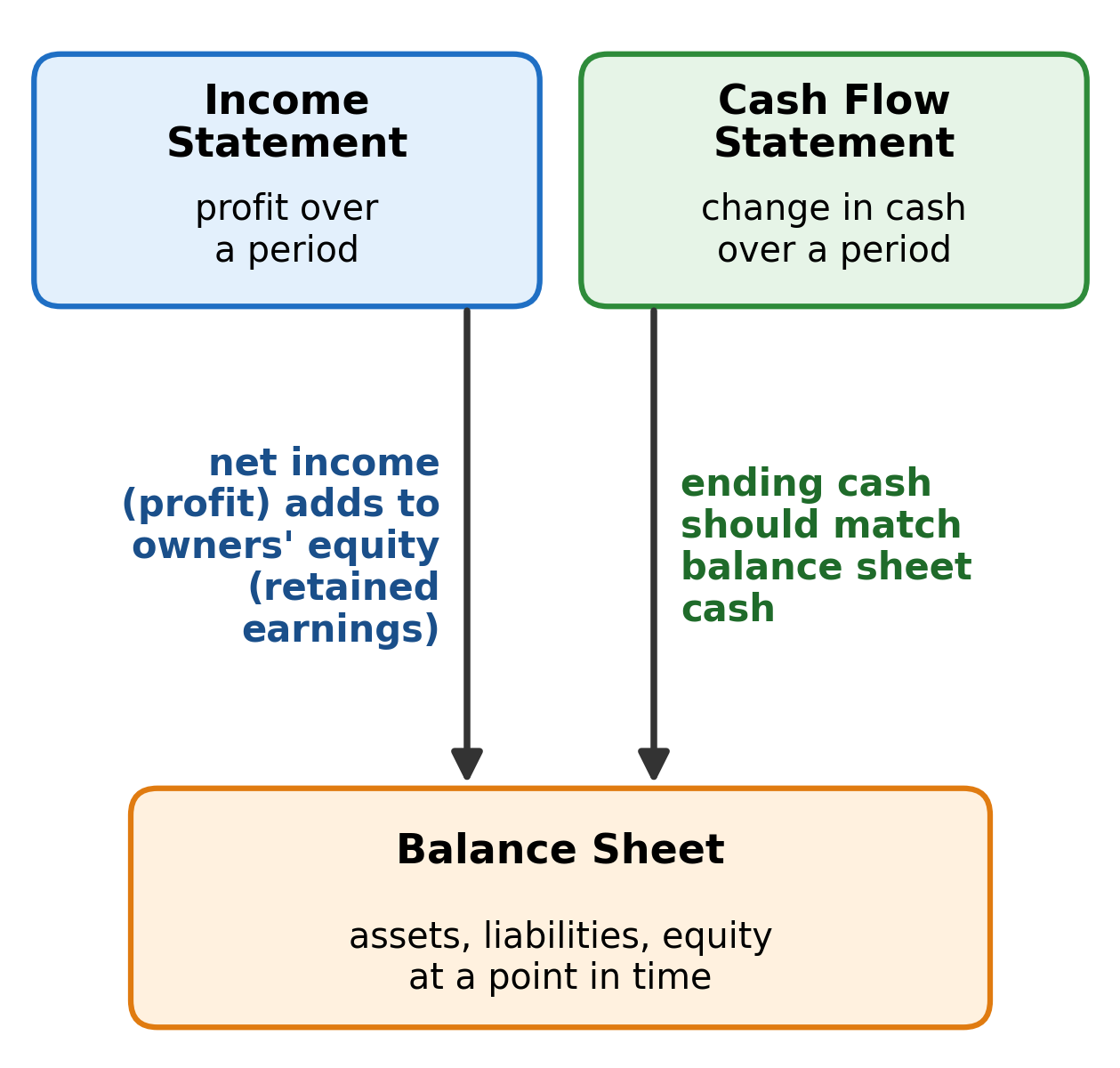
Both period statements feed the balance sheet: net income adds to owners’ equity, and ending cash matches balance sheet cash.
Cash Inflows and Cash Outflows
Here’s the big rule. Cash is recorded when it is actually received or paid, not just when revenue or expense is recognized.
Cash inflows
Inflows increase cash. Common ones include:
- Payments from customers for goods or services
- Collections of accounts receivable. This means customers who bought on credit are finally paying.
- Interest received
- Dividends received from investments
- Proceeds from selling assets, such as equipment
- Proceeds from a new loan
- Cash from owners or share issuance
Cash outflows
Outflows decrease cash. Common ones include:
- Payments to employees, including payroll
- Payments to suppliers
- Rent and other operating expenses paid in cash
- Interest paid on loans
- Taxes paid to the government
- Purchases of equipment, property, or other assets
- Repayment of loan principal
- Dividends paid to shareholders
What students mix up
This part gets tested a lot because the words sound similar.
| Transaction | Changes cash? | Revenue or expense? |
|---|---|---|
| New loan | Yes, inflow | Not revenue |
| Sell equipment | Yes, inflow | Not normal sales revenue |
| Buy equipment | Yes, outflow | Not an ordinary expense for the full amount |
| Repay loan principal | Yes, outflow | Not an expense |
| Pay interest | Yes, outflow | Yes, expense |
| Pay dividends | Yes, outflow | Not an operating expense |
Two high-value distinctions:
- Interest vs principal
- Interest is the cost of borrowing. It is an expense.
- Principal is the amount borrowed. Paying it back reduces a liability.
- Cash flow vs income
- Cash moved does not automatically mean profit changed.
Operating, Investing, and Financing Activities
Formal cash flow statements group transactions into three categories. You should know the categories before classifying examples.
Operating activities
These are the business’s normal day-to-day cash activities.
Includes:
- Cash collected from customers
- Payments to employees
- Payments to suppliers
- Interest paid
- Taxes paid
Investing activities
These involve buying and selling long-term assets and investments.
Includes:
- Purchase of equipment, property, or other long-term assets
- Proceeds from selling equipment or other assets
Financing activities
These involve getting or returning financial capital.
Includes:
- New loan proceeds
- Repayment of loan principal
- Owner investment or share issuance
- Dividends paid
A fast classification check:
- Is this from normal operations?
- Is this from buying or selling long-term assets?
- Is this from borrowing, repaying debt, or owner/shareholder funding?
Calculating Net Cash Flow and Ending Cash
Cash flow problems usually follow the same logic:
- Begin with the beginning cash balance.
- Add up all cash inflows.
- Add up all cash outflows.
- Find net cash flow.
- Use it to find ending cash.
Here’s the full example you need to know:
- Beginning cash = $20,000
- Total inflows = $72,300
- Customer payments $50,000
- Interest/dividends received $300
- Sale of equipment $2,000
- New loan $20,000
- Total outflows = $90,000
- Employees and suppliers $49,000
- Interest $1,000
- Taxes $4,000
- Equipment purchase $25,000
- Loan principal repayment $8,000
- Dividends $3,000
That example proves two things:
- A business can have negative net cash flow and still end with positive cash.
- The source of cash matters. The loan brought in $20,000, which kept the cash balance from dropping even lower.
Why Stakeholders Care About Cash Flow
Cash flow is mostly about liquidity and whether the business can meet obligations on time.
Different stakeholders read it for different reasons:
- Managers and owners check available cash, spot shortages, and decide whether to delay spending or raise funds.
- Employees care about reliable payroll.
- Suppliers decide whether to extend trade credit or tighten terms.
- Lenders and creditors look at whether interest and principal can be paid.
- Investors and shareholders want to know whether the business can keep operating, grow, service debt, and pay dividends.
This is why profit and cash flow are not the same:
- A business can be profitable but short on cash if it sold on credit and customers have not paid yet.
- A business can have positive cash flow because it borrowed money or sold assets even if its operations are weak.
The AANE example shows this well. AANE is a nonprofit with an annual operating deficit and an ongoing cash flow challenge. The key question is whether the problem is about timing or a recurring deficit.
- A temporary timing problem may be solved by faster collections, reserves, short-term funding, or revised terms.
- A persistent deficit needs dependable funding increases, lower expenses, or operating changes.
Negative cash flow may signal trouble paying current expenses and can lead to shutdown or bankruptcy if it continues. A business may need to raise more funds, collect accounts receivable faster, or negotiate better terms with suppliers and lenders.
Key Takeaways
Cash Flow Statement
A financial statement showing how actual cash inflows and outflows changed a business’s cash balance during a reporting period
Cash Inflow
A transaction that increases cash, recorded when the business actually receives the cash
Cash Outflow
A transaction that decreases cash, such as a payment to employees, suppliers, lenders, shareholders, or the government
Net Cash Flow
The change in cash during a period: total cash inflows − total cash outflows
Ending Cash Balance
The cash available at the end of a period: beginning cash balance + net cash flow
Operating Activities
Ordinary business activities involving cash, such as collecting from customers and paying employees, suppliers, interest, and taxes
Investing Activities
Cash transactions involving the purchase or sale of long-term assets and investments
Financing Activities
Cash transactions that obtain or return financial capital, including loans, principal repayments, owners’ investments, and dividends
Positive Cash Flow
Total cash inflows exceed total cash outflows, increasing the business’s cash balance
Negative Cash Flow
Total cash outflows exceed total cash inflows, decreasing the business’s cash balance
Cash Flow vs. Profit
Cash flow tracks actual cash received and paid, while profit is revenue minus costs and expenses; either can be positive when the other is negative
Liquidity
A business’s ability to access enough cash to meet financial obligations when they come due
Notes
Cash Flow Statement
A financial statement showing how actual cash inflows and outflows changed a business’s cash balance during a reporting period
Cash Inflow
A transaction that increases cash, recorded when the business actually receives the cash
Cash Outflow
A transaction that decreases cash, such as a payment to employees, suppliers, lenders, shareholders, or the government
Net Cash Flow
The change in cash during a period: total cash inflows − total cash outflows
Ending Cash Balance
The cash available at the end of a period: beginning cash balance + net cash flow
Operating Activities
Ordinary business activities involving cash, such as collecting from customers and paying employees, suppliers, interest, and taxes
Investing Activities
Cash transactions involving the purchase or sale of long-term assets and investments
Financing Activities
Cash transactions that obtain or return financial capital, including loans, principal repayments, owners’ investments, and dividends
Positive Cash Flow
Total cash inflows exceed total cash outflows, increasing the business’s cash balance
Negative Cash Flow
Total cash outflows exceed total cash inflows, decreasing the business’s cash balance
Cash Flow vs. Profit
Cash flow tracks actual cash received and paid, while profit is revenue minus costs and expenses; either can be positive when the other is negative
Liquidity
A business’s ability to access enough cash to meet financial obligations when they come due
