Topic 3.7 Notes – The Balance Sheet and Net Worth
What a Balance Sheet Shows
A balance sheet is a snapshot of a business at one point in time. It answers three basic questions:
- What does the business own?
- What does the business owe?
- What is left for the owners after debts are covered?
That relationship is the accounting equation:
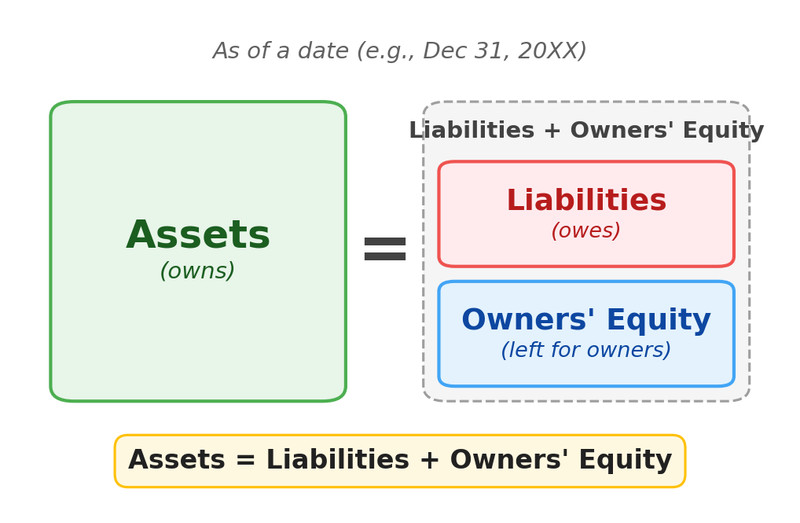
Balance sheet accounting equation
The diagram puts the whole statement into one view. Assets are what the business owns, and they must equal the claims against those assets from creditors and owners.
You should also know the rearranged forms:
“Balance” just means the equation works. It does not mean the business is healthy. A company can have a perfectly balanced balance sheet and still have:
- weak liquidity
- too much debt
- negative owners’ equity
This statement is always as of a date, like December 31 or the end of a quarter. That makes it different from:
- Income statement = performance over a period
- Cash flow statement = cash movement over a period
Comparative balance sheets often show the same date for multiple years or quarters so you can see changes in assets, debt, liquidity, and owners’ equity over time.
The Parts of a Balance Sheet
A balance sheet has three main sections. Everything you read on it fits into assets, liabilities, or owners’ equity.
Assets
Assets are items of value the business owns. They are grouped by liquidity, which means how easily something can be turned into cash.
Current assets
These are the most liquid assets and help fund day-to-day operations.
- Cash
- Short-term investments
- Accounts receivable = money customers owe the business
- Inventory = goods or materials the business plans to sell or use
A common trap is mixing up receivables and payables. Accounts receivable means others owe the business. Accounts payable means the business owes others.
Long-term assets
These are less liquid and usually held for extended use.
- Fixed assets
- physical assets used to operate the business
- examples include production plants, buildings, machinery, and equipment
- Long-term investments
- financial assets not expected to become cash soon
Intangible assets
These are nonphysical assets that still have value because they can help produce revenue.
- Patents
- Brand names
- Trademarks
Liabilities
Liabilities are debts and obligations the business owes. They are grouped by when payment is due.
Current liabilities
These must be paid within one year.
- Accounts payable = money owed to suppliers
- Short-term debt
- Current payments on long-term debt
- Accrued operating expenses = expenses already incurred but not yet paid
Long-term liabilities
These are due beyond one year.
- Mortgages
- Bank loans
- Long-term bonds
Owners’ equity
Owners’ equity is the owners’ net worth in the business.
It often includes:
- Stock = owner investment in exchange for ownership shares
- Retained earnings = cumulative profits kept in the business instead of paid out as dividends
Retained earnings are a big test point. They are not the same as a pile of cash. Those profits may now be tied up in inventory, equipment, or receivables.
Equity can be:
- positive when assets exceed liabilities
- zero when they are equal
- negative when liabilities exceed assets
How Balance Sheets Change and How to Read Them
Every transaction changes the balance sheet, but the equation still has to stay true.
- Bank loan
cash goes up, liabilities go up - Buy equipment with cash
cash goes down, equipment goes up - Pay accounts payable
cash goes down, liabilities go down - Owner invests capital for stock
assets go up, owners’ equity goes up - Profit kept in the business
retained earnings goes up, so owners’ equity goes up
When you read a balance sheet, move through it in this order:
- Check whether total assets = total liabilities + owners’ equity.
- See whether owners’ equity is positive, zero, or negative.
- Compare current assets to current liabilities.
- Look at the mix of assets. Cash is very different from buildings or patents.
- Compare with earlier years or quarters.
- Judge debt by comparing it to similar businesses, not in isolation.
Working capital
Working capital is one of the most useful numbers here.
What it tells you:
- Positive working capital = current assets exceed current liabilities
- Zero = no cushion
- Negative = possible trouble paying short-term obligations
Be careful here. Working capital is not the same as cash. Receivables still have to be collected, and inventory still has to be sold.
In a comparative balance sheet, this is the quick short-term liquidity check to look for first.
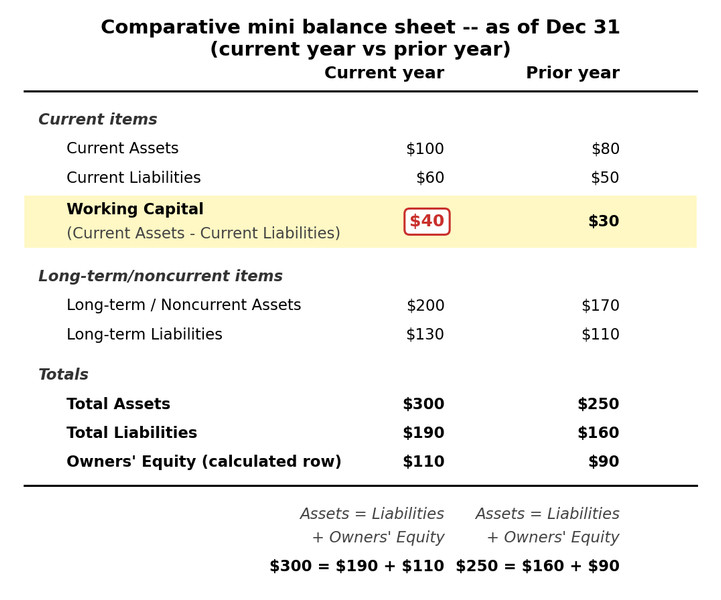
Comparative mini balance sheet with working capital
What the Balance Sheet Tells Stakeholders
Both internal stakeholders and external stakeholders use this statement.
- Internal
managers, owners - External
lenders, investors
They use it to answer questions like:
- Does the business have positive net worth?
- Can it likely fund day-to-day operations?
- Do current assets meet or exceed current liabilities?
- Is the debt level reasonable for similar firms?
- Is the financial condition getting better or worse over time?
A few interpretation ideas matter a lot on tests:
- Positive net worth does not guarantee liquidity.
- Good short-term liquidity does not erase heavy long-term debt risk.
- The balance sheet alone does not show whether the company was profitable this period.
- The balance sheet alone does not show whether cash flow was positive.
If a business cannot access enough current assets, especially cash, to keep operating, owners may shut it down or pursue bankruptcy. Bankruptcy is a legal process used to liquidate assets, eliminate or repay debts, shut down, or reorganize under legal supervision. Negative equity is a warning sign, but it does not automatically mean bankruptcy.
In DCH and DK Coffee Lab, Part 3, the balance sheet is used to determine the business’s value and assess whether it can fund day-to-day operations.
Personal Net Worth
The same idea applies to a household.
This is usually calculated for the household, not just one person, if finances are shared.
Household assets include:
- cash and savings
- investments and retirement accounts
- real estate
- vehicles
- personal possessions
Household liabilities include:
- mortgages
- auto loans
- student loans
- credit card debt
- other personal loans
Lenders may ask for net worth during a loan application. Households and financial planners also use it to track financial condition and think about retirement readiness.
Common mistakes:
- mixing up net worth with income or a monthly budget
- assuming positive net worth means lots of spendable cash
- double-counting home equity
list the full home value as an asset and the mortgage separately as a liability
Business owners’ equity and personal net worth are the same residual idea, assets minus liabilities, but they apply to different entities.
Key Takeaways
Balance Sheet
A financial statement showing a business’s assets, liabilities, and owners’ equity at a specific point in time
Balance Sheet Equation / Fundamental Accounting Equation
Assets = Liabilities + Owners’ Equity
Assets
Items of value owned by a business, grouped by liquidity into current, long-term, and intangible assets
Liquidity
The ease with which an asset can be converted into cash
Current Assets
Highly liquid assets used for day-to-day operations, including cash, short-term investments, accounts receivable, and inventory
Accounts Receivable
Money owed to a business by its customers; a current asset
Inventory
Goods or materials a business expects to sell or use in production; a current asset that must generally be sold to become cash
Long-Term Assets
Less-liquid assets a business expects to hold for an extended period, including fixed assets and long-term investments
Fixed Assets
Physical resources, such as buildings, plants, and equipment, used to operate a business rather than held for immediate sale
Long-Term Investments
Financial assets a business does not expect to convert into cash in the near term
Intangible Assets
Valuable nonphysical assets, such as patents, brand names, and trademarks, that can create potential revenue
Liabilities
Debts and other financial obligations owed by a business, grouped according to when payment is due
Current Liabilities
Obligations due within one year, including accounts payable, short-term debt, current payments on long-term debt, and accrued operating expenses
Accounts Payable
Money a business owes to suppliers; a current liability
Accrued Operating Expenses
Operating expenses a business has incurred but has not yet paid; a current liability
Long-Term Liabilities
Obligations due beyond one year, such as mortgages, bank loans, and long-term bonds
Owners’ Equity / Business Accounting Net Worth
The owners’ residual claim on a business, calculated as total assets − total liabilities
Stock
Ownership shares issued by a corporation; funds contributed for the shares increase owners’ investment in the business
Retained Earnings
A business’s cumulative profits that have not been distributed to owners as dividends
Working Capital
Current assets − current liabilities; it is positive when current assets exceed current liabilities
Bankruptcy
A legal process through which a business may liquidate assets, eliminate or repay debts, and shut down or reorganize under legal supervision
Personal Net Worth / Household Net Worth
Household assets − household liabilities; used to assess financial progress, loan applications, and retirement readiness
Notes
Balance Sheet
A financial statement showing a business’s assets, liabilities, and owners’ equity at a specific point in time
Balance Sheet Equation / Fundamental Accounting Equation
Assets = Liabilities + Owners’ Equity
Assets
Items of value owned by a business, grouped by liquidity into current, long-term, and intangible assets
Liquidity
The ease with which an asset can be converted into cash
Current Assets
Highly liquid assets used for day-to-day operations, including cash, short-term investments, accounts receivable, and inventory
Accounts Receivable
Money owed to a business by its customers; a current asset
Inventory
Goods or materials a business expects to sell or use in production; a current asset that must generally be sold to become cash
Long-Term Assets
Less-liquid assets a business expects to hold for an extended period, including fixed assets and long-term investments
Fixed Assets
Physical resources, such as buildings, plants, and equipment, used to operate a business rather than held for immediate sale
Long-Term Investments
Financial assets a business does not expect to convert into cash in the near term
Intangible Assets
Valuable nonphysical assets, such as patents, brand names, and trademarks, that can create potential revenue
Liabilities
Debts and other financial obligations owed by a business, grouped according to when payment is due
Current Liabilities
Obligations due within one year, including accounts payable, short-term debt, current payments on long-term debt, and accrued operating expenses
Accounts Payable
Money a business owes to suppliers; a current liability
Accrued Operating Expenses
Operating expenses a business has incurred but has not yet paid; a current liability
Long-Term Liabilities
Obligations due beyond one year, such as mortgages, bank loans, and long-term bonds
Owners’ Equity / Business Accounting Net Worth
The owners’ residual claim on a business, calculated as total assets − total liabilities
Stock
Ownership shares issued by a corporation; funds contributed for the shares increase owners’ investment in the business
Retained Earnings
A business’s cumulative profits that have not been distributed to owners as dividends
Working Capital
Current assets − current liabilities; it is positive when current assets exceed current liabilities
Bankruptcy
A legal process through which a business may liquidate assets, eliminate or repay debts, and shut down or reorganize under legal supervision
Personal Net Worth / Household Net Worth
Household assets − household liabilities; used to assess financial progress, loan applications, and retirement readiness
