Topic 2.1 Notes – Marketing to Customers
What Marketing to Customers Is
Marketing is all the activities a business uses to identify customers’ problems, needs, and wants and to promote, sell, and deliver products that address them.
That’s wider than advertising. Advertising is just one promotional tool. Marketing also includes understanding customers, choosing which customers to serve, shaping the product to fit them, communicating with them, delivering the product, and keeping the relationship going after the first sale.
A good way to picture the sequence is:
- Who are the potential customers?
- What do they need or want?
- Which customers should the business serve?
- What product or features fit them?
- How should the business reach them?
- How should it keep them after the first purchase?
One detail that gets tested a lot is customer vs. user.
- The customer is the person or organization that buys.
- The user is the person who actually uses the product.
- Sometimes they’re the same person.
- Sometimes they aren’t, like a parent buying for a child or a company buying software employees use.
That matters because marketers need to know whose decision drives the sale and whose needs the product must satisfy.
Customer data matters because it reduces uncertainty. It helps a business decide which customers to serve, which products or features to offer, and how to market in a profitable way instead of wasting money on people unlikely to buy.
Customer Data and How Businesses Collect It
Businesses collect lots of customer data, but two categories matter most here.
Demographics and psychographics
| Type | What it tells you | Main examples | Best use |
|---|---|---|---|
| Demographic | Who the customer is in measurable terms | age, sex, race, ethnicity, income, location | finding and reaching likely customers |
| Psychographic | What the customer cares about and how they live | interests, activities, values, lifestyles | explaining preferences and likely buying behavior |
Demographics might tell you who can buy. Psychographics often explain why they would want to.
How businesses gather data
- Subscriber lists
These can include names, emails, phone numbers, stated interests, and response history. They show interest, but a subscriber is not automatically a buyer. - Online accounts
These can store contact info, preferences, purchase history, saved items, and service requests. They help with personalization and repeat-purchase tracking. - Click-tracking software
This records page views, ad clicks, cart adds, and checkout abandonment. It shows behavior, but not definite motivation. A customer leaving checkout might be price-sensitive, distracted, or dealing with a glitch. - Tracking apps
These can track app use, purchases, device info, and geographic location. Location can help with convenience, but it raises privacy concerns. - Social media monitoring
Businesses watch posts, comments, reviews, mentions, and reactions to spot complaints, interests, and customer response. - Surveys and interviews
These give direct customer input about needs, wants, experiences, and satisfaction. - Purchased data from other businesses
A business can buy datasets about characteristics, interests, purchases, or behavior. Buying data does not remove responsibility for accuracy, ethics, or security.
The key idea here is simple. A business should collect relevant data, not just all available data. That leads right into segmentation.
Market Segmentation, Target Customers, and Customer Profiles
This is the core flow of the topic:
segment the market → choose the target customer → build a customer profile
Market segmentation
Market segmentation means grouping potential customers into market segments based on shared demographic and psychographic characteristics.
The point is to find groups with meaningful shared needs, wants, preferences, or buying likelihood.
A basic segmentation process looks like this:
- Define the broad market and the problem.
- Collect relevant customer data.
- Identify shared characteristics.
- Group customers into meaningful segments.
- Compare segment needs, buying likelihood, and profitability.
- Select one or more segments to target.
A segment has to be meaningful, not random. If the shared trait doesn’t help explain demand, it’s not useful segmentation.
Target customers
Target customers are the buyers most likely to purchase a specific product because of their wants, needs, and preferences.
A common trap is assuming the biggest segment is best. It isn’t always. A smaller segment with a stronger need and better fit can be more effective and less costly to serve than trying to appeal to everyone.
Targeting shapes later choices like branding, pricing, and advertising.
Customer profiles
A customer profile is a fictional description of a sample customer representing the target segment.
It should include:
- demographic data
- psychographic data
- wants, needs, and preferences
A profile makes the target feel concrete. It helps you test whether the business’s choices actually fit the intended buyer. It should be based on evidence, not stereotypes.
Token of Trust
Token of Trust shows why identifying the actual buying customer matters.
In identity verification, there may be:
- the organization buying the service
- the decision-maker inside that organization
- the individual being verified
Those are not the same person. Strong target-customer analysis identifies who has the urgent problem and the authority to buy.
Building Customer Relationships and Measuring Their Value
Marketing does not stop after the first sale. The goal becomes satisfaction, loyalty, repeat purchases, referrals, and feedback.
Main relationship tactics include:
- Personalized service
Recommendations, remembered preferences, useful reminders, and informed support. This should feel helpful, not intrusive. - Rewards programs
Points, discounts, free products, repeat-purchase benefits, and referral incentives. These only make sense if the extra loyalty is worth the cost. - Customer feedback opportunities
Surveys, reviews, interviews, service contact, and social media. Feedback matters most when the business actually responds and improves.
Social media and the internet make these tactics easier to use at scale and more quickly.
Two numbers show up a lot here.
Customer acquisition cost tells you what the business spends to gain a customer. The denominator is the total number of customers, not leads or website visits.
Customer lifetime value is the estimated amount a customer will spend over the relationship, often thought of as spending amount × purchase frequency × relationship length.
The quick comparison below puts those two measures side by side.
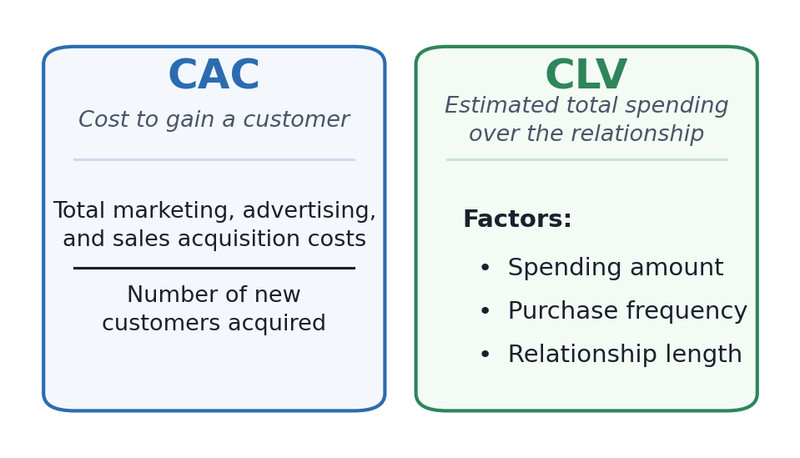
Strong relationships can lower CAC through referrals and raise CLV through loyalty and repeat purchases. Neither measure alone proves profitability.
Customer Data Risks and Responsible Use
Customer data can make people vulnerable to privacy infringement, identity theft, and fraud.
Data that can create risk includes:
- online searches
- purchases of goods and services
- credit card numbers
- social media posts
- geographic location
Privacy infringement happens when businesses collect or use data in ways customers do not know about or would not reasonably expect. Even ordinary facts can become sensitive when combined into a detailed profile.
Poor security can lead to data breaches, stolen accounts, unauthorized purchases, and financial or reputational harm.
The business also faces risk:
- loss of customers
- violation of core values
- harm to reputation
- costs from breaches and fraud
Responsible use means:
- collect only needed data
- be transparent about what is collected and why
- get appropriate permission
- limit access
- secure stored and transmitted data
- keep data only as long as needed
A good example is location tracking. A lunch app using your location to find a nearby pickup site makes sense. Constant background location tracking with little customer benefit creates much more risk and weak justification.
Key Takeaways
Marketing
All activities a business undertakes to identify customers’ problems, needs, and wants and to promote, sell, and deliver products that address them
Customer
The person or organization that buys a product, who may differ from the product’s user
Demographic Characteristics
Measurable qualities describing a population, such as age, sex, race, ethnicity, income, and location
Psychographic Characteristics
Cognitive and behavioral factors such as interests, activities, values, and lifestyles
Subscriber List
A record of people who expressed interest by subscribing, often including contact information, interests, and responses to messages
Online Accounts
Customer records that can connect contact information, preferences, purchases, saved products, and service interactions over time
Click-Tracking Software
Software that records digital actions such as page views, link selections, ad responses, cart additions, and checkout abandonment
Tracking Apps
Applications that record data such as app use, purchases, device information, and permitted geographic location
Social Media Monitoring
Observing posts, comments, reviews, mentions, and reactions to learn about customer opinions, interests, complaints, and preferences
Surveys vs. Interviews
Surveys gather responses from many people, while interviews obtain more detailed explanations from individuals
Purchased Customer Data
Customer lists or datasets bought from another business, often categorized by characteristics, interests, purchases, or online behavior
Market Segmentation
Aggregating potential customers into market segments based on shared demographic and psychographic characteristics
Market Segmentation Process
Define potential customers and their problem, collect data, identify shared characteristics, form meaningful segments, compare them, and select segments to target
Target Customers
The buyers most likely to purchase a particular product because of their wants, needs, and preferences
Customer Profile
A fictional, evidence-based description of a sample target customer incorporating demographic and psychographic data plus wants, needs, and preferences
Personalized Service
Adapting the customer experience to a customer’s known needs, preferences, history, or prior interactions
Rewards Program
A program that gives frequent buyers benefits such as points, discounts, free products, or special access for continued purchasing
Customer Feedback Opportunities
Ways to invite customer responses, such as satisfaction surveys, reviews, interviews, service contacts, and social media
Customer Acquisition Cost
Average cost to gain a new customer: marketing, advertising, and sales acquisition costs ÷ number of new customers acquired
Customer Lifetime Value
The estimated amount a unique customer will spend on the business’s products over time, often estimated as purchase amount × frequency × relationship duration
Customer-Relationship Plan
A plan connecting target customers’ needs to specific relationship-building tactics, evaluation measures, and responsible customer-data use
Privacy Infringement
Collecting, combining, sharing, or using personal information in ways customers do not know about or would not reasonably expect
Data Breach
Unauthorized access to or disclosure of stored data
Identity Theft
Using another person’s identifying information to impersonate that person, access accounts, open accounts, or conduct unauthorized transactions
Fraud
Intentional deception for financial or other gain, such as using stolen information for purchases or account takeovers
Notes
Marketing
All activities a business undertakes to identify customers’ problems, needs, and wants and to promote, sell, and deliver products that address them
Customer
The person or organization that buys a product, who may differ from the product’s user
Demographic Characteristics
Measurable qualities describing a population, such as age, sex, race, ethnicity, income, and location
Psychographic Characteristics
Cognitive and behavioral factors such as interests, activities, values, and lifestyles
Subscriber List
A record of people who expressed interest by subscribing, often including contact information, interests, and responses to messages
Online Accounts
Customer records that can connect contact information, preferences, purchases, saved products, and service interactions over time
Click-Tracking Software
Software that records digital actions such as page views, link selections, ad responses, cart additions, and checkout abandonment
Tracking Apps
Applications that record data such as app use, purchases, device information, and permitted geographic location
Social Media Monitoring
Observing posts, comments, reviews, mentions, and reactions to learn about customer opinions, interests, complaints, and preferences
Surveys vs. Interviews
Surveys gather responses from many people, while interviews obtain more detailed explanations from individuals
Purchased Customer Data
Customer lists or datasets bought from another business, often categorized by characteristics, interests, purchases, or online behavior
Market Segmentation
Aggregating potential customers into market segments based on shared demographic and psychographic characteristics
Market Segmentation Process
Define potential customers and their problem, collect data, identify shared characteristics, form meaningful segments, compare them, and select segments to target
Target Customers
The buyers most likely to purchase a particular product because of their wants, needs, and preferences
Customer Profile
A fictional, evidence-based description of a sample target customer incorporating demographic and psychographic data plus wants, needs, and preferences
Personalized Service
Adapting the customer experience to a customer’s known needs, preferences, history, or prior interactions
Rewards Program
A program that gives frequent buyers benefits such as points, discounts, free products, or special access for continued purchasing
Customer Feedback Opportunities
Ways to invite customer responses, such as satisfaction surveys, reviews, interviews, service contacts, and social media
Customer Acquisition Cost
Average cost to gain a new customer: marketing, advertising, and sales acquisition costs ÷ number of new customers acquired
Customer Lifetime Value
The estimated amount a unique customer will spend on the business’s products over time, often estimated as purchase amount × frequency × relationship duration
Customer-Relationship Plan
A plan connecting target customers’ needs to specific relationship-building tactics, evaluation measures, and responsible customer-data use
Privacy Infringement
Collecting, combining, sharing, or using personal information in ways customers do not know about or would not reasonably expect
Data Breach
Unauthorized access to or disclosure of stored data
Identity Theft
Using another person’s identifying information to impersonate that person, access accounts, open accounts, or conduct unauthorized transactions
Fraud
Intentional deception for financial or other gain, such as using stolen information for purchases or account takeovers
