Topic 4.1 Notes – Management and Leadership
What Management Is
Management means planning, organizing, leading, and evaluating how a business uses its human, financial, and physical resources to reach its goals and objectives.
A quick reminder on those last two terms:
- Goal = a broad desired result
- Objective = a more specific target or action tied to that goal
Management is bigger than just supervising workers. It includes decisions across the whole business.
The four functions
These four functions work together in a cycle rather than as isolated tasks.
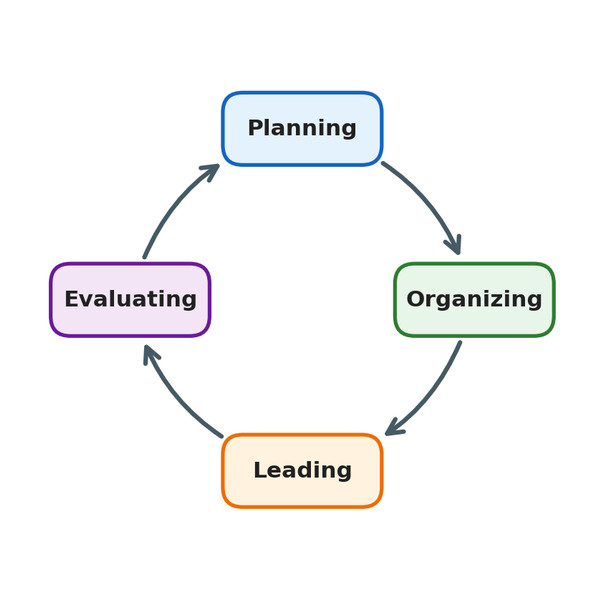
Management cycle
-
Planning
- Deciding what the business wants to achieve
- Figuring out actions, responsibilities, limits, and needed resources
-
Organizing
- Arranging people, money, equipment, schedules, and reporting relationships
- The three resource types matter here:
- Human resources = employee time, skills, experience, knowledge
- Financial resources = money for wages, supplies, and operations
- Physical resources = buildings, equipment, inventory, other tangible assets
-
Leading
- Giving direction
- Motivating people
- Building teams
- Solving conflict and supporting performance
-
Evaluating
- Comparing actual results to expected results
- Finding problems
- Giving feedback and making changes to plans, roles, or training
These are not four separate jobs. They work as a cycle. A manager checks results, updates the plan, reorganizes resources, and leads people through the change.
A simple example helps tie it together. If deliveries are late, an operations manager might revise routes (planning), assign drivers and timing (organizing), explain the change to workers (leading), and then track whether late deliveries drop (evaluating).
Management at Different Levels
Management happens throughout the business, not just at the top.
Executive or senior leaders
They work on the biggest and longest-term decisions.
- Set overall direction
- Make major resource-allocation choices
- Think about expansion, funding, and broad strategy
Department or functional managers
They turn broad goals into plans for one area.
- Coordinate specialized work
- Help departments support the whole business
- Common areas include marketing, finance, operations, sales, and customer service
Frontline managers and supervisors
They handle day-to-day work.
- Assign tasks
- Coach employees
- Solve immediate problems
- Pass information up and down the business
All three levels use the same four functions, but the scope changes. An executive may plan a new region launch. A department manager may plan staffing and schedules. A supervisor may plan this week’s workflow.
Managers also keep departments aligned with the company’s vision and mission.
- Vision = the future the business wants to create
- Mission = the business’s core purpose and whom it serves
That alignment shows up a lot in questions. A good manager connects daily work to the larger direction of the business.
Leadership and Business Communication
Management is coordinating work and resources. Leadership is influencing, guiding, and motivating people toward goals. They overlap, but they are not the same thing. Someone can show leadership without having a manager title.
Leadership skills
-
Articulating vision and mission
- People work better when they understand how their job supports the business purpose.
-
Building productive teams
- Strong teams need the right mix of competencies, clear roles, and shared goals.
-
Negotiating conflict
- Conflict may be about schedules, resources, methods, priorities, or rewards.
- A strong process looks like this:
- identify the real interests and constraints
- listen to both sides
- connect the issue to business goals
- develop workable alternatives
- reach a clear agreement
-
Motivating people
- Motivation improves productivity, retention, and relationships with customers and coworkers.
- Common motivators include pay, incentives, autonomy, recognition, development, flexibility, fair treatment, and culture.
Communication skills
Managers and leaders communicate with many stakeholders, including supervisors, colleagues, employees, lenders, investors, customers, and the public.
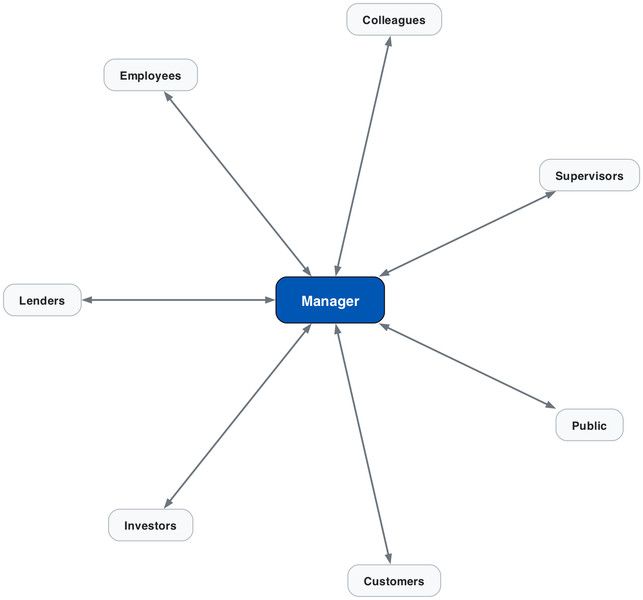
Manager communication with stakeholders
The communication skills you need to know:
- Expressing ideas clearly
State the purpose, action, responsibility, and timing without confusion. - Communicating persuasively
Support recommendations with reasons and evidence. Address risks and objections honestly. - Listening empathetically
Understand both the facts and the speaker’s point of view. Ask questions before reacting. - Interpreting and responding to feedback
Pull out the useful information, even if the tone is rough. Then decide whether to change, explain, investigate, or follow up.
Hiring, Developing, and Using Employee Talent
Businesses need employees to handle day-to-day work such as:
- producing goods or providing services
- marketing
- sales
- finance
- customer support
- operations and technology
Different jobs need different skills and backgrounds. One easy mistake is mixing up employee competency and business core competency.
- Employee competency = a person’s skill or knowledge
- Business core competency = something the company does especially well
How businesses get needed capabilities
-
Hire
- Best when needed skills are missing inside the business or would take too long to build
-
Develop current employees
- Training can include:
- postsecondary education
- apprentice programs
- on-the-job training
- online training
- continuing education
- Training can include:
-
Outsource
- Use outside providers for some work, especially tasks outside the firm’s core competencies or normal operations
- Managers still have to weigh cost, quality, reliability, control, confidentiality, and customer impact
A practical staffing sequence is:
- identify the work
- identify needed competencies
- compare with current capabilities
- find the gap
- choose hiring, development, reassignment, or outsourcing
If employees lack skill or training, the chain can go bad fast. Errors or poor service lead to unhappy customers, complaints, returns, reputation damage, lost revenue, and higher costs.
Assort Health and Canva
-
Assort Health
- Needs AI and software talent, plus understanding of health care workflows, implementation, reliability, and customer communication
-
Canva
- Needs engineering, design, product, marketing, sales, support, and varied user perspectives
- Shows why managers must coordinate specialized talent around one shared mission
Compensation, Motivation, and Retention
Businesses use different employment arrangements:
- Full-time = regular ongoing work
- Part-time = fewer hours
- Temporary = limited-time, seasonal, project, or coverage need
- Contract = specified work or specialized project-based services
Compensation methods
You also need to know:
- Annual salary = fixed yearly pay
- Commission = percentage of sales or transactions
- Piece rate pay = pay per unit completed
- Profit sharing = employees receive part of business profit
Compensation depends on:
- industry and role
- education, skills, experience, productivity
- legal rules such as minimum wage
- labor market scarcity
- rival employers’ offers
- the business’s ability to pay
- the behavior the pay system is meant to encourage
Benefits and retention
Benefits are part of total compensation:
- health insurance contributions
- retirement plan contributions
- health savings plans
- disability insurance
- educational reimbursement
- paid time off
Businesses motivate and retain strong employees with:
- financial and career incentives such as raises, promotions, and bonuses
- nonfinancial motivators such as autonomy, flexible work hours or locations, flexible scheduling, recognition, positive culture, and growth opportunities
Retention matters because keeping strong employees is usually cheaper than replacing them. Turnover costs include recruiting, onboarding, lost productivity, disruption to teams and customers, and loss of business-specific knowledge.
The best systems line up compensation, incentives, communication, training, and job design with the performance the business actually wants.
Key Takeaways
Management
The process of planning, organizing, leading, and evaluating a business’s use of resources to meet its goals and objectives
Planning
Determining the goals to pursue and the actions, responsibilities, constraints, and resources needed to achieve them
Organizing
Assigning responsibilities and arranging human, financial, and physical resources to carry out a plan
Leading (Management Function)
Communicating direction, motivating people, building teams, and resolving conflict so employees can perform effectively
Evaluating
Comparing actual performance and resource use with expectations, diagnosing gaps, and using the results to improve future plans
Executive or Senior Leader
A manager who establishes overall direction, makes major resource decisions, and coordinates the business as a whole
Department or Functional Manager
A manager who translates broad goals into plans for a specialized area and coordinates its work with the rest of the business
Frontline Manager or Supervisor
A manager who oversees day-to-day work by assigning tasks, coaching employees, addressing problems, and communicating standards
Leadership
Influencing, guiding, and motivating people to work toward shared business goals
Articulating Vision and Mission
Explaining how employees’ decisions, roles, and standards contribute to the business’s future direction and fundamental purpose
Building Productive Teams
Combining needed competencies, clarifying roles, coordinating interdependent work, and focusing members on a common result
Negotiating Conflict
Identifying parties’ interests and constraints, developing feasible alternatives, and reaching a clear agreement that supports shared goals
Motivation
The willingness to direct effort toward a result
Effective Business Communication
Accurate, audience-appropriate expression, listening, interpretation, and feedback that allow a recipient to understand and respond appropriately
Expressing Ideas Clearly
Stating the purpose, relevant information, requested action, responsibility, and timing in audience-appropriate language without avoidable ambiguity
Persuasive Business Communication
Making a claim or recommendation supported by audience-relevant reasons and evidence while addressing major costs, risks, or objections
Empathetic Listening
Seeking to understand both a message’s substance and the speaker’s perspective by attending, clarifying, and checking understanding before responding
Interpreting and Responding to Feedback
Separating feedback’s factual content from its tone, seeking needed clarification, and responding constructively through action or explanation
Employee Competency
An ability, skill, or body of knowledge that enables a person to perform work effectively
Organizational Core Competency
A capability the business performs especially well that contributes to its value or competitive advantage
Employee Development
Building employees’ capabilities after hiring to prepare them for changing work, new technology, or advancement
Employee Training
Learning that develops the knowledge and skills employees need to perform their work effectively
Apprentice Program
Training that combines structured instruction with supervised practical experience
On-the-Job Training
Training conducted while an employee performs or observes actual work
Continuing Education
Education or training that updates or expands an employee’s skills and knowledge over time
Outsourcing
Obtaining work from an outside provider rather than performing it with the business’s own employees
Business Viability
A business’s ability to continue operating and competing successfully
Full-Time Employee
An employee who works the business’s regular full-time schedule, usually on continuing and predictable responsibilities
Part-Time Employee
An employee who works fewer hours than the business’s full-time schedule
Temporary Employee
An employee hired for a limited period or purpose, such as seasonal demand, a short project, or absence coverage
Contract Worker
A worker engaged under a contract to provide specified work or services, often for a specialized or project-based need
Compensation
What employees receive in exchange for their work, including direct pay and possible benefits
Hourly Wage
Pay based on time worked, calculated as hours worked × wage rate
Annual Salary
A stated amount of pay for a year, commonly distributed across regular pay periods
Commission
Pay based on sales or another transaction measure, calculated as the qualifying amount × commission rate
Piece Rate Pay
Pay based on the number of qualifying units completed, calculated as units × rate per unit
Profit Sharing
A plan that distributes part of the business’s profit to eligible employees
Benefits
Nonwage compensation such as employer health-insurance or retirement contributions, disability insurance, educational reimbursement, and paid time off
Total Compensation
The combined value of an employee’s direct pay and benefits
Incentive
A link between a desired behavior or result and a reward
Raise
An increase in an employee’s ongoing rate of pay
Promotion
Movement into a role with greater responsibility, status, or opportunity, often with higher compensation
Bonus
Additional compensation tied to a result, milestone, or performance period that does not necessarily become part of regular base pay
Employee Retention
A business’s ability to keep capable, productive employees
Notes
Management
The process of planning, organizing, leading, and evaluating a business’s use of resources to meet its goals and objectives
Planning
Determining the goals to pursue and the actions, responsibilities, constraints, and resources needed to achieve them
Organizing
Assigning responsibilities and arranging human, financial, and physical resources to carry out a plan
Leading (Management Function)
Communicating direction, motivating people, building teams, and resolving conflict so employees can perform effectively
Evaluating
Comparing actual performance and resource use with expectations, diagnosing gaps, and using the results to improve future plans
Executive or Senior Leader
A manager who establishes overall direction, makes major resource decisions, and coordinates the business as a whole
Department or Functional Manager
A manager who translates broad goals into plans for a specialized area and coordinates its work with the rest of the business
Frontline Manager or Supervisor
A manager who oversees day-to-day work by assigning tasks, coaching employees, addressing problems, and communicating standards
Leadership
Influencing, guiding, and motivating people to work toward shared business goals
Articulating Vision and Mission
Explaining how employees’ decisions, roles, and standards contribute to the business’s future direction and fundamental purpose
Building Productive Teams
Combining needed competencies, clarifying roles, coordinating interdependent work, and focusing members on a common result
Negotiating Conflict
Identifying parties’ interests and constraints, developing feasible alternatives, and reaching a clear agreement that supports shared goals
Motivation
The willingness to direct effort toward a result
Effective Business Communication
Accurate, audience-appropriate expression, listening, interpretation, and feedback that allow a recipient to understand and respond appropriately
Expressing Ideas Clearly
Stating the purpose, relevant information, requested action, responsibility, and timing in audience-appropriate language without avoidable ambiguity
Persuasive Business Communication
Making a claim or recommendation supported by audience-relevant reasons and evidence while addressing major costs, risks, or objections
Empathetic Listening
Seeking to understand both a message’s substance and the speaker’s perspective by attending, clarifying, and checking understanding before responding
Interpreting and Responding to Feedback
Separating feedback’s factual content from its tone, seeking needed clarification, and responding constructively through action or explanation
Employee Competency
An ability, skill, or body of knowledge that enables a person to perform work effectively
Organizational Core Competency
A capability the business performs especially well that contributes to its value or competitive advantage
Employee Development
Building employees’ capabilities after hiring to prepare them for changing work, new technology, or advancement
Employee Training
Learning that develops the knowledge and skills employees need to perform their work effectively
Apprentice Program
Training that combines structured instruction with supervised practical experience
On-the-Job Training
Training conducted while an employee performs or observes actual work
Continuing Education
Education or training that updates or expands an employee’s skills and knowledge over time
Outsourcing
Obtaining work from an outside provider rather than performing it with the business’s own employees
Business Viability
A business’s ability to continue operating and competing successfully
Full-Time Employee
An employee who works the business’s regular full-time schedule, usually on continuing and predictable responsibilities
Part-Time Employee
An employee who works fewer hours than the business’s full-time schedule
Temporary Employee
An employee hired for a limited period or purpose, such as seasonal demand, a short project, or absence coverage
Contract Worker
A worker engaged under a contract to provide specified work or services, often for a specialized or project-based need
Compensation
What employees receive in exchange for their work, including direct pay and possible benefits
Hourly Wage
Pay based on time worked, calculated as hours worked × wage rate
Annual Salary
A stated amount of pay for a year, commonly distributed across regular pay periods
Commission
Pay based on sales or another transaction measure, calculated as the qualifying amount × commission rate
Piece Rate Pay
Pay based on the number of qualifying units completed, calculated as units × rate per unit
Profit Sharing
A plan that distributes part of the business’s profit to eligible employees
Benefits
Nonwage compensation such as employer health-insurance or retirement contributions, disability insurance, educational reimbursement, and paid time off
Total Compensation
The combined value of an employee’s direct pay and benefits
Incentive
A link between a desired behavior or result and a reward
Raise
An increase in an employee’s ongoing rate of pay
Promotion
Movement into a role with greater responsibility, status, or opportunity, often with higher compensation
Bonus
Additional compensation tied to a result, milestone, or performance period that does not necessarily become part of regular base pay
Employee Retention
A business’s ability to keep capable, productive employees
