Topic 2.5 Notes – Price
What Price Is
Price is the amount a business charges for a good or service. A pricing strategy is the method a business uses to decide that price.
Price sits inside the larger marketing picture. It has to fit the target customer, the value proposition (why the customer should buy), and the business’s competitive position.
Why price matters so much:
- It affects whether customers buy at all.
- It shapes perceived quality, status, and value. A high price can make something feel premium. A very low price can make customers question quality.
- It affects sales volume and market share.
- It determines revenue and helps determine profit.
- It influences whether the business can attract new customers and keep existing ones.
The main tradeoff is simple:
- Higher price = more money per unit, but maybe fewer sales
- Lower price = more sales and maybe more market share, but less profit per unit
So the best price is the one that fits the business goal and can actually last over time.
Price, Cost, Revenue, and Profit
A business has to think about per-unit cost, which means the cost to produce and distribute one unit.
Two relationships matter constantly here:
If a product sells for $45 and costs $28 per unit, then per-unit profit is $17.
That leads to a few testable ideas:
- If price > per-unit cost, each sale adds something above direct cost.
- If price = per-unit cost, there is no per-unit profit.
- If price < per-unit cost, the business loses money on each unit unless it is doing that on purpose for a short-term strategy such as penetration pricing.
One easy mistake is mixing up revenue and profit.
- Revenue is total sales money coming in.
- Profit is what remains after costs.
This chart makes the revenue side clear. Changing price changes quantity sold, so the highest price does not automatically produce the highest revenue.
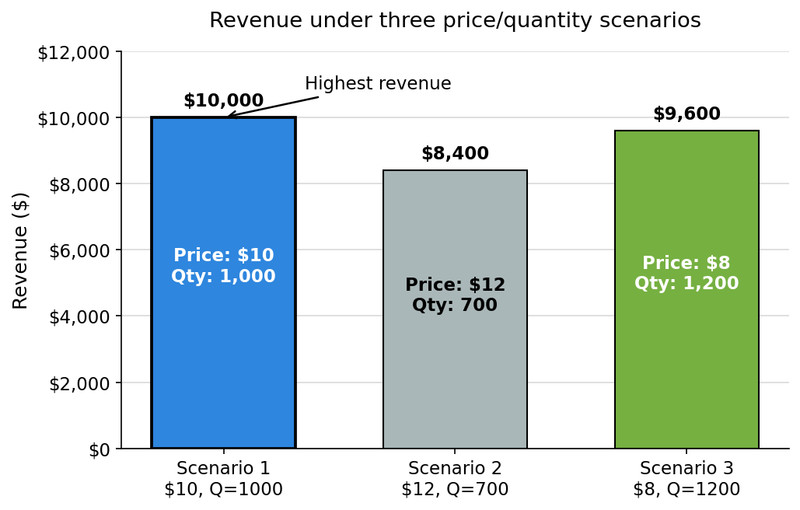
Revenue under three price and quantity scenarios
This is where quiz questions like to trap you. A higher price does not guarantee higher revenue. A lower price does not guarantee higher revenue or higher profit.
Quick examples:
- Raise price and sales drop a lot → revenue can fall.
- Cut price and sales rise only a little → revenue may still fall.
- Cut price and revenue rises → profit may still fall because the margin got smaller.
When you evaluate any price change, check both the change in quantity sold and the change in per-unit profit.
The Four Pricing Strategies
These four strategies are the ones you need to know by name.
Value-based pricing
With value-based pricing, the business sets price based on the product’s perceived value to the customer.
This works best when the product is highly differentiated or uniquely useful. Customers pay more because they think it is worth more.
Sources of perceived value include:
- quality or functionality
- convenience or time savings
- design
- brand or status
- personalization
- scarcity
- solving a problem especially well
The upside is premium pricing and high per-unit profit. The risk is overestimating what customers will actually pay.
Competitive pricing
With competitive pricing, the business sets price mainly in relation to rival prices.
Common versions:
- match competitors
- price below competitors to gain share
- price above competitors if the product deserves a premium
This is common when products are similar and easy to compare. It keeps price realistic for the market, but it can squeeze profit and create price wars.
Cost-based pricing
With cost-based pricing, the business starts with per-unit cost and adds the desired profit.
This is common when costs are clear and easy to explain.
- Construction contractors are a classic example because labor, materials, permits, and project costs can be estimated clearly.
Its strength is that it helps ensure the price covers cost and includes target profit. Its weakness is that it may ignore customer value and competitor prices.
Penetration pricing
With penetration pricing, the business sets a low introductory price, sometimes even below per-unit cost, to gain customers and market share quickly. The plan is to raise the price later.
This works best when:
- customers are price-sensitive
- the business wants fast adoption
- the business can handle lower short-term profit or losses
Sega used lower pricing and a Sonic bundle to make the Genesis more attractive against Nintendo. That shows pricing can be used to grow market share and platform adoption, not just immediate profit.
The risk is that customers may leave when the price rises, low price may hurt perceived value, and competitors may respond with lower prices too.
Pricing Power and Market Conditions
Pricing power means the ability to raise prices without losing too much market share.
A business has more pricing power when:
- products are differentiated
- customers see unique value
- brand loyalty is strong
- few close substitutes exist
- the market is less competitive
- customers are less price-sensitive
A business has less pricing power when:
- many rivals sell similar products
- switching is easy
- prices are easy to compare
- products feel interchangeable
- customers are highly price-sensitive
Customer responsiveness and elasticity
Price elasticity of demand means how strongly customers respond to price changes.
You do not have to calculate elasticity on this AP exam. You do need to interpret it.
- More elastic demand means customers respond a lot to price changes. A price increase can cause a big drop in sales, so pricing power is weaker.
- More inelastic demand means customers respond less. A business can often raise price with less damage to sales, so pricing power is stronger.
This side-by-side example helps you connect elasticity to what happens after the same price increase.
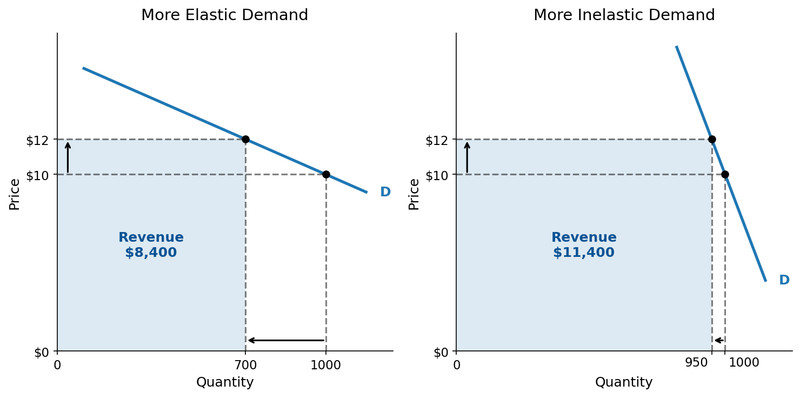
On the exam, connect elasticity to sales, revenue, and pricing power. Don’t stop at “people buy less when price rises.” In the figure, both businesses raise price from $10 to $12, but the more elastic product loses far more unit sales. The more inelastic product keeps most of its sales, which is why revenue holds up better and pricing power is stronger.
Choosing and Checking a Pricing Strategy
How to evaluate a pricing decision
A strong pricing judgment usually follows this order:
- Identify the goal such as profit, premium positioning, market entry, market share, retention, or response to competition.
- Find the per-unit cost.
- Estimate what customers think the product is worth.
- Compare competitor prices and product differences.
- Judge pricing power by looking at competition and customer responsiveness.
- Choose the strategy that fits best.
- Predict the effects on quantity sold, revenue, per-unit profit, market share, and sustainability.
Legal limits on pricing
A business cannot just charge whatever it wants in any way it wants.
- Price collusion means competitors agree on a price. That is illegal in the U.S. and many countries.
- Price gouging means sharply raising prices during a crisis, especially for necessities. That is illegal in many states and countries.
- Price discrimination means charging different prices to different customer segments. It becomes illegal when it is based on a protected status such as race, nationality, or sex.
A detail students miss here is that different prices are not automatically illegal. The legal issue is why the prices are different.
Common mistakes to avoid
- assuming the lowest price is best
- assuming the highest price is best
- confusing revenue with profit
- naming a strategy without tying it to the goal, customer value, competition, cost, and legal limits
Key Takeaways
Pricing Strategy
A way of determining how much to charge for a product
Per-Unit Cost
The costs attributed to producing and distributing one unit of a good or service
Per-Unit Profit
Price minus per-unit cost: per-unit profit = price − per-unit cost
Sales Revenue
The amount received from sales: revenue = price × quantity sold
Value-Based Pricing
Setting price primarily according to the product’s perceived value or worth to the customer
Competitive Pricing
Setting price primarily in relation to rival products’ prices, whether at, below, or above them
Cost-Based Pricing
Setting price by adding the desired per-unit profit to per-unit cost: price = per-unit cost + desired per-unit profit
Penetration Pricing
Using a low initial price, possibly below per-unit cost, to gain customers and market share quickly with the intention of raising it later
Pricing Power
A business’s ability to raise prices without risking a substantial loss of market share
Price Elasticity of Demand
How responsive the quantity customers buy is to a change in price
Elastic Demand vs. Inelastic Demand
Elastic demand is relatively responsive to price changes; inelastic demand is relatively unresponsive to them
Price Collusion
An agreement among competitors to set prices rather than make independent pricing decisions; illegal in the U.S. and many other countries
Price Gouging
Sharply raising a product’s price when its demand has increased because of a crisis, a practice illegal in many jurisdictions
Price Discrimination
Charging different customer segments different prices for the same product; it is illegal when based on protected status
Notes
Pricing Strategy
A way of determining how much to charge for a product
Per-Unit Cost
The costs attributed to producing and distributing one unit of a good or service
Per-Unit Profit
Price minus per-unit cost: per-unit profit = price − per-unit cost
Sales Revenue
The amount received from sales: revenue = price × quantity sold
Value-Based Pricing
Setting price primarily according to the product’s perceived value or worth to the customer
Competitive Pricing
Setting price primarily in relation to rival products’ prices, whether at, below, or above them
Cost-Based Pricing
Setting price by adding the desired per-unit profit to per-unit cost: price = per-unit cost + desired per-unit profit
Penetration Pricing
Using a low initial price, possibly below per-unit cost, to gain customers and market share quickly with the intention of raising it later
Pricing Power
A business’s ability to raise prices without risking a substantial loss of market share
Price Elasticity of Demand
How responsive the quantity customers buy is to a change in price
Elastic Demand vs. Inelastic Demand
Elastic demand is relatively responsive to price changes; inelastic demand is relatively unresponsive to them
Price Collusion
An agreement among competitors to set prices rather than make independent pricing decisions; illegal in the U.S. and many other countries
Price Gouging
Sharply raising a product’s price when its demand has increased because of a crisis, a practice illegal in many jurisdictions
Price Discrimination
Charging different customer segments different prices for the same product; it is illegal when based on protected status
