Topic 3.2 Notes – Borrowing, Credit, and Debt
What Borrowing and Credit Are
When you borrow, you get money now and promise to repay it later. What you still owe is debt, and for you that debt is a liability. A liability is something you owe.
A few terms belong together:
- Principal means the amount borrowed.
- Interest means the price of using someone else’s money.
- Repayment terms mean the rules for paying back principal, interest, and any fees.
- APR means annual percentage rate, a standard yearly measure of borrowing cost.
- Finance charge means the total dollar cost of credit shown in disclosures.
People borrow for a few common reasons:
- Big purchases that cost more than current income or savings, like a car, house, or college tuition
- Emergencies
- Keeping savings or an emergency fund intact
- Convenience, especially with credit cards or pay-later bills
The core tradeoff is simple. Borrowing gives you more purchasing power now, but it uses up future income because that future income has to go toward payments. Debt does not make you richer. It moves spending across time.
Lenders make loans because they expect to get back the principal plus interest and fees. Banks and credit unions use money deposited by individual savers, businesses, and other entities to make loans to consumers and to businesses, nonprofits, and government entities. Interest pays lenders for waiting, handling the loan, and taking on default risk, which is the risk that the borrower will not repay.
Sources and Types of Consumer Credit
Consumers can borrow from many places:
- Commercial banks
- Credit unions
- Credit card companies or issuers
- Retail stores with store cards or financing
- Mortgage lenders
- Automobile lenders
- Student loan providers
- Personal loan companies
- Alternative financial services, including payday loans, check-cashing services, instant tax refunds, and tax-refund advances / refund-anticipation products
Main forms of credit
Installment credit gives you a fixed amount and you repay it in scheduled payments over time.
- Examples include auto loans, mortgages, student loans, and many personal loans.
- The big pattern is tested a lot. A longer term usually means a lower monthly payment, but also more total interest.
Revolving credit lets you borrow up to a limit, repay, and borrow again.
- Main example is a credit card.
- Statement items matter. Know balance, due date, minimum payment, interest, and fees.
- Paying only the minimum keeps you in debt longer and usually costs much more in interest.
Open or service credit means you receive the service first and pay later.
- Examples include utility bills and telecommunications bills.
Secured and unsecured credit
Secured loans use collateral, which is property the lender can take if you default.
- Examples are car loans and mortgages.
- These often have lower interest rates because lender risk is lower.
- Your risk is losing the asset through repossession or foreclosure.
Unsecured loans do not use specific collateral.
- Examples are credit card debt and many personal loans.
- These usually have higher rates because the lender has less protection.
Comparing loan offers
You need to compare more than the payment. Look at:
- APR
- Fees
- Term
- Monthly payment
- Total of payments
- Collateral
- Penalties
A common trap is choosing the lowest monthly payment. A 60-month car loan can cost less overall than a 72-month car loan, even if the 72-month loan feels easier month to month.
Down payments matter here too.
- They reduce the amount financed.
- They lower monthly payments and total interest.
- They may help you qualify for better terms.
- They also use cash you could have kept in savings.
How Lenders Judge Creditworthiness
Creditworthiness means how likely a lender thinks you are to repay. Default means failing to repay as agreed.
Lenders want lower-risk borrowers because default can cost them both principal and interest. They usually evaluate several things together:
- Income
- Employment stability
- Savings or assets
- Existing debt
- Loan amount requested
- Collateral
- Past repayment history
- Credit report and credit score
Credit reports
A credit report is created by credit bureaus or credit reporting agencies. It grows from your interactions with financial institutions.
Report-generating interactions include:
- opening a savings account
- securing a bank loan
- applying for a credit card
- making a payment
Reports usually include:
- identifying information
- current and past accounts
- balances and credit limits
- payment history
- delinquencies, defaults, and collections
- inquiries
Credit scores
A credit score is a numerical summary of credit risk based on report information. Reports and score information may be shared with:
- potential lenders
- potential employers
- potential landlords
- insurance companies
- government agencies
Actions that tend to improve your score:
- Paying bills on time
- Paying down debt
- Keeping credit card balances low
- Limiting unnecessary new credit use and applications
Students often miss this point. High credit card balances can hurt your score even before you miss a payment. Many higher-risk borrowers, including frequent users of alternative financial services, end up paying higher interest rates.
Managing Debt and Choosing Better Credit
Debt affects your financial condition because payments take money away from other uses.
- Less room for saving
- Less room for regular expenses
- Higher balances and rates mean higher required payments
- Too much debt can hurt net worth and future borrowing ability
Repayment problems often come from:
- Loss of income
- Emergency expenses
- Rising living costs
- Variable rates increasing
- Too much borrowing
- Payments that are simply too high
Strong debt-management strategy
- List every debt with its balance, interest rate, fee, due date, and whether it is secured.
- Make at least the required payment on all debts.
- Avoid new unnecessary borrowing.
- Put extra money toward high-interest debt first, especially credit card debt.
- Compare lenders if refinancing could lower costs.
- Contact lenders early if trouble is coming.
- Maintain a high credit score so you can qualify for better loan terms and reduce the impact of debt on your finances.
Refinancing or consolidation can help lower rates, lower fees, or simplify payments. A lower monthly payment is only better if the total deal is better too. A longer term or high fees can make the new loan more expensive overall.
A major caution that shows up in scenarios is using home equity to pay off credit cards. That can turn unsecured debt into debt secured by your home.
Consequences of Debt and Consumer Protections
If debt becomes unmanageable, consequences can include:
- late fees
- credit score damage
- collections
- judgments
- property seizures
- repossession
- foreclosure
Help can come from:
- debt-management assistance
- nonprofit credit counseling
- hardship arrangements with lenders
- bankruptcy
Bankruptcy is a legal process that can erase some debts and create repayment plans for others. It is a last-resort option because it can harm future credit access for years.
Consumer protection laws show up as names you should recognize:
- Truth in Lending Act
Requires clear disclosure of terms like APR, finance charge, and payment information. - Equal Credit Opportunity Act
Prohibits discriminatory lending. - Fair Credit Reporting Act
Governs accuracy, access, and use of credit report information. - Fair Debt Collection Practices Act
Limits abusive, deceptive, and unfair collection tactics.
A credit card disclosure box is a good example of Truth in Lending in practice. It puts key borrowing costs and fees in one standardized place so consumers can compare offers quickly.
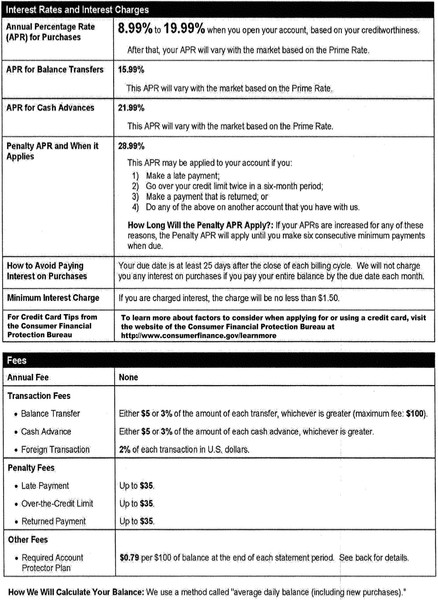
Sample credit card disclosure box
The whole topic comes together in one idea. Credit can be useful, but a smart borrowing decision weighs the purpose of the loan, total cost, risk, ability to repay, and long-term effect on your finances.
Key Takeaways
Loan
Money borrowed and repaid under agreed terms, ordinarily with interest and any applicable fees
Debt
The amount still owed to a lender; a personal liability requiring future payments
Principal
The original amount of money borrowed
Interest
The price paid for using a lender’s money
Interest Rate
The rate charged for the use of borrowed money
Repayment Terms
The conditions establishing how and when principal, interest, and fees must be paid
Credit
The ability to receive money, goods, or services now under an agreement to pay later
Installment Credit
A specific amount borrowed and repaid through scheduled payments over a set term
Revolving Credit
Credit that permits repeated borrowing up to a limit, with payments restoring available credit
Open or Service Credit
An arrangement in which a consumer receives a service before the related bill is due
Secured Loan
A loan backed by an asset the lender may claim if the borrower defaults, usually resulting in a lower interest rate
Unsecured Loan
A loan not backed by specific collateral, generally carrying a higher interest rate because lender recovery is less certain
Annual Percentage Rate (APR)
A standardized annual measure used to communicate and compare the cost of credit
Finance Charge
The dollar cost of credit identified in required lending disclosures
Down Payment
Income or savings used to pay part of a major purchase at purchase, reducing the amount financed
Alternative Financial Services
Nontraditional financial providers or products offering services or fast credit, often at high fees or interest rates
Payday Loan
A small, high-cost, short-term loan expected to be repaid from the borrower’s next paycheck
Tax-Refund Advance or Refund-Anticipation Product
A product providing early access to an expected tax refund in exchange for fees or other charges
Default
Failure to meet the repayment obligations in a credit agreement
Creditworthiness
A lender’s assessment of how likely a potential borrower is to repay as agreed
Credit Report
A record of a consumer’s credit accounts, balances, payment history, inquiries, and related information compiled by a credit bureau
Credit Bureau or Credit Reporting Agency
An organization that collects consumer credit information and compiles credit reports
Credit Score
A numerical estimate of credit risk based on information about a consumer’s past use and repayment of credit
Credit Utilization
The percentage of available revolving credit currently being used
Highest-Interest-First Debt Repayment
Make required payments on every debt and direct extra money to the highest-interest debt, then repeat with the next-highest rate
Refinancing
Replacing an existing loan with a new loan, potentially to obtain a better rate, fee structure, or payment schedule
Debt Consolidation
Combining multiple debts into one new obligation
Debt-Management Plan
An arrangement in which a consumer makes one payment to a counseling organization that distributes funds to creditors under agreed terms
Bankruptcy
A legal process that may discharge some debts and establish a supervised repayment plan for others
Truth in Lending Act
A law requiring covered lenders to disclose important credit costs and terms in a standardized form
Equal Credit Opportunity Act
A law prohibiting creditors from discriminating in credit decisions on legally protected grounds
Fair Credit Reporting Act
A law governing the collection, accuracy, access, use, and permitted sharing of consumer credit information
Fair Debt Collection Practices Act
A law restricting abusive, deceptive, and unfair conduct by covered third-party debt collectors
Fixed-Rate Loan
A loan whose interest rate ordinarily remains unchanged for the stated term
Variable-Rate Loan
A loan whose interest rate, and potentially its payment, can change according to the contract and an underlying benchmark
Notes
Loan
Money borrowed and repaid under agreed terms, ordinarily with interest and any applicable fees
Debt
The amount still owed to a lender; a personal liability requiring future payments
Principal
The original amount of money borrowed
Interest
The price paid for using a lender’s money
Interest Rate
The rate charged for the use of borrowed money
Repayment Terms
The conditions establishing how and when principal, interest, and fees must be paid
Credit
The ability to receive money, goods, or services now under an agreement to pay later
Installment Credit
A specific amount borrowed and repaid through scheduled payments over a set term
Revolving Credit
Credit that permits repeated borrowing up to a limit, with payments restoring available credit
Open or Service Credit
An arrangement in which a consumer receives a service before the related bill is due
Secured Loan
A loan backed by an asset the lender may claim if the borrower defaults, usually resulting in a lower interest rate
Unsecured Loan
A loan not backed by specific collateral, generally carrying a higher interest rate because lender recovery is less certain
Annual Percentage Rate (APR)
A standardized annual measure used to communicate and compare the cost of credit
Finance Charge
The dollar cost of credit identified in required lending disclosures
Down Payment
Income or savings used to pay part of a major purchase at purchase, reducing the amount financed
Alternative Financial Services
Nontraditional financial providers or products offering services or fast credit, often at high fees or interest rates
Payday Loan
A small, high-cost, short-term loan expected to be repaid from the borrower’s next paycheck
Tax-Refund Advance or Refund-Anticipation Product
A product providing early access to an expected tax refund in exchange for fees or other charges
Default
Failure to meet the repayment obligations in a credit agreement
Creditworthiness
A lender’s assessment of how likely a potential borrower is to repay as agreed
Credit Report
A record of a consumer’s credit accounts, balances, payment history, inquiries, and related information compiled by a credit bureau
Credit Bureau or Credit Reporting Agency
An organization that collects consumer credit information and compiles credit reports
Credit Score
A numerical estimate of credit risk based on information about a consumer’s past use and repayment of credit
Credit Utilization
The percentage of available revolving credit currently being used
Highest-Interest-First Debt Repayment
Make required payments on every debt and direct extra money to the highest-interest debt, then repeat with the next-highest rate
Refinancing
Replacing an existing loan with a new loan, potentially to obtain a better rate, fee structure, or payment schedule
Debt Consolidation
Combining multiple debts into one new obligation
Debt-Management Plan
An arrangement in which a consumer makes one payment to a counseling organization that distributes funds to creditors under agreed terms
Bankruptcy
A legal process that may discharge some debts and establish a supervised repayment plan for others
Truth in Lending Act
A law requiring covered lenders to disclose important credit costs and terms in a standardized form
Equal Credit Opportunity Act
A law prohibiting creditors from discriminating in credit decisions on legally protected grounds
Fair Credit Reporting Act
A law governing the collection, accuracy, access, use, and permitted sharing of consumer credit information
Fair Debt Collection Practices Act
A law restricting abusive, deceptive, and unfair conduct by covered third-party debt collectors
Fixed-Rate Loan
A loan whose interest rate ordinarily remains unchanged for the stated term
Variable-Rate Loan
A loan whose interest rate, and potentially its payment, can change according to the contract and an underlying benchmark
