Topic 1.5 Notes – Vision
What Vision Is in Business Decision Making
In AP Business, vision is not just a slogan. It is the direction created by core values, core competencies, goals, and purpose.
That matters because businesses and individuals do not decide only by asking, “Will this make money?” They also ask:
- Does this fit what we believe?
- Are we actually good at this?
- Does this help us reach our long-term purpose?
Here’s the quick distinction you want in your head for tests:
- Core values = what the person or organization believes is important
- Core competencies = what the person or organization can do especially well
- Vision statement = future aspiration tied to values
- Mission statement = what the organization does and how it pursues goals
A good shortcut for scenario questions:
- Values establish alignment
- Competencies establish capability
- Goals determine what success looks like
That difference between should do and can do well drives almost everything else in this topic.
Core Values and Core Competencies
Core values
Core values are the defining beliefs and principles that guide actions and choices. They help answer what the organization or person thinks is worth protecting, prioritizing, or pursuing.
Examples you need to recognize:
- creativity
- excellence
- transparency
- empathy
- reliability
In a scenario, strong evidence of values usually comes from behavior, not branding. Look for:
- repeated priorities across decisions
- tradeoffs the business is willing to make
- how stakeholders are treated, such as customers, workers, suppliers, or the community
- how the business communicates those values internally to align employees to a shared purpose and guide decision makers toward actions consistent with the business’s beliefs and principles
A company saying “we value transparency” on its website is weak evidence by itself. If it clearly explains pricing, admits mistakes, and avoids misleading customers, that is better evidence.
Core competencies
Core competencies are capabilities, skills, and expertise that help a business or individual perform especially well and outperform rivals.
Examples you need to know:
- innovation
- customer service
- communication
- ethical behavior
- efficiency
A competency is more than just having resources. Money, equipment, or employees are resources. A competency is the ability to use those resources effectively.
For example:
- A company with expensive machines does not automatically have an efficiency competency.
- A company that consistently produces at low cost with strong quality control does.
This connects to competitive advantage:
- Competency = internal capability
- Competitive advantage = better market performance because of that capability
Values vs competencies
This is one of the easiest places to get tricked.
| If the term shows... | It is probably a... |
|---|---|
| a principle, belief, or standard | Core value |
| a demonstrated skill, process, or expertise | Core competency |
Common confusing examples:
- Creativity can be a value if the company believes original thinking matters, or a competency if it consistently designs strong new products.
- Reliability can be a value if keeping promises matters, or a competency if operations consistently run on time.
- Ethical behavior can be a value if it reflects beliefs, or a competency if the organization has systems and judgment that produce responsible decisions.
Individual decision making
People use values and competencies when choosing:
- education paths
- careers
- jobs
A career can fit your values and still require competencies you do not yet have. That usually means the path is still possible, but more education, training, or practice is needed.
How Values and Competencies Shape Decisions
Decision making usually follows this logic:
- Identify the opportunity.
- Ask whether it matches core values.
- Ask whether existing competencies support success.
- Ask whether it advances long-term goals.
- Then consider profit, costs, demand, risk, and viability.
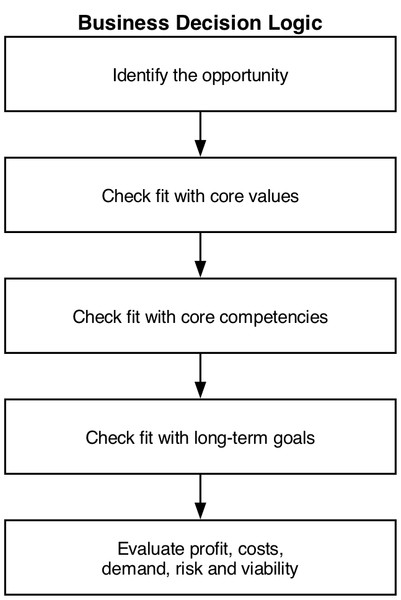
Business decision logic
Businesses use this sequence when deciding:
- which opportunities to pursue
- how to allocate resources
- how to meet customer needs
A common AP answer pattern works well here:
- name the specific value or competency
- connect it to the specific decision
- explain why that makes the option more or less appropriate
For resource allocation, firms usually invest more in areas tied to their competencies.
Examples:
- strong customer service competency → spend more on training or service technology
- strong efficiency competency → expand production capacity
One of the most testable ideas here is the nuance. An opportunity may look profitable and still be a bad choice if it conflicts with values or requires competencies the business does not have.
Beekeeper’s Daughter
With Beekeeper’s Daughter, the goal is to identify:
- the entrepreneur’s values
- the entrepreneur’s competencies
- which goals and opportunities align with both
Strong answers do more than label evidence. They explain how beliefs shape what is desirable and how expertise shapes what is realistic.
Vision Statements and Mission Statements
Vision and mission work together, but they are not the same.
Vision statements
A vision statement is a concise description of a business’s core values and aspirations. It is future-oriented.
A good vision statement is:
- concise
- tied to values
- focused on the future
- aligned with long-term goals
Weak vision signs:
- only says “make money”
- lists current tasks
- sounds inspiring but does not fit the scenario
Mission statements
A mission statement explains what a business does and how it will achieve its long-term goals. It is more action-oriented than vision.
It often includes:
- customers served
- need addressed
- product or service
- broad methods or capabilities used
Weak mission signs:
- too vague
- only gives aspiration
- does not explain what the organization actually does
How to evaluate them from a scenario
- Identify values.
- Identify long-term goals or aspirations.
- Identify what the organization does.
- Identify how it does it.
- Match future aspiration to vision.
- Match action and method to mission.
- Check alignment between the two.
These statements are for both:
- Internal audiences such as employees and managers, who use them for shared purpose and decisions
- External audiences such as customers and investors, who use them to understand goals and values
Goals of Businesses, Social Enterprises, and Nonprofits
Different organizations have different goals, even when they all bring in revenue.
Conventional businesses
Regular businesses aim to:
- increase profits
- fulfill mission and goals
- remain competitive
- remain viable long term
Profit is:
Profit improves by:
- increasing revenue
- decreasing costs
- or both
Short-term profit can conflict with long-term viability. That is a favorite test angle.
Social enterprises
Social enterprises seek profit plus social objectives.
Their social impact can come through:
- products
- operations
- financial model
They must balance:
- financial sustainability
- social mission
A business that helps society is not automatically a nonprofit. It may be a social enterprise.
Nonprofit organizations
Nonprofits serve the public good, not owners’ profit.
Important facts:
- they can earn revenue
- they can have money left over
- that excess is surplus funds
- by law, surplus must be reinvested in the organization
They often rely on:
- grants
- donations
- and may also charge fees or sell services
| Organization type | Main goals |
|---|---|
| Conventional business | Profit, competitiveness, mission, long-term viability |
| Social enterprise | Profit plus social objective |
| Nonprofit | Public good plus reinvested surplus |
Key Takeaways
Core Values
Defining beliefs and principles that guide an individual’s or business’s actions and choices
Core Competencies
Capabilities, skills, and expertise that help an individual or business perform effectively, outperform rivals, and achieve competitive advantage
Vision Statement
A concise description of a business’s core values and long-term aspirations or desired future
Mission Statement
A description of what a business does and how it will achieve its long-term goals
Conventional Business
A business that seeks profit, fulfills its mission and goals, remains competitive, and maintains long-term viability; its owners may benefit from profit
Profit
The amount by which revenue exceeds costs: profit = revenue − costs; it rises when revenue increases or costs decrease
Social Enterprise
A business that seeks to generate profit while also achieving social objectives through its products, operations, or financial model
Nonprofit Organization
An organization that serves the public good rather than generating distributable profit for owners; any surplus must be reinvested in the organization
Developing Vision and Mission Statements
Identify the organization’s values, aspirations, work, and methods; express values and aspirations in the vision and work and methods in the mission; then check both for alignment with each other and the scenario
Notes
Core Values
Defining beliefs and principles that guide an individual’s or business’s actions and choices
Core Competencies
Capabilities, skills, and expertise that help an individual or business perform effectively, outperform rivals, and achieve competitive advantage
Vision Statement
A concise description of a business’s core values and long-term aspirations or desired future
Mission Statement
A description of what a business does and how it will achieve its long-term goals
Conventional Business
A business that seeks profit, fulfills its mission and goals, remains competitive, and maintains long-term viability; its owners may benefit from profit
Profit
The amount by which revenue exceeds costs: profit = revenue − costs; it rises when revenue increases or costs decrease
Social Enterprise
A business that seeks to generate profit while also achieving social objectives through its products, operations, or financial model
Nonprofit Organization
An organization that serves the public good rather than generating distributable profit for owners; any surplus must be reinvested in the organization
Developing Vision and Mission Statements
Identify the organization’s values, aspirations, work, and methods; express values and aspirations in the vision and work and methods in the mission; then check both for alignment with each other and the scenario
