Topic 1.3 Notes – Comparative Advantage and Gains from Trade
1. Absolute Advantage vs Comparative Advantage
Trade starts with opportunity cost, which is what you give up to get something else. Comparative advantage is built on that idea.
Absolute Advantage
A country has absolute advantage if it can:
- Produce more output with the same resources (output problems), or
- Use fewer resources to produce one unit (input problems).
It’s purely about productivity. Bigger output or smaller input wins.
Possible outcomes:
- One country has absolute advantage in both goods.
- Each country has one.
- Neither has one (if numbers are equal).
Comparative Advantage
A country has comparative advantage if it can produce a good at a lower opportunity cost.
Key idea:
- Lower opportunity cost → comparative advantage.
- Countries export the good they have comparative advantage in.
- Countries import the good they don’t.
This idea goes back to David Ricardo in the early 1800s. His classic example was England and Portugal trading cloth and wine. Portugal had absolute advantage in both, but still benefited from specializing where its opportunity cost was lower.
On tests, the trap is confusing absolute and comparative advantage. Trade is based on comparative advantage, not who is better at everything.
2. How to Find Absolute and Comparative Advantage from Data
You’ll see two formats: output tables/PPCs or input tables. Identify which type you’re dealing with before calculating.
Output Problems
You’re given maximum production with the same resources.
Example:
| Country | Corn | Cars |
|---|---|---|
| Alpha | 40 | 20 |
| Beta | 30 | 30 |
Step 1: Absolute Advantage
- Corn → 40 > 30 → Alpha
- Cars → 30 > 20 → Beta
Step 2: Opportunity Cost
For Alpha:
- 1 car costs corn
- 1 corn costs cars
For Beta:
- 1 car costs corn
- 1 corn costs car
Step 3: Comparative Advantage
- Cars → Beta (1 < 2)
- Corn → Alpha (0.5 < 1)
Rule for output problems:
If you’re using a PPC, the slope represents opportunity cost.
Input Problems
You’re given resources required per unit.
| Country | Hours per TV | Hours per Computer |
|---|---|---|
| Delta | 2 | 4 |
| Echo | 3 | 3 |
Absolute Advantage
- TVs → Delta (2 < 3)
- Computers → Echo (3 < 4)
For input problems, flip the ratio:
Delta:
- 1 computer costs TVs
Echo:
- 1 computer costs TV
Echo has comparative advantage in computers.
Students mess this up every year by using the wrong ratio. Output is give up over gain. Input flips.
3. Specialization and Gains from Trade
Once you know comparative advantage, the logic becomes powerful.
- Each country specializes in the good where it has comparative advantage.
- They trade at acceptable terms.
- Total production increases.
Here’s what that looks like in a two-country example producing computers and food:
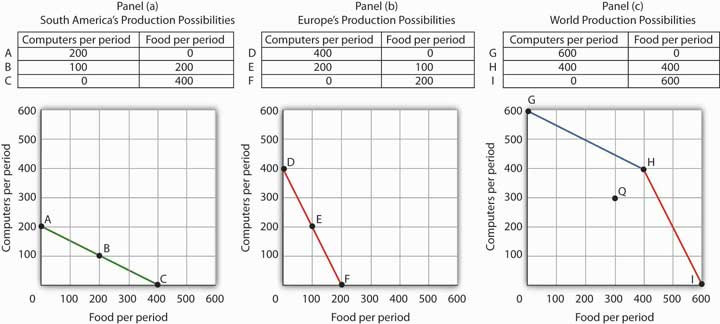
Individual PPCs and the world PPC after specialization
The left panel shows one country’s PPC. The middle panel shows the other country’s PPC. The right panel combines them into a world production possibilities curve. When each country specializes according to comparative advantage, total output expands and the world can reach a point beyond either country’s individual PPC.
Trade allows consumption beyond the PPC. That’s the entire enduring understanding of this topic. Production and consumption both rise.
Real-world examples:
- The United States specializes in capital- and technology-intensive goods.
- China specializes in labor-intensive manufacturing.
- Oil-exporting countries specialize heavily in petroleum and trade for other goods.
4. Terms of Trade and Mutually Beneficial Exchange
Terms of trade (ToT) are the rate at which goods exchange.
To be mutually beneficial, the trade ratio must fall between the two opportunity costs.
Suppose:
- Country A: 1 wheat costs 2 steel
- Country B: 1 wheat costs 6 steel
Acceptable terms of trade:
- Between 2 and 6 steel per wheat
- For example, 1 wheat for 4 steel
If the trade ratio is outside that range, one country won’t benefit.
Favorable vs Unfavorable Terms of Trade
- Favorable ToT → Can receive more imports per export.
- Unfavorable ToT → Must export more to get the same imports.
Terms of trade can change due to:
- Exchange rate movements
- Global demand shifts
- Commodity price shocks (like oil price spikes)
Key Takeaways
Absolute Advantage
The ability to produce more output with the same resources, or the same output with fewer resources.
Comparative Advantage
The ability to produce a good or service at a lower opportunity cost than another producer.
Opportunity Cost
The amount of one good given up to produce one more unit of another good.
Output Problems vs. Input Problems
Output compares goods produced from resources; input compares resources needed to produce one unit.
Determining Absolute Advantage in Output and Input Problems
In output, choose the higher production; in input, choose the lower resource requirement.
Determining Comparative Advantage in Output and Input Problems
Find per-unit opportunity cost; in output use give up/gain, in input use gain/give up; lower cost wins.
Specialization According to Comparative Advantage
Each producer focuses on the good with the lower opportunity cost.
Exports and Imports Under Comparative Advantage
A country exports the good with lower opportunity cost and imports the good with higher opportunity cost.
Terms of Trade
The exchange ratio between goods that must fall between both producers’ opportunity costs.
Gains From Trade
Specialization and trade let producers consume beyond their own production possibilities curve.
Notes
Absolute Advantage
The ability to produce more output with the same resources, or the same output with fewer resources.
Comparative Advantage
The ability to produce a good or service at a lower opportunity cost than another producer.
Opportunity Cost
The amount of one good given up to produce one more unit of another good.
Output Problems vs. Input Problems
Output compares goods produced from resources; input compares resources needed to produce one unit.
Determining Absolute Advantage in Output and Input Problems
In output, choose the higher production; in input, choose the lower resource requirement.
Determining Comparative Advantage in Output and Input Problems
Find per-unit opportunity cost; in output use give up/gain, in input use gain/give up; lower cost wins.
Specialization According to Comparative Advantage
Each producer focuses on the good with the lower opportunity cost.
Exports and Imports Under Comparative Advantage
A country exports the good with lower opportunity cost and imports the good with higher opportunity cost.
Terms of Trade
The exchange ratio between goods that must fall between both producers’ opportunity costs.
Gains From Trade
Specialization and trade let producers consume beyond their own production possibilities curve.
