Topic 6.6 Notes – Real Interest Rates and International Capital Flows
Real Interest Rates and Why Capital Moves
The real interest rate tells investors how much their purchasing power actually increases.
If a bond pays 8% and expected inflation is 3%, the real return is 5%.
In an open economy, investors can buy foreign stocks, bonds, and bank deposits. So they compare real returns across countries. A country with the higher real interest rate offers more purchasing power growth.
Core rule
- Higher domestic real interest rate (relative to abroad) → capital inflow
- Lower domestic real interest rate → capital outflow
It’s always relative. If U.S. rates are 4% and Europe’s are 6%, money tends to flow to Europe.
Inbound vs Outbound Capital Flows
Capital flow simply means the movement of financial investment funds across borders.
Inbound capital flow
Foreign investors buy domestic assets (stocks, bonds, bank accounts).
- Happens when domestic real interest rate rises relative to other countries
- Example: Japanese investors buying U.S. Treasury bonds because U.S. rates are higher
- Creates net capital inflow
- Increases demand for the domestic currency (foreigners need it to buy assets)
Outbound capital flow
Domestic investors buy foreign assets.
- Happens when domestic real interest rate falls relative to abroad
- Example: Americans buying German bonds because European rates are higher
- Creates net capital outflow
- Increases supply of domestic currency in foreign exchange markets
Here’s a clean comparison:
| Inbound Capital Flow | Outbound Capital Flow | |
|---|---|---|
| Who buys what? | Foreigners buy domestic assets | Domestic residents buy foreign assets |
| Interest rate condition | Domestic real rate is higher | Foreign real rate is higher |
| Currency effect | Demand for domestic currency ↑ | Supply of domestic currency ↑ |
Now let’s connect this to the three markets you draw on tests.
Loanable Funds Market
The loanable funds market determines the real interest rate through saving (supply) and borrowing (demand).
This graph shows the real interest rate on the vertical axis and the quantity of loanable funds on the horizontal axis. The upward-sloping curve is the supply of loanable funds, and the downward-sloping curve is the demand. Their intersection determines the equilibrium real interest rate.
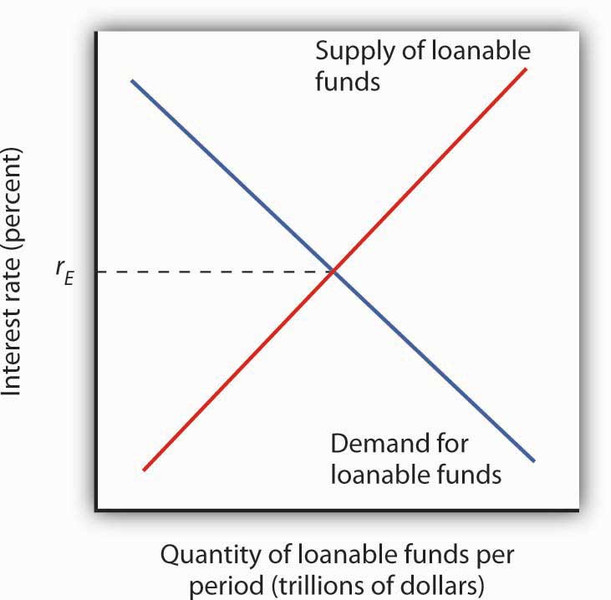
Loanable funds market equilibrium
Foreign investors are part of the supply of loanable funds.
If the domestic real interest rate rises relative to other countries:
- Capital inflow increases
- Supply of loanable funds shifts right
- This puts downward pressure on the interest rate
That rightward shift reflects foreign money entering the domestic financial system.
If domestic rates fall:
- Capital outflow
- Supply shifts left
On an FRQ, if they say “foreign investors purchase domestic bonds,” that means S shifts right in loanable funds.
Foreign Exchange Market
The foreign exchange market determines the value of a currency.
In the graph below, the vertical axis shows the price of dollars in pesos, and the horizontal axis shows the quantity of dollars. The intersection of supply and demand gives the equilibrium exchange rate and quantity exchanged.

Foreign exchange market equilibrium
- Demand for domestic currency comes from:
- Foreigners buying exports
- Foreigners buying domestic assets
- Supply of domestic currency comes from:
- Domestic consumers buying imports
- Domestic investors buying foreign assets
If domestic real interest rate rises:
- Capital inflow increases
- Demand for domestic currency shifts right
- Currency appreciates
If domestic rates fall:
- Capital outflow
- Supply shifts right
- Currency depreciates
This is a favorite exam chain: higher interest rate → appreciation.
Net Exports Connection
Exchange rates affect trade.
- Appreciation → exports more expensive, imports cheaper → net exports fall
- Depreciation → exports cheaper, imports more expensive → net exports rise
Full chain you should memorize:
- Real interest rate increases (relative to abroad)
- Capital inflow
- Demand for currency increases
- Currency appreciates
- Net exports decrease
Reverse every step if the interest rate falls.
Central Banks and Capital Flows
Central banks influence short-run interest rates.
Contractionary monetary policy
Decrease money supply → interest rate rises.
- Attracts foreign capital
- Currency appreciates
- Net exports decrease
Example: In the early 1980s, Federal Reserve Chair Paul Volcker sharply raised U.S. interest rates to fight inflation. High U.S. rates attracted global capital and strengthened the dollar.
Expansionary monetary policy
Increase money supply → interest rate falls.
- Capital outflow
- Currency depreciates
- Net exports increase
After the 2008 financial crisis, the Federal Reserve lowered interest rates significantly. Lower returns reduced capital inflow pressure and contributed to a weaker dollar relative to high-rate countries.
On questions, when they say “the central bank lowers rates,” you should automatically think: capital outflow → depreciation → NX rises.
Key Takeaways
Capital Flow
The movement of financial capital across countries for investment in assets.
Real Interest Rate and Financial Capital Flows
Financial capital moves toward countries with higher real interest rates and away from lower-yield countries.
Net Capital Inflow
The amount of capital entering a country minus the amount leaving it.
Central Bank Influence On Interest Rates And Capital Flows
Short-run monetary policy changes domestic interest rates, which changes net capital inflows or outflows.
Capital Inflows And Capital Outflows
Foreign asset purchases bring funds in, while domestic purchases of foreign assets send funds out.
Foreign Exchange Market Effects Of Capital Flows
Capital inflows raise demand for domestic currency, while outflows raise demand for foreign currency.
Loanable Funds Market Effects Of Capital Flows
Capital inflows increase loanable funds supply, while outflows decrease it and raise interest rates.
Notes
Capital Flow
The movement of financial capital across countries for investment in assets.
Real Interest Rate and Financial Capital Flows
Financial capital moves toward countries with higher real interest rates and away from lower-yield countries.
Net Capital Inflow
The amount of capital entering a country minus the amount leaving it.
Central Bank Influence On Interest Rates And Capital Flows
Short-run monetary policy changes domestic interest rates, which changes net capital inflows or outflows.
Capital Inflows And Capital Outflows
Foreign asset purchases bring funds in, while domestic purchases of foreign assets send funds out.
Foreign Exchange Market Effects Of Capital Flows
Capital inflows raise demand for domestic currency, while outflows raise demand for foreign currency.
Loanable Funds Market Effects Of Capital Flows
Capital inflows increase loanable funds supply, while outflows decrease it and raise interest rates.
