Topic 4.1 Notes – Financial Assets
1. What Financial Assets Are
A financial asset is a claim on a real asset or on future income. When you buy a bond or a stock, you’re buying a legal claim to future payments.
These assets connect savers (lenders) and borrowers through the financial sector. That includes banks, financial markets, and institutions that move money from people who have it to people who want to use it.
In macro, people constantly choose between:
- Holding money (cash and demand deposits)
- Holding other financial assets like bonds or stocks
That choice depends on three attributes.
The Three Attributes of Financial Assets
| Attribute | What It Means | Examples |
|---|---|---|
| Liquidity | How quickly and easily an asset can be converted to cash without losing value. | Most liquid: cash and demand deposits (checking accounts). Less liquid: bonds and stocks. Very low liquidity: real estate, collectibles. |
| Rate of Return | The gain or loss on an investment over time. | Bonds: interest payments. Stocks: dividends + capital gains. Money: usually zero or very low. |
| Risk | The chance actual returns differ from expected returns. | U.S. government bonds = low risk. Corporate bonds = higher risk (default). Stocks = higher risk, higher potential return. |
You rarely get all three. High liquidity usually means low return. Higher return usually means higher risk.
2. The Main Types of Financial Assets
You are responsible for three categories.
Money
In AP Macro, the most liquid forms of money are:
- Cash
- Demand deposits (checking accounts)
Money is:
- A medium of exchange
- Extremely liquid
- Very low or zero return
- Very low risk in nominal terms
This is straight from the learning objective. If they ask what’s most liquid, it’s cash and demand deposits.
Bonds
A bond is an interest-bearing asset issued by a government or corporation.
When you buy a bond:
- You are lending money.
- The issuer promises to repay the principal.
- You receive periodic interest payments.
This is debt financing. You are a lender, not an owner.
Key features:
- Fixed interest payments
- Lower risk than stocks (especially U.S. Treasury bonds)
- Moderate liquidity (can be sold in secondary markets)
- Subject to interest rate risk
Governments finance deficits this way. During World War II and more recently after the 2008 financial crisis, the U.S. government issued large amounts of bonds to fund spending.
Stocks
A stock is a security that represents ownership in a firm.
When you buy stock:
- You own part of the company.
- You may receive dividends.
- You can earn capital gains if the price rises.
This is equity financing.
Stock prices are driven by expectations of future profits. That’s why during the 2008 financial crisis and early COVID period in 2020, stock prices fell sharply when future profits looked uncertain.
Higher potential return. Higher risk.
3. The Opportunity Cost of Holding Money
Money earns little to no interest. That means holding it has a cost.
The opportunity cost of holding money is the interest you could have earned by holding bonds or other financial assets instead.
If interest rates rise:
- Bonds pay more.
- The opportunity cost of holding money increases.
- People shift from money into bonds.
If interest rates fall:
- Bonds pay less.
- The opportunity cost of holding money decreases.
- Holding cash becomes more attractive.
This idea connects directly to monetary policy later when the Federal Reserve changes interest rates.
4. The Inverse Relationship Between Bond Prices and Interest Rates
This is one of the most tested relationships in Unit 4.
Core Rule
Bond prices and interest rates move in opposite directions.
When interest rates rise, bond prices fall.
When interest rates fall, bond prices rise.
The bond market graph below shows this inverse relationship. A higher bond price corresponds to a lower interest rate, and a lower bond price corresponds to a higher interest rate.
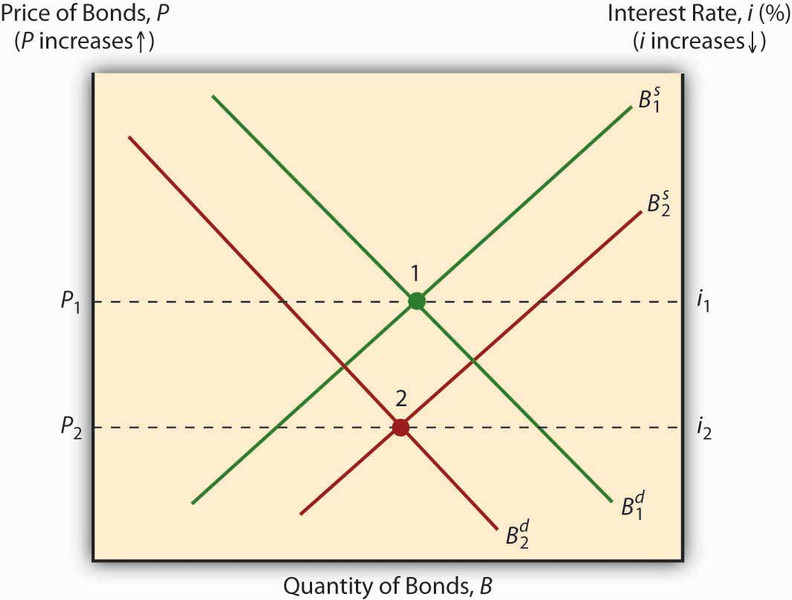
Bond market equilibrium and the inverse bond price-interest rate relationship
Why This Happens
Most bonds pay a fixed interest payment.
Imagine:
- You own a bond paying 4 percent interest.
- New bonds are issued paying 6 percent.
- Investors prefer the 6 percent bonds.
- Your 4 percent bond becomes less attractive.
- To sell it, you must lower its price.
- The lower price raises its effective return to match the market rate.
The reverse happens when interest rates fall.
Historical anchor: In the early 1980s, Federal Reserve Chair Paul Volcker sharply raised interest rates to fight inflation. Bond prices fell significantly. During 2008-2020, the Fed lowered rates, and bond prices rose.
If you see a question that says “the Fed increases interest rates,” your brain should immediately think “existing bond prices fall.”
Key Takeaways
Liquidity
The ease with which an asset can be converted into cash quickly.
Rate of Return
The gain or loss on an investment over a specific period.
Risk
The chance an investment's actual return will differ from its expected return.
Cash and Demand Deposits
The most liquid forms of money; cash is physical currency, deposits are checking-account funds.
Bond
An interest-bearing asset representing a loan to a government or business.
Stock
An equity asset that represents partial ownership in a corporation.
Bond Prices and Interest Rates
Previously issued bond prices and market interest rates move in opposite directions.
Opportunity Cost of Holding Money
The forgone interest that could have been earned by holding other financial assets.
Previously Issued Bond
A bond already sold once that can later be resold to another buyer.
Notes
Liquidity
The ease with which an asset can be converted into cash quickly.
Rate of Return
The gain or loss on an investment over a specific period.
Risk
The chance an investment's actual return will differ from its expected return.
Cash and Demand Deposits
The most liquid forms of money; cash is physical currency, deposits are checking-account funds.
Bond
An interest-bearing asset representing a loan to a government or business.
Stock
An equity asset that represents partial ownership in a corporation.
Bond Prices and Interest Rates
Previously issued bond prices and market interest rates move in opposite directions.
Opportunity Cost of Holding Money
The forgone interest that could have been earned by holding other financial assets.
Previously Issued Bond
A bond already sold once that can later be resold to another buyer.
