Topic 2.1 Notes – The Circular Flow and GDP
1. Gross Domestic Product
GDP is the dollar value of all final goods and services produced within a country’s borders in one year.
Break that definition apart carefully:
- Final goods and services
Only goods sold to the end user.
A tire used to make a car is an intermediate good. The car is the final good. Counting both would be double counting. - Produced
Must be current production. A used car sold this year was produced in a past year, so it doesn’t count again. - Within a country’s borders
Production inside the U.S. counts in U.S. GDP, even if the firm is foreign-owned. A Toyota made in Kentucky counts toward U.S. GDP. - In one year
GDP is a flow variable. It measures output per year, not total wealth.
GDP Measures Output and Income
Every dollar spent becomes someone else’s income.
When you buy a 30-dollar haircut, the barber receives 30 dollars in income.
So:
Total spending = Total income = Total output
That identity is the heart of this topic.
2. The Circular Flow Model
The circular flow shows why spending equals income.
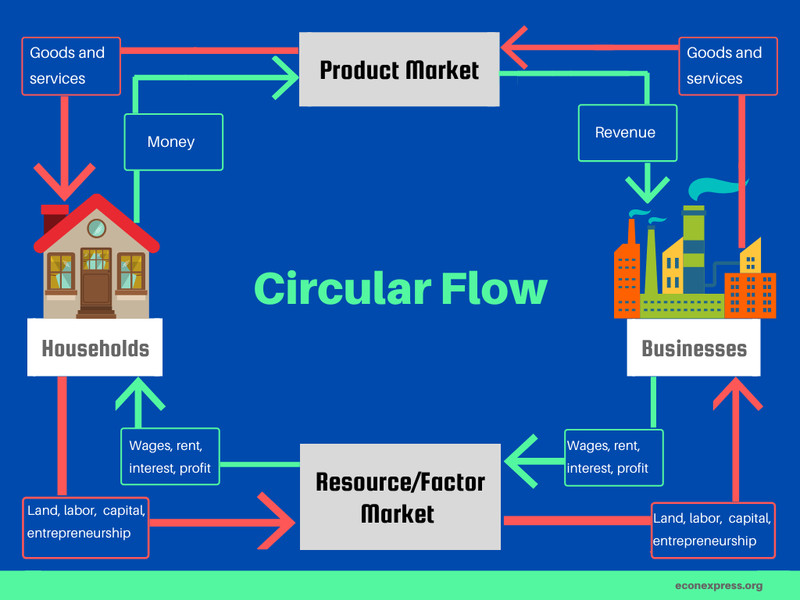
The circular flow of households, firms, and markets
There are two key players:
- Households (consumers, resource owners)
- Firms (producers)
And two markets:
Product Market
- Firms sell goods and services
- Households buy them
- Money flows households → firms
- Goods and services flow firms → households
Factor (Resource) Market
- Households sell resources (labor, land, capital, entrepreneurship)
- Firms buy resources
- Money flows firms → households (wages, rent, interest, profit)
- Resources flow households → firms
This is based on voluntary exchange. Both sides choose to trade because they expect to benefit.
If you work at a grocery store:
- You sell labor in the factor market and earn wages.
- You spend those wages in the product market.
The money just keeps circulating. That’s why measuring total spending gives the same result as measuring total income.
3. The Three Ways to Measure GDP
All three approaches should produce the same number.
1. Expenditures Approach
This is the most tested formula.
- C (Consumption)
Household spending on goods and services
Includes durable goods, nondurables, and services. - I (Investment)
Business spending on capital- Equipment, factories
- New residential construction
- Changes in inventories
- G (Government Spending)
Government purchases of goods and services
Military equipment and highways count.
Transfer payments like Social Security or unemployment benefits do not. - Net Exports (X − M)
Exports add.
Imports subtract because they were not produced domestically.
Quick Calculation Practice
Suppose:
- C = 900 billion
- I = 250 billion
- G = 300 billion
- Exports = 120 billion
- Imports = 170 billion
Net exports =
GDP = billion
Always subtract imports.
2. Income Approach
Adds up income earned from production:
- Wages
- Rent
- Interest
- Profit
Since spending becomes income, this must equal the expenditure total.
3. Value-Added Approach
Adds the value added at each stage of production.
Value added = Sales revenue − Cost of intermediate goods
This avoids double counting and ensures only final output is included.
4. What Is Not Included in GDP
Common test traps:
- Intermediate goods
- Used goods
- Financial transactions (stocks, bonds)
- Transfer payments
- Unpaid work (volunteering, stay-at-home parenting)
- Illegal activities
- Depreciation (wear and tear)
If it’s not new, final production this year inside the country, it doesn’t count.
Key Takeaways
Circular Flow Diagram
A model showing how money, resources, goods, and services move between households and firms.
Product Market and Factor Market
Product market: goods and services are sold; factor market: resources like labor, land, and capital are sold.
Households and Firms in the Circular Flow
Households supply resources and buy output; firms demand resources and produce and sell output.
Gross Domestic Product (GDP)
The dollar value of all final goods and services produced within a country's borders in one year.
Final Goods and Services
Products bought for end use rather than for resale or further production.
Intermediate Goods
Products used to make other goods and excluded from GDP to avoid double counting.
Three Approaches to Measuring GDP
Expenditures approach sums spending, income approach sums income, value-added approach sums each stage's added value.
Expenditures Approach
A method that adds consumption, investment, government purchases, and net exports to find total output.
Consumption
Household spending on final goods and services, except new housing.
Investment
Business spending on capital goods, inventories, and new residential construction.
Government Spending
Government purchases of final goods and services, excluding transfer payments.
Net Exports
Exports minus imports, showing the value of domestically produced goods sold abroad minus foreign goods bought domestically.
Income Approach
A method that adds wages, rent, interest, and profit earned from current production.
Value-Added Approach
A method that adds the increase in value created at each production stage.
Double Counting
Mistakenly counting the same output more than once, usually by including intermediate and final goods together.
Transfer Payments
Government payments without current production in return, so they are excluded from GDP.
Unpaid Work
Nonmarket labor like volunteering or caregiving that is excluded because no market transaction occurs.
Illegal Activities
Underground market transactions excluded because they are not officially recorded in national accounts.
Depreciation
The wear and tear on capital goods over time, which is not counted as new output.
Nominal GDP
The value of current final output found using current-year prices and quantities.
Notes
Circular Flow Diagram
A model showing how money, resources, goods, and services move between households and firms.
Product Market and Factor Market
Product market: goods and services are sold; factor market: resources like labor, land, and capital are sold.
Households and Firms in the Circular Flow
Households supply resources and buy output; firms demand resources and produce and sell output.
Gross Domestic Product (GDP)
The dollar value of all final goods and services produced within a country's borders in one year.
Final Goods and Services
Products bought for end use rather than for resale or further production.
Intermediate Goods
Products used to make other goods and excluded from GDP to avoid double counting.
Three Approaches to Measuring GDP
Expenditures approach sums spending, income approach sums income, value-added approach sums each stage's added value.
Expenditures Approach
A method that adds consumption, investment, government purchases, and net exports to find total output.
Consumption
Household spending on final goods and services, except new housing.
Investment
Business spending on capital goods, inventories, and new residential construction.
Government Spending
Government purchases of final goods and services, excluding transfer payments.
Net Exports
Exports minus imports, showing the value of domestically produced goods sold abroad minus foreign goods bought domestically.
Income Approach
A method that adds wages, rent, interest, and profit earned from current production.
Value-Added Approach
A method that adds the increase in value created at each production stage.
Double Counting
Mistakenly counting the same output more than once, usually by including intermediate and final goods together.
Transfer Payments
Government payments without current production in return, so they are excluded from GDP.
Unpaid Work
Nonmarket labor like volunteering or caregiving that is excluded because no market transaction occurs.
Illegal Activities
Underground market transactions excluded because they are not officially recorded in national accounts.
Depreciation
The wear and tear on capital goods over time, which is not counted as new output.
Nominal GDP
The value of current final output found using current-year prices and quantities.
