Topic 4.3 Notes – Definition, Measurement, and Functions of Money
1. What Money Is
Money = any asset that is accepted as a means of payment.
That’s it. If people widely accept it to buy goods, services, and pay debts, it counts as money. What matters is acceptability, not whether it has intrinsic value.
Forms of Money
Fiat money
- Has no intrinsic value.
- Its value comes from government decree and public trust.
- Examples: U.S. paper bills and coins.
- Modern economies, including the United States, use fiat money.
Commodity money
- Has intrinsic value and a non-monetary use.
- Examples: gold, silver, oil, tobacco (historically in colonial America).
- Gold and silver were common under systems like the gold standard.
The U.S. dollar today is fiat money. It works because people trust it and the government declares it legal tender.
2. The Three Functions of Money
For something to truly be money, it must perform all three roles.
Medium of Exchange
Money is used to buy goods and services.
It solves the double coincidence of wants problem in barter. In barter, both parties must want what the other has at the same time. That’s inefficient.
Examples:
- Paying 9,000 dollars for a European vacation.
- Receiving wages for your job.
- Buying groceries with cash or a debit card.
Without a medium of exchange, trade would be clunky and limited.
Unit of Account
Money is a measuring stick for value.
Prices let you compare goods easily:
- If a laptop costs 1,200 dollars and a phone costs 600 dollars, the laptop is worth twice as much.
- A name-brand jacket priced at 120 dollars vs. a generic one at 60 dollars.
It standardizes value across the economy, like inches measure length.
Store of Value
Money allows you to transfer purchasing power into the future.
Examples:
- A high school student depositing income into a savings account.
- A bank investing 5 million dollars into stocks and bonds.
This function works best when inflation is low. During hyperinflation like in Weimar Germany or Zimbabwe, money rapidly loses purchasing power and fails as a store of value.
Here’s how the three functions compare:
| Function | What It Does | Example | If It Fails |
|---|---|---|---|
| Medium of Exchange | Facilitates trade | Buying groceries | Return to barter |
| Unit of Account | Measures value | Comparing prices | Confusion in pricing |
| Store of Value | Holds purchasing power | Savings account | Inflation erodes value |
3. Measuring the Money Supply
The money supply is the total amount of money in the economy. The AP exam focuses on M1 and M2.
Liquidity means how easily an asset can be converted to cash.
M1 - Most Liquid
Includes:
- Cash and coins in circulation
- Checking accounts (demand deposits)
- Traveler’s checks
Used directly for transactions.
M2 - Broader Measure
Includes:
- Everything in M1
- Savings accounts
- Small CDs
- Retail money market mutual funds
Less liquid than M1 but still easily accessible.
| M1 | M2 | |
|---|---|---|
| Liquidity | Highest | High but slightly less |
| Main Use | Daily transactions | Savings & near-money |
| Includes | Cash + checking | M1 + savings + small CDs |
⚠️ Common traps:
- Credit cards are not money. They are short-term loans.
- Stocks and bonds are not part of M1 or M2.
- The AP exam does not test M3.
Be comfortable calculating. If currency is 700 billion, checking deposits are 1.3 trillion, savings are 2 trillion, and small CDs are 400 billion:
- billion
- billion
4. The Monetary Base vs the Money Supply
Monetary Base (MB or M0)
Includes:
- Currency in circulation
- Bank reserves (required + excess reserves)
It represents the final means of settlement in transactions.
The monetary base is not the same as M1 or M2. It underlies them.
Through fractional reserve banking, the monetary base can expand into a larger money supply. You’ll study that multiplier effect in Topic 4.4.
During the 2008 financial crisis and the COVID-19 recession, the Federal Reserve dramatically increased the monetary base to stabilize the economy.
In the money market graph below, the money supply curve is vertical because the Fed controls it.
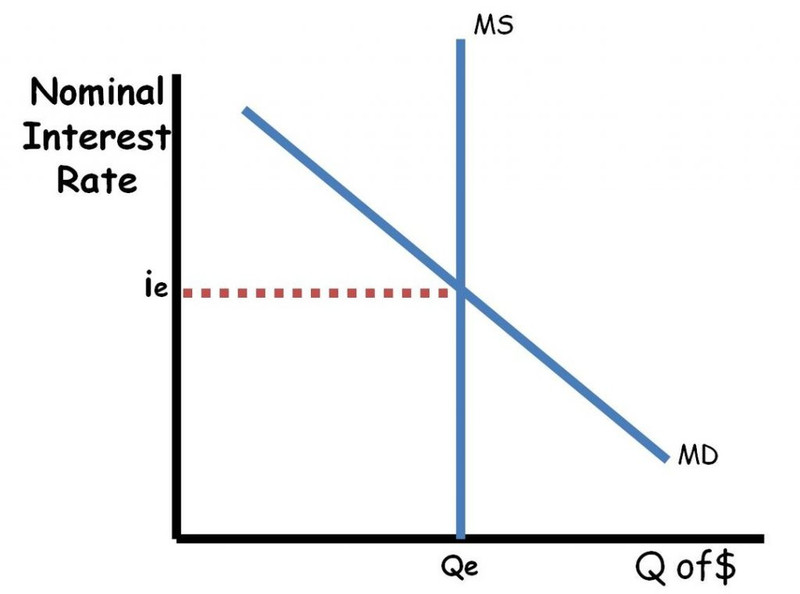
Money market equilibrium
The vertical line labeled MS shows the Fed-set money supply. The downward-sloping MD curve represents money demand. Their intersection determines the equilibrium nominal interest rate, which is the “price of money.”
5. Why Money Matters in the Economy
Money:
- Enables specialization and large-scale trade.
- Makes price comparison possible.
- Supports saving, investment, and lending.
- Forms the foundation of the money market and Fed policy.
Modern economies could not function efficiently without it.
Key Takeaways
Money
Any asset accepted as payment for goods, services, or debts.
Fiat Money
Currency with value by government acceptance, not from a nonmonetary use.
Commodity Money
An item used as money that also has an alternative nonmonetary use.
Functions of Money
Medium of exchange, unit of account, and store of value.
Medium of Exchange
Something widely accepted for buying and selling goods and services.
Unit of Account
A standard measure that allows prices and values to be compared.
Store of Value
Something that keeps purchasing power over time if inflation is low.
Liquidity
The ease with which an asset can be converted into cash.
M1
Currency, coins, checkable deposits, and traveler's checks; the most liquid money measure.
M2
M1 plus savings deposits, small time deposits, and retail money market funds.
Monetary Base / M0 / MB
Currency in circulation plus bank reserves held by banks.
Money Supply
The total amount of money in the economy, commonly measured by M1 and M2.
Credit Card
A short-term loan used for purchases, not an asset counted as money.
Notes
Money
Any asset accepted as payment for goods, services, or debts.
Fiat Money
Currency with value by government acceptance, not from a nonmonetary use.
Commodity Money
An item used as money that also has an alternative nonmonetary use.
Functions of Money
Medium of exchange, unit of account, and store of value.
Medium of Exchange
Something widely accepted for buying and selling goods and services.
Unit of Account
A standard measure that allows prices and values to be compared.
Store of Value
Something that keeps purchasing power over time if inflation is low.
Liquidity
The ease with which an asset can be converted into cash.
M1
Currency, coins, checkable deposits, and traveler's checks; the most liquid money measure.
M2
M1 plus savings deposits, small time deposits, and retail money market funds.
Monetary Base / M0 / MB
Currency in circulation plus bank reserves held by banks.
Money Supply
The total amount of money in the economy, commonly measured by M1 and M2.
Credit Card
A short-term loan used for purchases, not an asset counted as money.
