Topic 5.3 Notes – Money Growth and Inflation
1. Inflation as a Monetary Phenomenon
Inflation is a sustained increase in the general price level.
Deflation is a sustained decrease in the general price level.
We are not talking about one good becoming more expensive. We mean overall prices rising across the economy.
The key AP claim comes from economist Milton Friedman:
“Inflation is always and everywhere a monetary phenomenon.”
That means if the money supply grows too quickly for a long time, inflation results.
How Money Growth Leads to Inflation
Here’s the chain reaction when the Federal Reserve increases the money supply using open market operations, lowering the reserve requirement, or lowering the policy rate.
In the AD-AS model, this shows up as a rightward shift of aggregate demand from AD0 to AD1, increasing both real GDP (Y0 to Y1) and the price level (PL0 to PL1) in the short run.
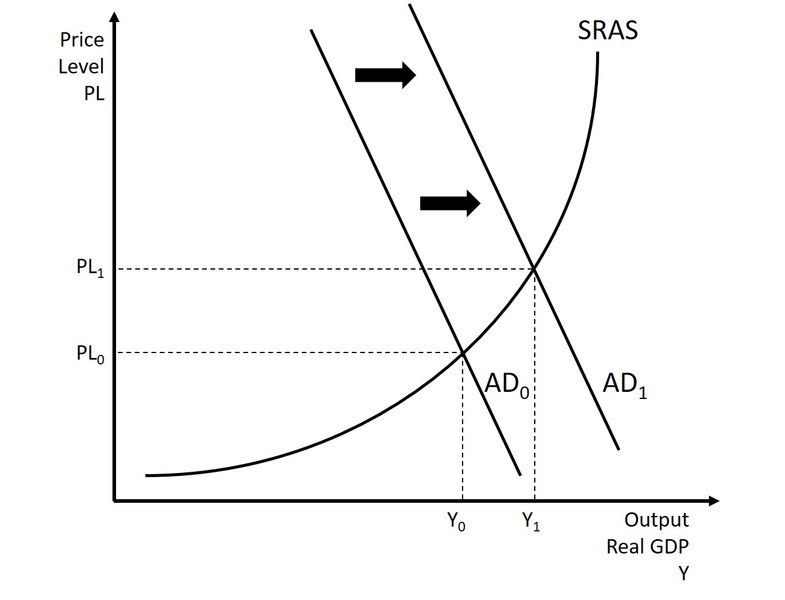
Expansionary monetary policy in the AD-AS model
Step 1: Money Market
- MS shifts right.
- Nominal interest rate falls.
Step 2: Interest Rate Effect
- Lower rates → more borrowing.
- Consumption (C) and Investment (I) increase.
- Aggregate Demand shifts right.
Short Run
- Higher real GDP
- Higher price level
If the economy was in a recessionary gap, this helps.
Long Run (at full employment)
- Wages rise.
- SRAS shifts left.
- Real GDP returns to potential (LRAS).
- Only the price level stays higher.
That’s the big idea:
Money affects output in the short run, but only prices in the long run.
When money growth continues year after year, inflation continues year after year. That’s what happened in the 1970s, when rapid money growth contributed to high inflation.
2. Demand-Pull, Cost-Push, and the Wage-Price Spiral
These explain how inflation shows up in AD-AS in the short run.
Demand-Pull Inflation
Start with an increase in aggregate demand.
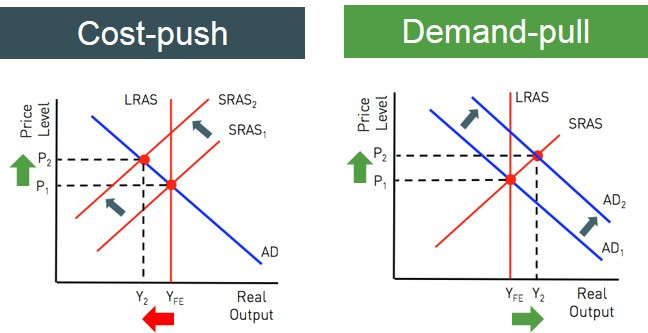
Demand-pull inflation in the AD-AS model
Focus on the right-hand panel. AD shifts right from AD1 to AD2 while SRAS and LRAS stay fixed.
Cause: Increase in aggregate demand (C, I, G, or Xn).
- Often linked to expansionary fiscal policy (deficit spending).
- Or expansionary monetary policy.
Results:
- Higher price level
- Higher real GDP
- Inflationary gap
Long run adjustment brings GDP back to potential, but at a higher price level.
Cost-Push Inflation
Now hold AD constant and shift SRAS.
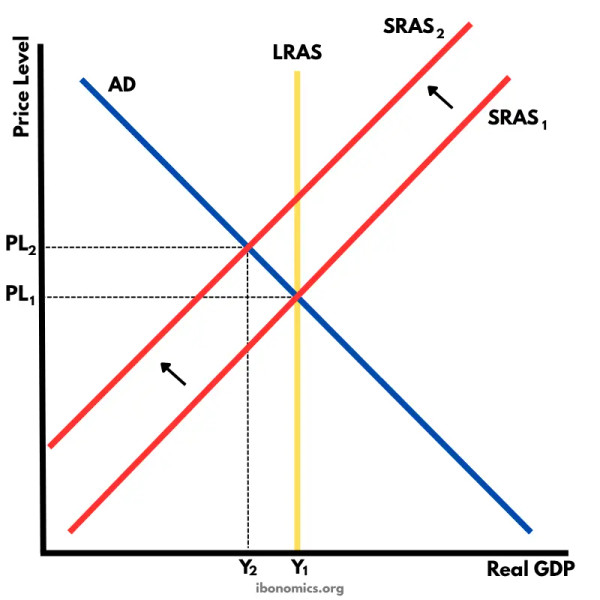
Cost-push inflation in the AD-AS model
SRAS shifts left from SRAS1 to SRAS2.
Cause: Higher production costs (wages, oil, supply shocks).
Results:
- Higher price level
- Lower real GDP
- Stagflation (inflation + unemployment)
Classic example: 1970s oil shocks. Oil prices spiked, SRAS shifted left, and the U.S. experienced stagflation.
Wage-Price Spiral
This is how inflation can feed on itself over time.
The economy starts with an inflationary gap. As nominal wages rise, SRAS shifts left, pushing the price level higher.
Process:
- Prices rise.
- Workers demand higher wages.
- Higher wages raise production costs.
- SRAS shifts left.
- Prices rise again.
This cycle can repeat, making inflation self-perpetuating.
Contractionary policy shifts AD left to reduce inflation.
Breaking this spiral is painful. In the early 1980s, Paul Volcker, Chair of the Federal Reserve, sharply reduced money growth. Inflation fell, but a recession followed.
3. The Quantity Theory of Money
Equation of Exchange
- = Money supply (often M1)
- = Velocity of money (how often a dollar is spent per year)
- = Price level
- = Real output (real GDP)
Total spending equals total output measured in dollars.
Velocity of Money
If people spend quickly, velocity is high. If they hold money, velocity is low.
Long-Run Assumptions
- Velocity is stable.
- Real output is determined by resources and technology.
So changes in mainly change .
In growth rate form:
If velocity is stable, then
.
Quick Calculation Example
Suppose:
- Money supply = 500 billion
- Velocity = 4
- Real GDP = 1,000 billion
Find the price level.
Be comfortable solving for any variable. On tests, they often hide one piece and expect you to rearrange the equation.
4. Monetary Neutrality
Monetary neutrality means that in the long run, changes in the money supply do not affect real variables.
If money doubles:
- Nominal wages double.
- Prices double.
- Nominal GDP doubles.
- Real GDP stays the same.
At full employment, increasing the money supply only increases the price level.
This is why long-run inflation equals the long-run growth rate of the money supply.
Key Takeaways
Demand-Pull Inflation
Rising prices caused by increased aggregate demand, usually with higher real output in the short run.
Cost-Push Inflation
Rising prices caused by falling short-run aggregate supply from higher input costs or supply shocks.
Wage-Price Spiral
A self-reinforcing cycle where higher wages raise costs and prices, prompting demands for still higher wages.
Monetary Neutrality
In the long run, changes in the money supply affect nominal variables, not real output.
Velocity of Money
The average number of times a dollar is spent on final goods and services in a period.
Quantity Theory of Money
States that MV = PY, where money growth mainly changes prices in the long run.
Inflation as a Monetary Phenomenon
Sustained money growth faster than real output growth causes long-run inflation.
Deflation
A sustained decrease in the overall price level over time.
Notes
Demand-Pull Inflation
Rising prices caused by increased aggregate demand, usually with higher real output in the short run.
Cost-Push Inflation
Rising prices caused by falling short-run aggregate supply from higher input costs or supply shocks.
Wage-Price Spiral
A self-reinforcing cycle where higher wages raise costs and prices, prompting demands for still higher wages.
Monetary Neutrality
In the long run, changes in the money supply affect nominal variables, not real output.
Velocity of Money
The average number of times a dollar is spent on final goods and services in a period.
Quantity Theory of Money
States that MV = PY, where money growth mainly changes prices in the long run.
Inflation as a Monetary Phenomenon
Sustained money growth faster than real output growth causes long-run inflation.
Deflation
A sustained decrease in the overall price level over time.
