Topic 6.2 Notes – Exchange Rates
1. What an Exchange Rate Is
An exchange rate is the price of one currency in terms of another currency.
Examples:
- U.S. dollar euros
- euro U.S. dollars
It tells you how much of Currency A you must give up to get Currency B.
In today’s world, major currencies like the U.S. dollar, euro, and yen operate in a flexible (floating) exchange rate system, where the price is determined by supply and demand in the foreign exchange (FOREX) market.
Appreciation and Depreciation
- Appreciation: a currency becomes more valuable relative to another.
- It buys more of the other currency.
- Depreciation: a currency becomes less valuable.
- It buys less of the other currency.
Exchange rates are reciprocals:
- If the dollar appreciates, the euro depreciates.
Quick Interpretation Rules
If we’re given:
- €1 = 1.20 dollars → €1 = 1.35 dollars
- It now takes more dollars to buy one euro → the dollar depreciated.
Strong vs weak currency effects:
- Strong currency → imports cheaper, exports more expensive.
- Weak currency → imports more expensive, exports cheaper.
On tests, students often just look at whether “the number went up.” Always ask: Which currency became more expensive?
2. How Exchange Rates Are Determined in a Floating System
In a floating system, currencies are traded like goods in a foreign exchange market.
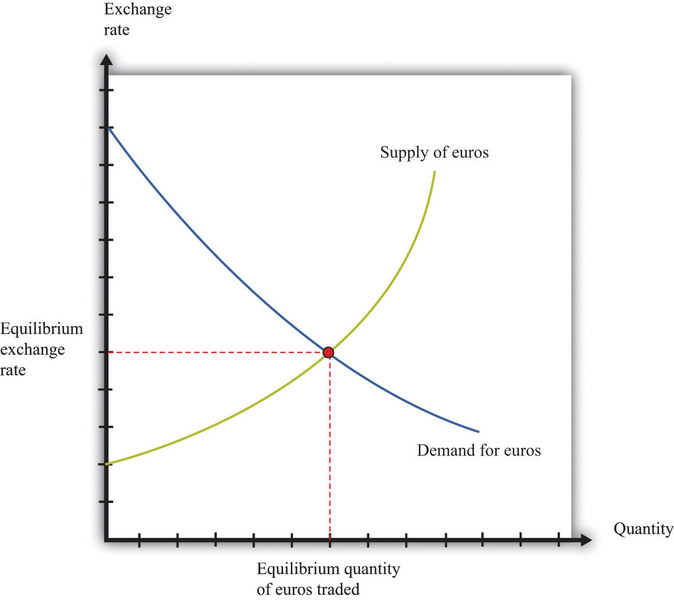
Foreign exchange market for euros
- Demand for a currency comes from foreigners who want:
- That country’s exports
- That country’s financial assets (stocks, bonds, real estate)
- Supply of a currency comes from domestic residents who want:
- Imports
- Foreign assets
The equilibrium exchange rate is at the intersection of the upward-sloping supply curve and the downward-sloping demand curve, where quantity demanded equals quantity supplied.
Four Major Shifters
1. Consumer Tastes
If Americans prefer German cars:
- Demand for euros ↑
- Euro appreciates
- Dollar depreciates
Reverse the story and you reverse the currencies.
2. Relative Income
Higher income → more spending → more imports.
If U.S. GDP rises faster than Europe’s:
- Americans buy more European goods
- Demand for euros ↑
- Dollar depreciates
If Europe grows faster:
- Demand for dollars ↑
- Dollar appreciates
3. Relative Inflation
Higher inflation makes a country’s goods relatively more expensive.
If U.S. inflation is higher than Japan’s:
- Americans shift toward Japanese goods
- Demand for yen ↑
- Dollar depreciates
This is why countries like the U.S. try to avoid high inflation. During the 1970s stagflation period, inflation weakened confidence in the dollar.
4. Speculation
Currencies are financial assets.
If investors expect:
- Higher U.S. interest rates → they buy dollars now → dollar appreciates today.
- Lower U.S. growth → they may sell dollars → dollar depreciates.
Expectations move exchange rates quickly.
3. Calculating Exchange Rates and Conversions
You must be comfortable converting both directions.
Suppose:
- dollar British pounds.
Converting
- Dollars → pounds: multiply by 0.50
- Pounds → dollars: divide by 0.50
Reciprocal:
So:
- pound dollars.
Example
A 400-dollar U.S. laptop.
Cost in pounds:
If the rate changes to:
- dollar pounds
Now:
The dollar buys fewer pounds. The dollar depreciated. U.S. goods are now cheaper for British consumers.
AP-style questions often flip the equation on purpose. Slow down and identify which currency is being priced.
4. Fixed Exchange Rates and the Gold Standard
Before the Great Depression, many countries used the gold standard.
Under the gold standard:
- Currency values were tied to gold.
- Exchange rates were essentially fixed.
- Governments promised convertibility into gold.
Problems:
- No flexibility during recessions.
- Trade imbalances persisted.
- It worsened the Great Depression because countries couldn’t adjust exchange rates to stimulate exports.
By the 1930s, countries abandoned the gold standard. Today, most major economies use floating exchange rates, where market forces determine value.
Key contrast:
- Floating system → market-determined.
- Fixed system → government-determined.
Key Takeaways
Exchange Rate
The price of one country's currency in terms of another country's currency.
Currency Appreciation and Currency Depreciation
A rise in a currency's value relative to another; a fall in its value relative to another.
Reciprocal Exchange Rates
Two countries' exchange rates are inverses, so one currency's appreciation means the other's depreciation.
Flexible Exchange Rate System
A system where currency values change based on supply and demand in foreign exchange markets.
Foreign Exchange Market
The market where buyers and sellers trade one nation's currency for another nation's currency.
Exchange Rate Calculation
Convert values by multiplying an amount in one currency by the quoted exchange rate.
Consumer Tastes and Exchange Rates
Greater preference for another country's goods raises demand for its currency and increases its value.
Relative Income and Exchange Rates
Higher income in one country increases imports, raising demand for foreign currency.
Relative Inflation and Exchange Rates
Higher inflation makes domestic goods relatively expensive, reducing demand for that country's currency.
Speculation and Exchange Rates
Expectations about future currency values cause investors to buy or sell currencies now.
Equilibrium Exchange Rate
The market price where quantity of a currency demanded equals quantity supplied.
Notes
Exchange Rate
The price of one country's currency in terms of another country's currency.
Currency Appreciation and Currency Depreciation
A rise in a currency's value relative to another; a fall in its value relative to another.
Reciprocal Exchange Rates
Two countries' exchange rates are inverses, so one currency's appreciation means the other's depreciation.
Flexible Exchange Rate System
A system where currency values change based on supply and demand in foreign exchange markets.
Foreign Exchange Market
The market where buyers and sellers trade one nation's currency for another nation's currency.
Exchange Rate Calculation
Convert values by multiplying an amount in one currency by the quoted exchange rate.
Consumer Tastes and Exchange Rates
Greater preference for another country's goods raises demand for its currency and increases its value.
Relative Income and Exchange Rates
Higher income in one country increases imports, raising demand for foreign currency.
Relative Inflation and Exchange Rates
Higher inflation makes domestic goods relatively expensive, reducing demand for that country's currency.
Speculation and Exchange Rates
Expectations about future currency values cause investors to buy or sell currencies now.
Equilibrium Exchange Rate
The market price where quantity of a currency demanded equals quantity supplied.
