Topic 2.6 Notes – Real v. Nominal GDP
1. Nominal GDP vs Real GDP
You already know GDP is the total market value of all final goods and services produced within a country in a given year. The question here is what prices we use when we measure that value.
Nominal GDP
Nominal GDP measures output using current year prices.
What it tells you:
- How much is spent on output in that year.
- The dollar value of production in “today’s dollars.”
What it doesn’t tell you:
- Whether the increase came from more production or just higher prices (inflation).
If nominal GDP rises from one year to the next, three things could have happened:
- Quantities increased
- Prices increased
- Both increased
That’s the problem. During high inflation periods, like the 1970s stagflation, nominal GDP rose partly because prices were rising rapidly, not just because output increased.
Real GDP
Real GDP measures output using constant (base year) prices.
Now we’re isolating production only. Prices are held constant, so changes reflect actual changes in output.
✔️ Big distinction to memorize:
- Nominal GDP = spending
- Real GDP = production
When economists say the economy grew 3 percent last year, they mean real GDP grew 3 percent.
2. Calculating Nominal and Real GDP
Let’s walk through it clearly.
Step 1: Choose a Base Year
The base year is the year whose prices you’ll use to compare output over time.
In the base year:
- Nominal GDP = Real GDP
- GDP Deflator = 100
Step 2: Calculate Nominal GDP
Multiply each good’s current quantity × current price.
Example:
Suppose in 2025:
- 200 laptops at 1,000 dollars
- 500 textbooks at 100 dollars
Nominal GDP =
That’s the dollar value in 2025 prices.
Step 3: Calculate Real GDP
Assume 2024 is the base year and prices were:
- Laptops 800 dollars
- Textbooks 80 dollars
Real GDP for 2025:
Notice the difference. Nominal GDP is 250,000 dollars, but real GDP is 200,000 dollars. The gap is inflation.
One warning the College Board expects you to know: using base-year prices repeatedly can overstate growth because it ignores substitution effects. In real life, agencies like the Bureau of Economic Analysis (BEA) use chain-weighted methods. For AP, you use the base-year method shown above.
3. The GDP Deflator
The GDP deflator is a price index that measures the overall price level of all domestically produced final goods and services.
Here’s the formula:
Using our example:
The deflator is 125. That means prices are 25 percent higher than in the base year.
In the base year, the deflator always equals 100 because nominal = real.
You can rearrange the formula:
If the deflator rises from 120 to 126, inflation is 5 percent.
It’s called a “deflator” because it removes the inflation part of nominal GDP.
4. Why Real GDP Matters More
Measuring Economic Growth
If nominal GDP doubles but prices double too, production didn’t change. Real GDP catches that.
During the Great Depression (1930s) and the Great Recession (2008-2009), economists focused on falling real GDP to identify recessions.
Tracking the Business Cycle
Here’s the business cycle economists use. It shows how real GDP rises and falls over time around a long-run upward trend.
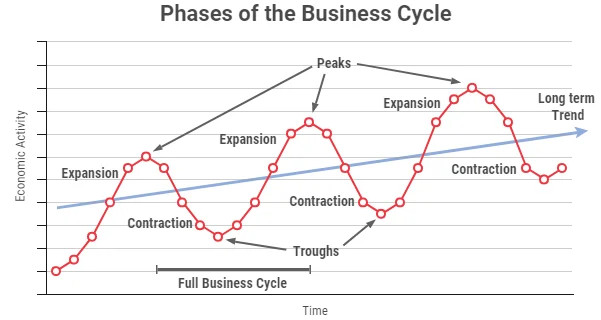
The business cycle: expansions, peaks, contractions, and troughs
Expansions move the economy upward toward a peak. Contractions move it downward toward a trough. A full business cycle runs from one peak to the next peak, or from one trough to the next trough.
Recessions are defined by declines in real GDP, not nominal GDP.
Standard of Living
We often use real GDP per capita to estimate average living standards. If real GDP rises faster than population, people are producing and consuming more on average.
Key Takeaways
Calculating Nominal GDP
Multiply each final good's current-year quantity by its current-year price, then add.
GDP Deflator
A price index equal to nominal GDP divided by real GDP, times 100.
GDP Deflator in the Base Year
It equals 100 because nominal GDP and real GDP are the same.
Why Nominal GDP Can Be Misleading
It can rise from higher prices alone, even if actual production does not increase.
Nominal GDP vs. Real GDP
Measures output using current prices versus base-year prices to separate prices from production.
Base Year and Constant Prices
The reference year whose prices are held constant to calculate inflation-adjusted output.
Calculating Real GDP
Finds inflation-adjusted output using base-year prices or by deflating nominal GDP with the GDP deflator.
Notes
Calculating Nominal GDP
Multiply each final good's current-year quantity by its current-year price, then add.
GDP Deflator
A price index equal to nominal GDP divided by real GDP, times 100.
GDP Deflator in the Base Year
It equals 100 because nominal GDP and real GDP are the same.
Why Nominal GDP Can Be Misleading
It can rise from higher prices alone, even if actual production does not increase.
Nominal GDP vs. Real GDP
Measures output using current prices versus base-year prices to separate prices from production.
Base Year and Constant Prices
The reference year whose prices are held constant to calculate inflation-adjusted output.
Calculating Real GDP
Finds inflation-adjusted output using base-year prices or by deflating nominal GDP with the GDP deflator.
