Topic 1.1 Notes – Scarcity
1. Scarcity and the Economic Problem
Scarcity exists because wants are unlimited but resources are limited.
A good is scarce if it is:
- Limited (there isn’t enough for everyone to have as much as they want)
- Desirable (people actually want it)
Air is usually not scarce. Clean drinking water in a drought is.
Scarcity applies to:
- Individuals (your time, your money)
- Firms (workers, machinery)
- Governments (tax revenue, land)
- Rich and poor countries alike
Even the United States faces trade-offs like more healthcare vs. more military spending. Time is scarce too. Studying for Macro means giving up something else.
Because of scarcity, every society must answer three questions:
- What to produce? (consumer goods vs. capital goods, military vs. education)
- How to produce? (labor-intensive vs. capital-intensive methods)
- For whom to produce? (who gets the goods and services)
Economics is the study of how societies allocate scarce resources to answer these questions.
Quick grounding:
- Microeconomics looks at individuals and firms.
- Macroeconomics looks at the economy as a whole, which is where this course lives.
2. The Four Factors of Production
These are the economic resources used to produce goods and services.
Land
All natural resources:
- Oil, water, forests, minerals, farmland
Payment = rent
Labor
Human effort, physical and mental:
- Teachers, engineers, construction workers
Payment = wages
Capital
Capital means goods used to produce other goods. It does not mean money.
Physical capital
- Machines, tools, factories, equipment, technology
Human capital
- Education, training, skills, experience
Payment = interest
⚠️ AP trap: Money is not a factor of production. It is a medium of exchange.
Entrepreneurship
The risk-taker and decision-maker who:
- Combines land, labor, and capital
- Innovates and organizes production
Examples you’ll see in textbooks: Henry Ford, Steve Jobs, Bill Gates.
Payment = profit
3. Trade-Offs and Opportunity Cost
Scarcity forces choices. Choices create costs.
Trade-Offs
All the alternatives you give up when you make a decision.
If you choose to work part-time, you give up free time and maybe study time.
Opportunity Cost
The value of the next best alternative.
Only one thing counts. The single best option you didn’t choose.
If you could:
- Work and earn 80 dollars
- Study and improve your test score
- Sleep
If you choose to study, the opportunity cost is the 80 dollars, assuming that was your next best option.
This idea shows up constantly in FRQs. Students often list multiple opportunity costs. The AP graders want the single best alternative.
The rule to remember:
The real cost of something is what you give up to get it.
4. Production Possibilities Curve PPC
The PPC model visually shows scarcity, trade-offs, and full employment.
Here’s the standard model. In this example, one good is on the vertical axis and one good is on the horizontal axis.
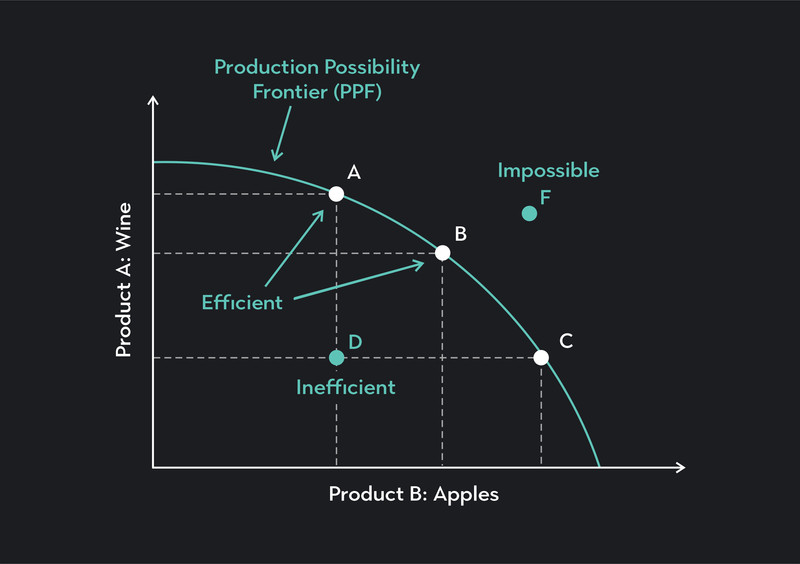
Production Possibilities Curve
What It Shows
- All possible combinations of two goods
- Given fixed resources and fixed technology
- Maximum output
Points on the Graph
- On the curve → Efficient, full employment (points like A, B, and C)
- Inside → Inefficient, unemployment or underused resources (like point D during a recession)
- Outside → Currently unattainable (like point F)
Opportunity Cost and the Slope
Moving along the curve means getting more of one good and less of another.
The slope represents opportunity cost. For example, moving from one point on the curve to another requires giving up some of the good on the vertical axis to gain more of the good on the horizontal axis.
The PPC is usually bowed outward because of increasing opportunity cost. Resources are specialized. As you shift more workers into producing one good, you start pulling workers who are better suited for the other good, so you give up more and more of that other good each time.
This model becomes huge later in Unit 1 when we talk about economic growth. Growth shifts the entire PPC outward.
5. Economic Systems
Different systems answer the three economic questions in different ways.
Traditional
- Based on customs and habits
- Seen in subsistence or tribal economies
Command
- Government makes decisions
- Example: Soviet Union, modern North Korea
Market
- Private property
- Decisions made by buyers and sellers
- Based on supply and demand
- Rooted in laissez-faire philosophy
Mixed
- Combination of market and government
- The United States and China are mixed economies
No modern economy is purely market or purely command.
Key Takeaways
Scarcity
The condition in which unlimited wants exceed limited resources.
Economic Resources / Factors Of Production
The inputs used to produce goods and services: land, labor, capital, and entrepreneurship.
Land
Natural resources used in production, such as water, minerals, forests, and oil.
Labor
Human effort, skills, and time used to produce goods and services.
Capital
Man-made resources used to produce other goods and services, including physical and human capital.
Physical Capital Vs. Human Capital
Physical capital is man-made productive equipment; human capital is workers' education, skills, and knowledge.
Entrepreneurship
The ability to combine resources and take risks to create goods, services, or businesses.
Trade-Offs
All the alternatives given up when a choice is made.
Opportunity Cost
The value of the next best alternative forgone when a choice is made.
Basic Economic Questions
Every economy must decide what to produce, how to produce, and for whom to produce.
Economic Systems
Traditional, command, market, and mixed systems differ in how they allocate scarce resources.
Notes
Scarcity
The condition in which unlimited wants exceed limited resources.
Economic Resources / Factors Of Production
The inputs used to produce goods and services: land, labor, capital, and entrepreneurship.
Land
Natural resources used in production, such as water, minerals, forests, and oil.
Labor
Human effort, skills, and time used to produce goods and services.
Capital
Man-made resources used to produce other goods and services, including physical and human capital.
Physical Capital Vs. Human Capital
Physical capital is man-made productive equipment; human capital is workers' education, skills, and knowledge.
Entrepreneurship
The ability to combine resources and take risks to create goods, services, or businesses.
Trade-Offs
All the alternatives given up when a choice is made.
Opportunity Cost
The value of the next best alternative forgone when a choice is made.
Basic Economic Questions
Every economy must decide what to produce, how to produce, and for whom to produce.
Economic Systems
Traditional, command, market, and mixed systems differ in how they allocate scarce resources.
