Topic 6.1 Notes – Balance of Payments Accounts
1. The Balance of Payments
The Balance of Payments (BOP) is an accounting system that records all transactions between a country and the rest of the world over a specific time period.
It includes:
- Trade in goods and services
- Income from investments
- Transfers like foreign aid
- Purchases and sales of assets
There are two main accounts:
- Current Account (CA)
- Capital and Financial Account (CFA)
And they follow this identity:
That equation is not theory. It is accounting. Total credits must equal total debits.
Credits vs. Debits
- Credit (+) → money flows into the country
- Debit (-) → money flows out of the country
Quick AP rule:
If dollars enter the U.S., it’s a credit. If dollars leave, it’s a debit.
This connects directly to the circular flow model. When Americans buy foreign goods, dollars leave through imports. Foreigners now hold those dollars and must use them to buy U.S. exports or U.S. financial assets. The dollars flow back through the capital and financial account.
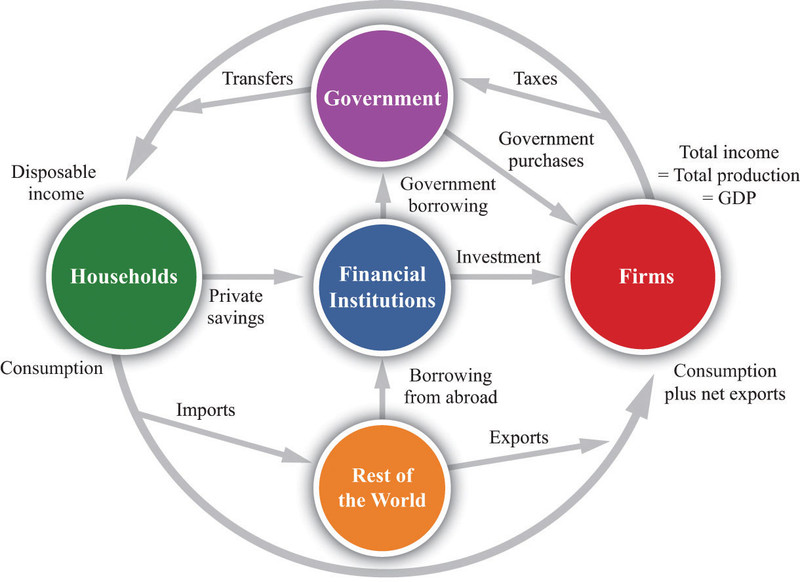
Circular flow model with the rest of the world sector
Focus on the arrows between the domestic economy and the “Rest of the World.” Imports send money out. Exports and foreign purchases of U.S. assets bring money back in. That back-and-forth movement is exactly what the Balance of Payments records.
2. The Current Account
The Current Account (CA) records flows of goods, services, income, and transfers.
Components of the Current Account
1. Net Exports (Balance of Trade)
- Exports → credit
- Imports → debit
- Trade surplus → NX > 0
- Trade deficit → NX < 0
The U.S. has run persistent trade deficits, meaning imports exceed exports.
2. Net Income from Abroad
Investment income:
- Dividends/interest earned from foreign assets → credit
- Dividends/interest paid to foreign investors → debit
Example: If U.S. investors earn profits from a factory in Mexico, that is a credit in the CA.
3. Net Unilateral Transfers
One-sided payments:
- Foreign aid sent → debit
- Remittances received → credit
Surplus vs. Deficit
- CA surplus → country exports more than it imports (net lender).
- CA deficit → country imports more than it exports (net borrower).
The CA does not have to balance. It can show a surplus or deficit in any year.
3. The Capital and Financial Account
The Capital and Financial Account (CFA) records purchases and sales of assets.
It tracks capital flows, not goods.
Types of Asset Transactions
1. Foreign Direct Investment (FDI)
Physical control of businesses or property.
- Toyota builds a factory in Texas → credit to U.S.
- U.S. firm buys a plant in Germany → debit
2. Portfolio Investment
Stocks and bonds.
- Foreigners buy U.S. Treasury bonds → credit
- Americans buy foreign stocks → debit
If foreigners are buying more U.S. assets than Americans buy foreign assets, the U.S. has a CFA surplus (capital inflow).
The U.S. often runs CFA surpluses because foreigners buy U.S. Treasury securities to finance U.S. current account deficits.
4. How the Accounts Balance and How to Calculate Them
The key identity again:
If the U.S. has:
- CA = -400 billion
Then:
- CFA must = +400 billion
Why This Happens
Suppose Americans import 200 billion dollars of electronics from South Korea.
- CA: -200 billion (debit)
South Korea now holds 200 billion dollars. Those dollars must be used to:
- Buy U.S. exports (affects CA), or
- Buy U.S. assets (affects CFA)
Most often, they purchase U.S. bonds or real estate → CFA credit.
Step-by-Step Calculation
- Identify each transaction.
- Ask: does money enter or leave?
- Classify:
- Goods/services/income/transfers → CA
- Asset purchases → CFA
- Add CA.
- Add CFA.
- Check that CA + CFA = 0.
If your numbers don’t balance on a test, something was misclassified.
Official Reserves
If a country’s accounts don’t automatically balance through private transactions, its central bank (in the U.S., the Federal Reserve) can use official reserves of foreign currency to settle differences.
Think of reserves like a savings account the Fed uses to stabilize payments.
Key Takeaways
Balance Of Payments (BOP)
An accounting record of all international transactions, equal to the current account plus the capital and financial account.
Capital And Financial Account (CFA)
Records capital transfers and cross-border purchases and sales of financial and real assets.
Net Income From Abroad
Interest, dividends, and other income received from foreign investments minus payments to foreign investors.
Net Unilateral Transfers
One-way payments such as foreign aid, remittances, or grants received minus those sent abroad.
Current Account Surplus And Deficit
A surplus means total current-account credits exceed debits; a deficit means debits exceed credits.
Credit And Debit In The BOP
Money flowing into a country is a credit; money flowing out is a debit.
BOP Accounting Identity
Credits equal debits, so the current account plus the capital and financial account equals zero.
Calculating CA, CFA, And BOP
Add each account's components, then use CA plus CFA to find the overall balance.
Current Account (CA)
Records net exports, net income from abroad, and net unilateral transfers.
Net Exports / Balance Of Trade
Exports minus imports of goods and services; positive is surplus, negative is deficit.
Capital And Financial Account Surplus And Deficit
A surplus means financial capital inflow; a deficit means financial capital outflow.
Notes
Balance Of Payments (BOP)
An accounting record of all international transactions, equal to the current account plus the capital and financial account.
Capital And Financial Account (CFA)
Records capital transfers and cross-border purchases and sales of financial and real assets.
Net Income From Abroad
Interest, dividends, and other income received from foreign investments minus payments to foreign investors.
Net Unilateral Transfers
One-way payments such as foreign aid, remittances, or grants received minus those sent abroad.
Current Account Surplus And Deficit
A surplus means total current-account credits exceed debits; a deficit means debits exceed credits.
Credit And Debit In The BOP
Money flowing into a country is a credit; money flowing out is a debit.
BOP Accounting Identity
Credits equal debits, so the current account plus the capital and financial account equals zero.
Calculating CA, CFA, And BOP
Add each account's components, then use CA plus CFA to find the overall balance.
Current Account (CA)
Records net exports, net income from abroad, and net unilateral transfers.
Net Exports / Balance Of Trade
Exports minus imports of goods and services; positive is surplus, negative is deficit.
Capital And Financial Account Surplus And Deficit
A surplus means financial capital inflow; a deficit means financial capital outflow.
