Topic 3.7 Notes – Long-Run Self-Adjustment
Long-Run Equilibrium in the AD-AS Model
Here’s what long-run equilibrium looks like on the AD-AS graph:
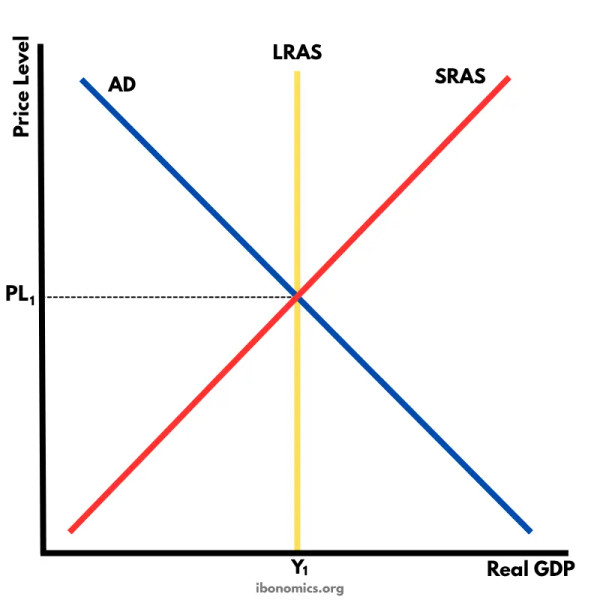
Long-run equilibrium in the AD-AS model
At this point, the AD curve, SRAS curve, and the vertical LRAS curve all intersect at a single equilibrium.
- Real GDP equals full-employment output (the level shown by the vertical LRAS line, labeled Y₁ here)
- Unemployment equals the natural rate of unemployment (NRU)
- Only frictional + structural
- No cyclical unemployment
- The price level matches what workers and firms expected
Quick grounding:
- AD shows total spending in the economy.
- SRAS reflects production given current nominal wages and input prices.
- LRAS is vertical at full-employment output because in the long run, output depends on labor, capital, technology, and institutions, not the price level.
The key idea is simple. If a shock pushes the economy away from this point, flexible wages and input prices shift SRAS until output returns to full-employment output.
Recessionary and Inflationary Gaps
When AD or SRAS shifts, the economy leaves long-run equilibrium.
Recessionary Gap
When AD shifts left, the short-run equilibrium moves to the left of the vertical LRAS line at potential GDP.
A recessionary gap exists when:
- Real GDP is below
- Unemployment is above the NRU
- AD and SRAS intersect left of LRAS
Common cause:
- Decrease in AD (collapse in consumer confidence, stock market crash, financial crisis like 2008 or the Great Depression)
Short-run results:
- Output ↓
- Unemployment ↑
- Price level often ↓ (if AD fell)
The economy is producing inside its production possibilities frontier.
Inflationary Gap
Here, AD shifts right, pushing short-run equilibrium to the right of the vertical LRAS line. Output temporarily rises above potential.
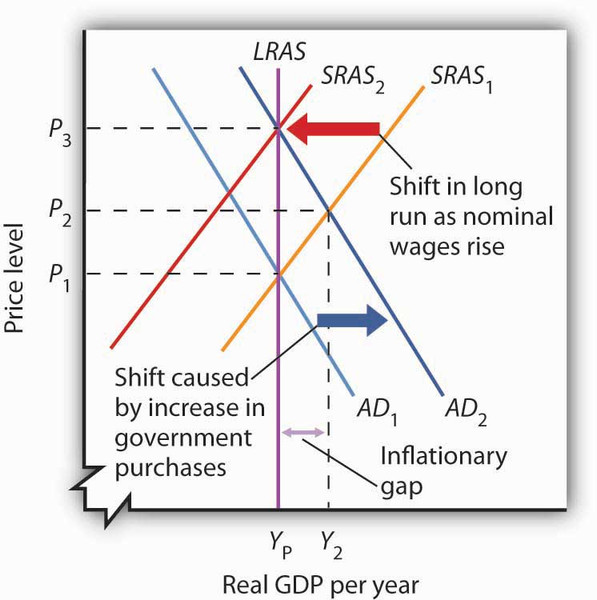
Inflationary gap in the AD-AS model
An inflationary gap exists when:
- Real GDP is above
- Unemployment is below the NRU
- Labor shortages occur
Common cause:
- Increase in AD (stimulus spending, rapid credit expansion, wartime spending, late 1960s demand surge)
Short-run results:
- Output ↑
- Unemployment ↓
- Price level ↑
The economy is temporarily producing beyond sustainable capacity.
Self-Adjustment from a Recessionary Gap
This is where the model becomes dynamic.
- High unemployment means excess labor supply.
- Workers accept lower nominal wages.
- Firms’ production costs fall.
- SRAS shifts right.
- Output increases back to .
- Unemployment returns to the natural rate.
Long-run outcome:
- Real GDP restored to full employment
- Lower price level than before
After the 2008 recession, wage growth stayed weak for years. That slow wage adjustment helped shift SRAS right over time. The same mechanism operated during the recovery from the Great Depression, though policy also played a major role there.
On an FRQ, always say wages fall → SRAS shifts right → output returns to .
Self-Adjustment from an Inflationary Gap
Now reverse the pressure.
- Very low unemployment creates labor shortages.
- Workers demand higher nominal wages.
- Firms face higher costs.
- SRAS shifts left.
- Output falls back to .
- Unemployment rises back to NRU.
Long-run outcome:
- Real GDP returns to full employment
- Higher price level
This is why inflation often follows periods of overheating. In the late 1960s, strong aggregate demand pushed unemployment very low, wages rose, and inflation accelerated as SRAS shifted left.
Inflation can be the natural byproduct of closing an inflationary gap.
Permanent Shocks and LRAS Shifts
Self-adjustment assumes productive capacity stays the same. If the economy’s resources change, LRAS shifts.
LRAS shifts right
Causes:
- More labor
- More capital
- Technological improvement
- Better education and human capital
- Institutional improvements
Result:
- Higher
- Long-run economic growth
- Expansion of the production possibilities frontier
LRAS shifts left
Causes:
- War
- Major natural disaster
- Permanent productivity decline
Result:
- Lower
- Permanently smaller economy
- Higher price level
Only LRAS shifts change long-run output. AD and SRAS shocks change output temporarily.
Key Takeaways
Long-Run Equilibrium
The point where AD, SRAS, and LRAS intersect at full-employment output.
Recessionary Gap and Self-Correction
Output is below full employment; wages fall, SRAS shifts right, and output returns to potential.
Inflationary Gap and Self-Correction
Output is above full employment; wages rise, SRAS shifts left, and output returns to potential.
Natural Rate of Unemployment
The unemployment rate that exists when the economy is producing at full-employment output.
Aggregate Demand Shock in the Long Run
A shift in demand changes output and employment temporarily, but long-run output returns to potential.
Short-Run Aggregate Supply Shock in the Long Run
A temporary supply shift changes output and prices short run, then wage adjustment restores potential output.
Permanent Negative Supply Shock
A lasting drop in productivity or resources shifts LRAS and SRAS left, lowering potential output.
Long-Run Self-Adjustment
Flexible wages and prices shift SRAS until output returns to full-employment real GDP.
Long-Run Aggregate Supply Shift and Economic Growth
Changes in resources, technology, or productivity shift potential output and show long-run economic growth.
Permanent Positive Supply Shock
A lasting increase in productivity or resources shifts LRAS and SRAS right, raising potential output.
Notes
Long-Run Equilibrium
The point where AD, SRAS, and LRAS intersect at full-employment output.
Recessionary Gap and Self-Correction
Output is below full employment; wages fall, SRAS shifts right, and output returns to potential.
Inflationary Gap and Self-Correction
Output is above full employment; wages rise, SRAS shifts left, and output returns to potential.
Natural Rate of Unemployment
The unemployment rate that exists when the economy is producing at full-employment output.
Aggregate Demand Shock in the Long Run
A shift in demand changes output and employment temporarily, but long-run output returns to potential.
Short-Run Aggregate Supply Shock in the Long Run
A temporary supply shift changes output and prices short run, then wage adjustment restores potential output.
Permanent Negative Supply Shock
A lasting drop in productivity or resources shifts LRAS and SRAS left, lowering potential output.
Long-Run Self-Adjustment
Flexible wages and prices shift SRAS until output returns to full-employment real GDP.
Long-Run Aggregate Supply Shift and Economic Growth
Changes in resources, technology, or productivity shift potential output and show long-run economic growth.
Permanent Positive Supply Shock
A lasting increase in productivity or resources shifts LRAS and SRAS right, raising potential output.
