Topic 5.7 Notes – Public Policy and Economic Growth
What Economic Growth Is and How Policy Affects It
Long-run economic growth is a sustained increase in real GDP per capita.
That means more output per person, not just more total output.
Graphically, growth shows up as increases in an economy’s productive capacity.
LRAS Shifting Right
In the AD-AS model, growth appears as a rightward shift of the long-run aggregate supply curve.
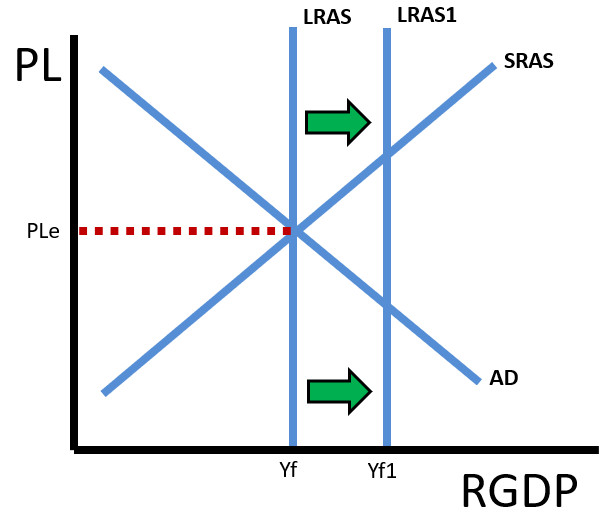
Rightward shift of LRAS (increase in potential output)
When LRAS shifts right, potential output increases from Yf to Yf1. The economy can produce more at every price level.
PPF Shifting Outward
You can see the same idea using a production possibilities frontier.
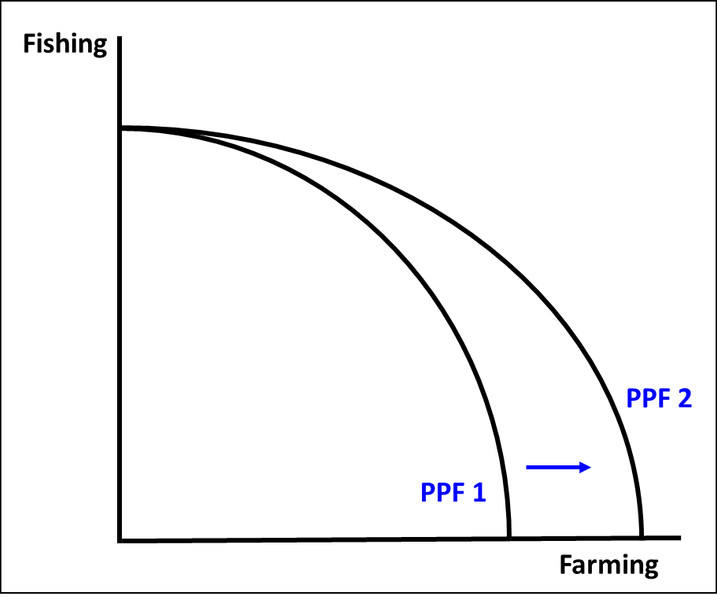
Outward shift of the production possibilities frontier
An outward shift of the PPF means the economy can produce more of all goods, like both farming and fishing in the graph.
Both visuals show the same idea: growth = greater productive capacity.
What Growth Depends On
Growth comes from improvements in:
- Labor (quantity and quality)
More workers or more skilled workers. - Human capital
Education, job training, skills. - Physical capital
Tools, factories, machines. - Technology
Better ways to combine inputs. - Natural resources
Public policy matters because it can increase productivity (output per worker) and labor force participation.
If a policy raises either of those → real GDP per capita rises → LRAS shifts right.
Government Policies That Promote Long-Run Growth
Think of four main channels.
1. Investment in Human Capital
When the government funds education or job training, workers become more productive.
Examples:
- Public education spending
- Workforce retraining programs
- The GI Bill after WWII, which expanded college access
More skilled workers → higher output per worker → LRAS shifts right → real wages rise over time.
2. Investment in Physical Capital and Infrastructure
Infrastructure includes roads, bridges, ports, power grids, broadband.
Examples:
- The U.S. Interstate Highway System
- Modern infrastructure bills expanding transportation and internet access
Infrastructure lowers production and transportation costs. That increases productivity across the entire economy. Result: LRAS shifts right.
In the short run, higher government spending can also shift AD right, but the growth effect comes from the productivity boost.
3. Policies That Encourage Technological Progress
Technology drives long-run growth.
Government can:
- Fund research and development (R&D)
- Protect intellectual property rights (patents)
- Support entrepreneurship
Historical anchors:
- Federal R&D during and after WWII
- Government-backed research that helped create the internet and GPS
New technology increases total factor productivity. Same inputs, more output. That’s pure LRAS growth.
4. Policies That Increase Labor Force Participation
Growth also happens when more people work.
Policies include:
- Lower income taxes
- Childcare support
- Immigration reform
- Welfare reform that encourages employment
More workers → more total output → higher potential GDP → LRAS shifts right.
Supply-Side Fiscal Policy
Supply-side fiscal policies are government actions designed to increase output by shifting SRAS and LRAS right, mainly by changing incentives.
Common tools:
- Lower marginal income tax rates
- Lower corporate taxes
- Reduced regulation
- Investment tax credits (tax reductions for firms that invest)
This approach became prominent in the 1980s under President Reagan.
Contrast it with demand-side fiscal policy, which focuses on shifting AD through government spending or tax changes aimed at boosting demand.
Supply-side focuses on production incentives.
How Supply-Side Policies Work in the Short Run and Long Run
Short Run
In the short run, supply-side tax cuts affect both demand and supply.
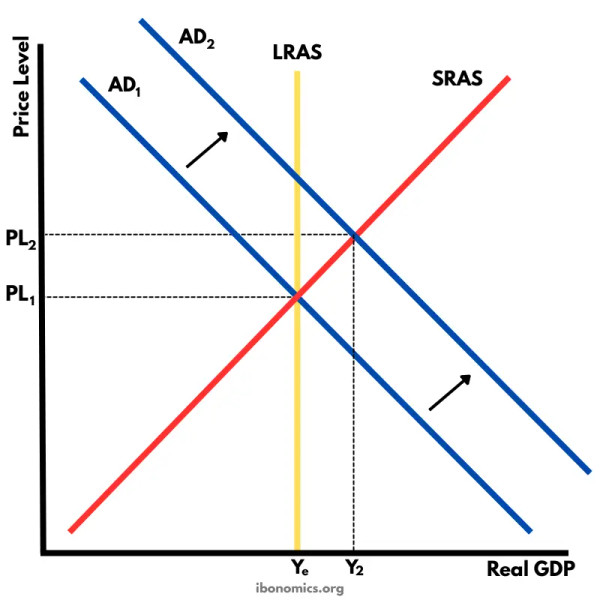
When taxes are cut:
- Households have more disposable income → AD shifts right
- Firms face lower costs → SRAS shifts right
In the diagram, AD shifts from AD1 to AD2, and SRAS also shifts right. Real GDP rises from Ye to Y2. The price level increases, but the rise is smaller than it would be if only AD had shifted.
Output rises. Price level pressure is smaller than with pure demand-side policy.
Long Run Incentive Chain
Supply-side economists argue:
- Lower taxes → higher after-tax income
- More saving
- Greater supply of loanable funds
- Lower real interest rates
- More investment
- Capital accumulation
- LRAS shifts right
Over time, this increase in capital and productive capacity shifts the vertical LRAS curve to the right, expanding the economy’s full-employment output.
They also emphasize:
- Productivity incentive: Workers keep more income, so they work more.
- Risk-taking incentive: Higher after-tax profits encourage entrepreneurship.
This connects to the debate over “trickle-down economics” and whether tax cuts “pay for themselves.” The Laffer Curve suggests tax revenue may rise if very high tax rates are cut, but that outcome is not guaranteed.
Key Takeaways
Human Capital Investment
Government spending on education and training that increases worker productivity and labor quality.
Infrastructure Investment
Government spending on transportation, utilities, and communication systems that improves productive efficiency.
Labor Force Participation Policies
Government actions that increase the number of people working or seeking work, raising output.
Supply-Side Fiscal Policies
Tax and spending policies designed to increase incentives to work, save, invest, and produce.
Supply-Side Economics vs. Demand-Side Economics
Supply-side targets SRAS and LRAS; demand-side targets aggregate demand to change output and prices.
Saving, Loanable Funds, and Investment Under Supply-Side Policy
Lower taxes can raise saving, increase loanable funds, lower real interest rates, and boost investment.
Investment Tax Credit
A tax reduction for firms that purchase new capital, encouraging business investment.
Technology, Research and Development, and Innovation Policy
Government support for research, technology, and patents increases productivity and long-run growth.
Business Tax Cuts and Deregulation
Policies that lower business taxes and rules reduce costs and increase production incentives.
Effects of Supply-Side Fiscal Policy
These policies shift SRAS and LRAS right, raising output and expanding potential GDP.
Notes
Human Capital Investment
Government spending on education and training that increases worker productivity and labor quality.
Infrastructure Investment
Government spending on transportation, utilities, and communication systems that improves productive efficiency.
Labor Force Participation Policies
Government actions that increase the number of people working or seeking work, raising output.
Supply-Side Fiscal Policies
Tax and spending policies designed to increase incentives to work, save, invest, and produce.
Supply-Side Economics vs. Demand-Side Economics
Supply-side targets SRAS and LRAS; demand-side targets aggregate demand to change output and prices.
Saving, Loanable Funds, and Investment Under Supply-Side Policy
Lower taxes can raise saving, increase loanable funds, lower real interest rates, and boost investment.
Investment Tax Credit
A tax reduction for firms that purchase new capital, encouraging business investment.
Technology, Research and Development, and Innovation Policy
Government support for research, technology, and patents increases productivity and long-run growth.
Business Tax Cuts and Deregulation
Policies that lower business taxes and rules reduce costs and increase production incentives.
Effects of Supply-Side Fiscal Policy
These policies shift SRAS and LRAS right, raising output and expanding potential GDP.
