Topic 5.4 Notes – Government Deficits and the National Debt
1. The Government Budget Balance and the National Debt
Every year the federal government creates a budget for its fiscal year (which begins October 1).
Government Budget Balance
The government budget balance is:
- Budget surplus → revenues > spending
- Budget deficit → spending > revenues
If the government runs a deficit, it must borrow to cover the gap. It borrows mainly by selling U.S. Treasury bonds to households, banks, pension funds, and foreign investors.
National Debt
The national debt is the total accumulation of all past deficits minus past surpluses.
- Deficit this year → adds to the national debt
- Surplus this year → reduces existing debt
Think of it this way:
- Deficit = one year’s shortfall
- Debt = the running total
The U.S. has run deficits in most years since 1969. Big spikes happened during:
- The Great Recession (2008-2009) due to stimulus and falling tax revenue
- The COVID‑19 pandemic (2020-2021) due to emergency relief spending
As of the early 2020s, the debt exceeded 30 trillion dollars.
Deficits often increase during expansionary fiscal policy in recessions. Surpluses are more likely during strong expansions, like the late 1990s under President Clinton.
2. What the Federal Government Spends Money On
To understand why deficits persist, you need to know where spending goes.
Mandatory Spending
Required by existing law. Congress must fund it unless laws change.
- Social Security
- Medicare and Medicaid
- Interest on the national debt
These grow automatically because:
- The population is aging.
- Health care costs rise.
- More debt → more interest payments.
Interest is especially important. It is not optional. If debt rises, interest payments rise, which increases spending further.
Discretionary Spending
Decided each year by Congress.
- Defense
- Education
- Infrastructure
- Scientific research
- Environmental programs
Important detail students miss: Defense is discretionary, not mandatory.
3. Why Governments Run Deficits
Deficits often reflect economic conditions, not irresponsibility.
During a Recession
Two things happen automatically:
- Tax revenue falls (lower income and spending).
- Transfer payments rise (unemployment benefits, welfare).
This creates larger deficits through automatic stabilizers.
Example:
- During the 2008 financial crisis, stimulus spending rose while tax revenue fell.
- During COVID‑19, relief programs dramatically increased deficits.
The U.S. Constitution does not require a balanced federal budget. That’s intentional.
If the government had to balance every year:
- In a recession → it would raise taxes and cut spending, making the recession worse.
- In inflation → it would cut taxes and increase spending, making inflation worse.
Many state and local governments must balance their budgets, which can worsen recessions because they cut spending right when the economy is weak.
4. The Burden of the National Debt
AP questions care less about the size of debt and more about its consequences.
Interest Payments and Opportunity Cost
The government must pay interest on accumulated debt.
This means:
- Higher future taxes or
- More borrowing
Those interest payments cannot be used for schools, infrastructure, or defense. That lost alternative use is the opportunity cost of debt.
Crowding Out
When the government borrows heavily:
- It increases demand in the loanable funds market.
- Interest rates may rise.
- Private investment falls.
In the loanable funds market, government borrowing shifts the demand curve to the right, raising the real interest rate from r0 to r1 and increasing the quantity of loanable funds from L0 to L1.
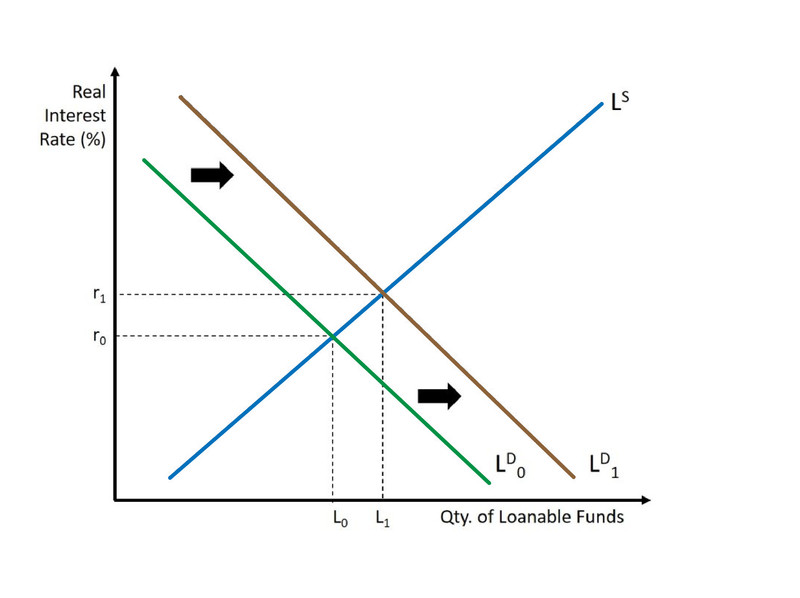
Crowding out in the loanable funds market
Less private investment today means less capital formation and slower long-run economic growth.
Who Is the Debt Owed To?
- Domestic lenders → interest payments stay within the country (mostly redistribution).
- Foreign lenders → interest payments leave the country, reducing national income.
Debt-to-GDP Ratio
The raw dollar amount matters less than the debt-to-GDP ratio.
- If GDP grows faster than debt → burden becomes manageable.
- If debt grows faster than GDP → burden increases over time.
That’s why economists focus on debt relative to the size of the economy.
Key Takeaways
Government Budget Surplus and Budget Deficit
The yearly difference between tax revenues and government spending, including transfer payments.
National Debt
The total accumulated federal debt created when yearly budget deficits require borrowing.
Burden of the National Debt
Interest on accumulated debt uses funds that could otherwise support other government priorities.
Notes
Government Budget Surplus and Budget Deficit
The yearly difference between tax revenues and government spending, including transfer payments.
National Debt
The total accumulated federal debt created when yearly budget deficits require borrowing.
Burden of the National Debt
Interest on accumulated debt uses funds that could otherwise support other government priorities.
