Topic 2.7 Notes – Business Cycles
1. What the Business Cycle Is
The business cycle is the recurring pattern of fluctuations in aggregate output (real GDP) and employment.
At its core:
- Real GDP measures total production.
- Unemployment rate measures unused labor.
- Inflation often moves with the cycle.
These fluctuations happen because of changes in aggregate demand (AD) and/or aggregate supply (AS). A financial crisis, a boom in consumer confidence, a supply shock, new technology, government policy shifts. All of these can move AD or AS and push the economy into expansion or recession.
Over time, real GDP trends upward because of:
- Growth in the labor force
- Capital accumulation
- Technological progress
But in the short run, the economy moves above and below that long-run path. Think of it as wiggles around an upward-sloping trend line.
2. Phases and Turning Points of the Business Cycle
Here’s the full picture of one cycle. Notice how real GDP moves above and below its long-run average trend over time.
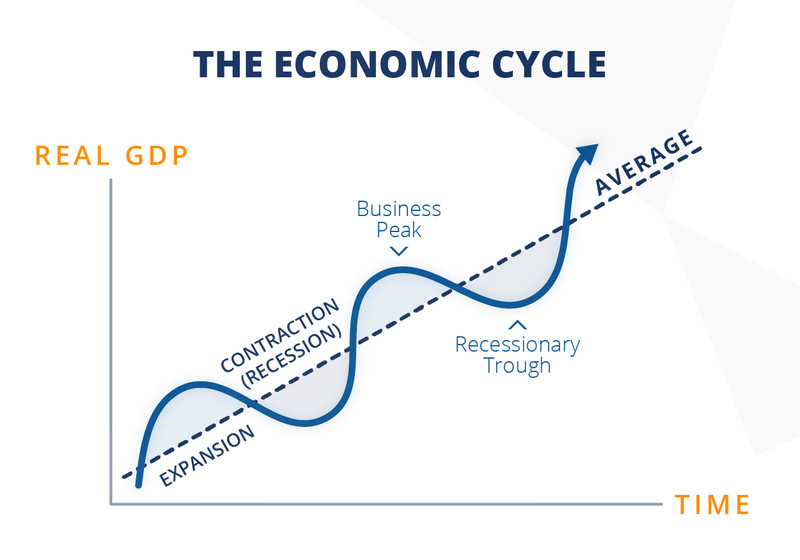
The business cycle around a rising long-run trend
There are two phases and two turning points.
Expansion (Phase 1)
During an expansion:
- Real GDP is rising
- Employment is increasing
- Unemployment is falling
- Inflation often starts to rise
If output rises above potential output, the economy enters an inflationary gap. That often happens late in an expansion when demand is strong.
Example:
- The long expansion of the 1990s tech boom
- The post-World War II economic boom
Peak (Turning Point #1)
The peak is the highest point of the cycle.
- GDP stops increasing
- The economy is often overheating
- Marks the shift from expansion to contraction
On exams, a peak is identified where the curve changes from rising to falling.
Contraction (Recession) (Phase 2)
A contraction means:
- Real GDP is decreasing
- Unemployment is rising
- Spending falls
- Inflation typically slows
A recession is defined as two consecutive quarters of negative real GDP growth.
A very severe and prolonged recession is called a depression.
Example:
- Great Depression (1930s)
- Unemployment reached about 25%
- 2008 Financial Crisis
- Collapse of housing market
- Sharp drop in AD
- Unemployment rose above 10%
Trough (Turning Point #2)
The trough is the lowest point.
- GDP stops falling
- Marks contraction to expansion
This is where recovery begins.
3. Potential Output and the Output Gap
To understand where the economy is in the cycle, you compare actual GDP to potential GDP.
Potential Output
Also called full-employment output.
It is the level of GDP where:
- Unemployment = natural rate of unemployment
- The economy is operating on the LRAS curve
Important:
- Full employment does not mean zero unemployment.
- It includes frictional and structural unemployment.
Output Gap
There are two possibilities:
| Type | What It Means | Economic Conditions |
|---|---|---|
| Inflationary Gap | Actual GDP > Potential GDP | Low unemployment, rising wages, upward pressure on prices |
| Recessionary Gap | Actual GDP < Potential GDP | High unemployment, unused resources |
On an AD-AS graph:
- Inflationary gap → equilibrium output is right of LRAS
- Recessionary gap → equilibrium output is left of LRAS
This shows up constantly in FRQs where you must identify whether the economy is above or below full employment.
4. How AD and AS Drive the Cycle
Business cycles are caused by shifts in AD and/or AS.
Expansion Example
Suppose consumer confidence rises.
- Consumption increases
- AD shifts right
- GDP rises
- Unemployment falls
If the increase is large, the economy may move into an inflationary gap.
Contraction Example
During the 2008 Financial Crisis:
- Housing prices collapsed
- Wealth fell
- Investment spending dropped
- AD shifted left
- GDP fell sharply
- Unemployment spiked
That leftward AD shift created a recessionary gap.
The Long-Run Perspective
Even though we cycle through expansions and recessions, the LRAS curve shifts right over time because of:
- Technology improvements
- Growth in capital
- Labor force growth
That’s why the long-run trend of real GDP is upward, even though the short run fluctuates.
On AP questions, be clear about whether they are asking about:
- A short-run fluctuation (business cycle)
- Or long-run economic growth (shifts in LRAS)
They are related but not the same thing.
Key Takeaways
Business Cycle
Short-run fluctuations in real output and employment around the economy's long-run growth trend.
Expansion and Recession
Expansion is rising real GDP and employment; recession is declining real GDP and employment.
Peak and Trough
Peak is the highest point before decline; trough is the lowest point before recovery.
Output Gap
The difference between actual real GDP and potential real GDP.
Potential Output / Full-Employment Output
The real GDP level produced when unemployment equals the natural rate.
Inflationary Gap and Recessionary Gap
Inflationary gap means actual output exceeds potential; recessionary gap means actual output is below potential.
Notes
Business Cycle
Short-run fluctuations in real output and employment around the economy's long-run growth trend.
Expansion and Recession
Expansion is rising real GDP and employment; recession is declining real GDP and employment.
Peak and Trough
Peak is the highest point before decline; trough is the lowest point before recovery.
Output Gap
The difference between actual real GDP and potential real GDP.
Potential Output / Full-Employment Output
The real GDP level produced when unemployment equals the natural rate.
Inflationary Gap and Recessionary Gap
Inflationary gap means actual output exceeds potential; recessionary gap means actual output is below potential.
