Topic 3.3 Notes – Short-Run Aggregate Supply (SRAS)
1. What Short-Run Aggregate Supply Is
Short-Run Aggregate Supply (SRAS) shows the relationship between the price level (PL) and the quantity of real GDP supplied by firms.
In the AD-AS graph below, the upward-sloping red curve is SRAS. It intersects the downward-sloping AD curve at price level PL1 and output Y1. The vertical line represents LRAS, or full-employment output.

AD-AS model with SRAS and LRAS
Two key ideas:
- The curve is upward sloping.
- A change in the price level causes a movement along SRAS.
- A change in production costs or expectations causes the entire curve to shift.
Quick grounding reminder:
- In the AD-AS model, short-run equilibrium happens where AD intersects SRAS.
- LRAS represents full-employment output.
- SRAS explains why the economy can temporarily produce above or below full employment.
2. Why the SRAS Curve Slopes Upward
The upward slope comes from sticky wages and sticky input prices.
In the short run:
- Many workers are on contracts.
- Nominal wages adjust slowly.
- Other costs like rent or supplier contracts don’t instantly change.
What happens when the price level rises
- The overall price level increases.
- Firms sell output at higher prices.
- Wages haven’t adjusted yet.
- Profit margins increase.
- Firms hire more workers and expand production.
- Real GDP rises → unemployment falls.
What happens when the price level falls
- Output prices fall.
- Wages remain temporarily high.
- Profits shrink.
- Firms cut output and lay off workers.
- Real GDP falls → unemployment rises.
So along SRAS:
Higher price level → higher output → lower unemployment.
That short-run trade-off connects directly to the Short-Run Phillips Curve you’ll study later.
3. Shifts of the SRAS Curve
A shift happens when production costs change at every price level. Use the acronym RAP:
- Resource prices
- Actions of government
- Productivity
Resource Prices
Includes:
- Wages
- Oil and energy
- Raw materials
If resource costs rise → SRAS shifts left (less output at every PL).
If costs fall → SRAS shifts right.
Classic example:
1970s Oil Shocks. OPEC sharply raised oil prices. Production costs jumped. SRAS shifted left. The result was stagflation: high inflation and high unemployment at the same time.
Actions of Government
- Business taxes
- Subsidies
- Regulations
Higher taxes or stricter regulations raise production costs → SRAS left.
Subsidies or business tax cuts lower costs → SRAS right.
Real-world example:
New environmental regulations, like carbon restrictions, raise compliance costs and shift SRAS left.
Productivity and Technology
Better technology, automation, improved worker skills, or more capital increase productivity.
Higher productivity lowers per-unit costs → SRAS shifts right.
Example:
- Automation in Japan increasing output per worker.
- AI adoption reducing labor costs.
Expected Inflation
This one shows up constantly in FRQs.
If workers expect higher inflation:
- They demand higher nominal wages.
- Firms face higher costs.
- SRAS shifts left.
The Volcker disinflation in the early 1980s is a great anchor. When the Federal Reserve under Paul Volcker crushed inflation, inflation expectations fell over time. That helped reduce wage pressures and shift SRAS right in the long run.
4. Movement Along SRAS and the Inflation-Unemployment Trade-Off
When AD shifts, you move along SRAS.
If AD increases:
- Price level rises.
- Output rises.
- Firms hire more workers.
- Unemployment falls.
- Inflation increases.
If AD decreases:
- Price level falls.
- Output falls.
- Unemployment rises.
The graph below shows AD shifting left from AD0 to AD1. Notice how the economy moves along the upward-sloping SRAS curve, leading to a lower price level and lower real GDP.
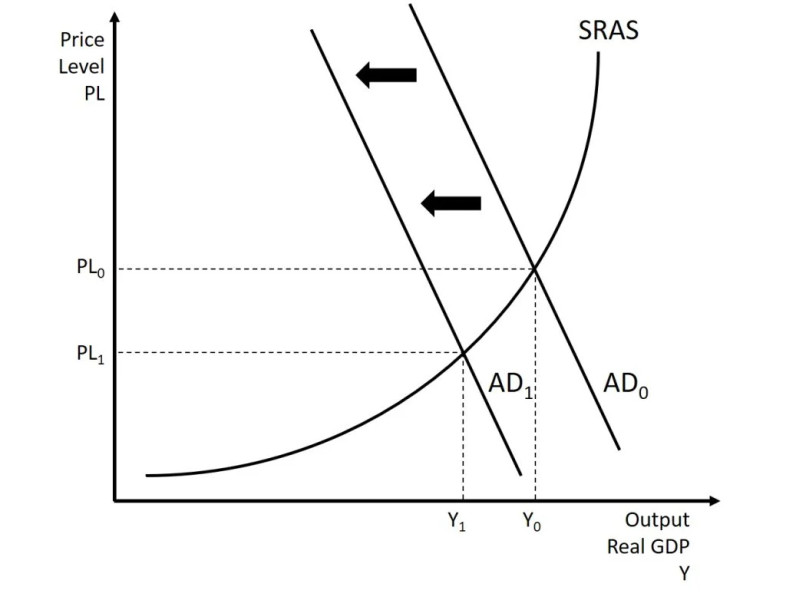
AD shift and movement along SRAS
This is why we say there’s a short-run trade-off between inflation and unemployment. An increase in AD raises inflation and lowers unemployment. A decrease in AD lowers inflation and raises unemployment.
Important distinction that trips people up:
- Demand shock → movement along SRAS.
- Supply shock (like oil prices) → shift of SRAS.
If a question says inflation rose because oil prices increased, that’s a leftward SRAS shift, not movement along the curve.
Key Takeaways
Short-Run Aggregate Supply (SRAS)
The relationship between the price level and real output firms produce in the short run.
Movement Along SRAS
A change in the overall price level causes a change in real output supplied.
SRAS Shifters
Changes in production costs, inflationary expectations, resources, government policy, or productivity shift the curve.
RAP: Resource Prices and Availability, Government Actions, Productivity and Technology
The main short-run supply shifters: input costs and availability, policy changes, and efficiency.
Inflationary Expectations and SRAS
Higher expected inflation raises input costs and shifts short-run aggregate supply left.
Short-Run Inflation-Unemployment Trade-Off
Along SRAS, higher price levels are associated with higher output, more employment, and lower unemployment.
Upward-Sloping SRAS And Sticky Input Costs
Higher price levels raise output because wages and input prices are sticky short run.
Notes
Short-Run Aggregate Supply (SRAS)
The relationship between the price level and real output firms produce in the short run.
Movement Along SRAS
A change in the overall price level causes a change in real output supplied.
SRAS Shifters
Changes in production costs, inflationary expectations, resources, government policy, or productivity shift the curve.
RAP: Resource Prices and Availability, Government Actions, Productivity and Technology
The main short-run supply shifters: input costs and availability, policy changes, and efficiency.
Inflationary Expectations and SRAS
Higher expected inflation raises input costs and shifts short-run aggregate supply left.
Short-Run Inflation-Unemployment Trade-Off
Along SRAS, higher price levels are associated with higher output, more employment, and lower unemployment.
Upward-Sloping SRAS And Sticky Input Costs
Higher price levels raise output because wages and input prices are sticky short run.
