Topic 3.9 Notes – Automatic Stabilizers
1. What Automatic Stabilizers Are
Automatic stabilizers are government tax and spending policies that change automatically as real GDP changes, helping moderate recessions and expansions.
Two key features:
- They are built into existing law (no new legislation required).
- They operate through the federal budget by changing tax revenue and government spending.
Connect this to what you already know:
- A recessionary gap means real GDP is below potential and unemployment is high.
- An inflationary gap means real GDP is above potential and prices are rising.
- In the AD-AS model, automatic stabilizers soften swings in aggregate demand (AD).
Here’s the business cycle they’re trying to smooth out:
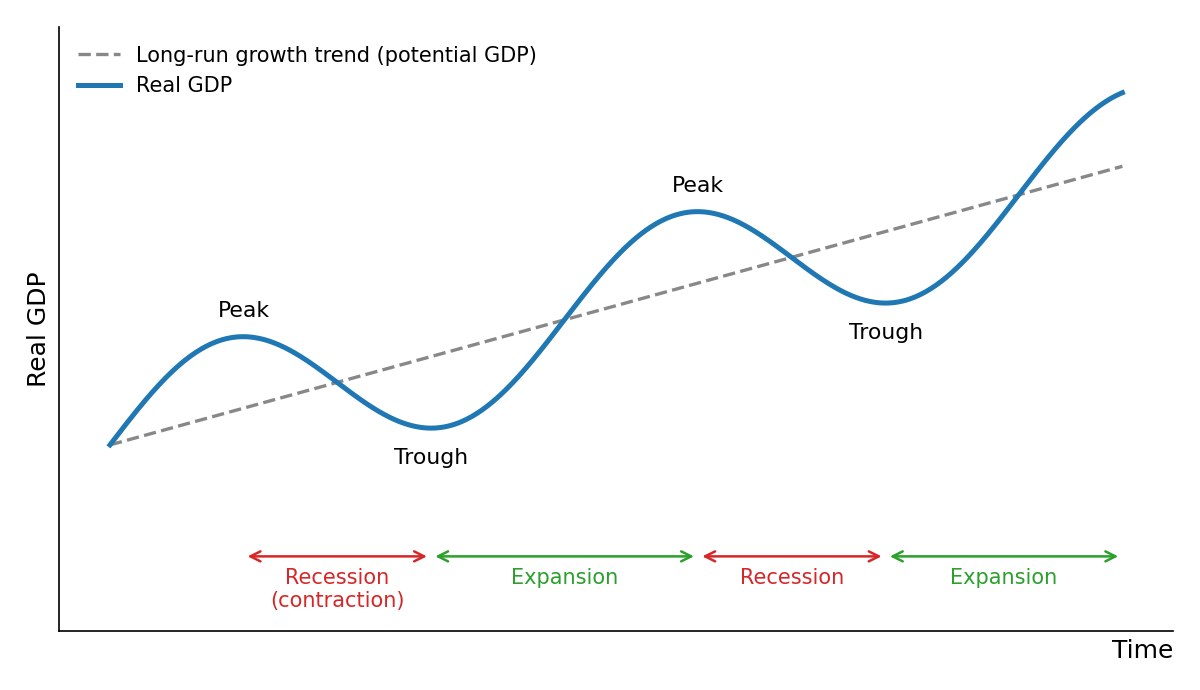
The business cycle: real GDP swings around its long-run growth trend through peaks, recessions, troughs, and expansions
Think of automatic stabilizers as guardrails along this curve. They do not eliminate expansions or recessions. They reduce how extreme the peaks and troughs become.
2. The Main Types of Automatic Stabilizers
AP focuses on two major categories: progressive income taxes and transfer payments/social programs.
A. Progressive Income Taxes
A progressive tax system taxes higher income at higher marginal rates.
What happens automatically:
- When GDP rises (expansion)
- Incomes increase.
- People move into higher tax brackets.
- Tax revenues increase automatically.
- Disposable income grows more slowly than total income.
- Consumption is restrained → AD rises less → inflation pressure cools.
- When GDP falls (recession)
- Incomes decrease.
- People move into lower tax brackets.
- Tax revenues decrease automatically.
- Disposable income does not fall as much as income.
- Consumption falls less → AD doesn’t drop as sharply.
That phrase shows up constantly on tests:
“Tax revenues decrease automatically as GDP falls.”
This was very visible during the Great Depression and again during the 2008 Great Recession, when falling incomes sharply reduced federal tax revenues without Congress changing tax rates.
B. Transfer Payments and Social Programs
Transfer payments are government payments where no good or service is received in return.
Key examples you should know:
- Unemployment insurance
- Temporary Assistance for Needy Families (TANF)
- Food assistance programs
- Medicaid (income-based eligibility)
How they stabilize:
- During a recession
- Unemployment rises.
- More people qualify for unemployment benefits and TANF.
- Government spending on transfers increases automatically.
- Recipients spend that income → AD increases.
- The downturn is cushioned.
- During an expansion
- Fewer people qualify.
- Transfer payments decrease automatically.
- Government spending falls.
- AD is restrained.
During the 2008 financial crisis, unemployment insurance payouts surged automatically as millions lost jobs. Congress later passed discretionary stimulus too, but the automatic stabilizers kicked in immediately.
3. How Automatic Stabilizers Moderate the Business Cycle
Think in terms of aggregate demand.
In the AD-AS model, a recession shows up as a leftward shift of aggregate demand, and an expansion shows up as a rightward shift.

AD-AS model with shifts in aggregate demand
During a Recession
- GDP ↓
- Tax revenue ↓
- Transfer payments ↑
- Budget deficit ↑ automatically
- Disposable income falls less
- AD decreases by less
Focus on the right-hand panel where AD shifts left. Automatic stabilizers reduce the size of that leftward shift, cushioning the drop in real GDP and the price level.
This creates a cyclical deficit. It happens because of the economy, not because policymakers voted to spend more.
During an Expansion
- GDP ↑
- Tax revenue ↑
- Transfer payments ↓
- Budget deficit shrinks (or surplus grows)
- Disposable income rises more slowly
- AD increases less
Now look at the left-hand panel where AD shifts right. Automatic stabilizers make that rightward shift smaller, helping prevent excessive inflation.
This can create a cyclical surplus, like the federal budget surpluses in the late 1990s during strong economic growth.
4. What Automatic Stabilizers Do and Do Not Do
What They Do
- Support the economy during recessions.
- Prevent overheating during expansions.
- Reduce the size of business cycle swings.
- Avoid recognition and implementation lags because they’re automatic.
What They Do Not Do
- They do not eliminate the business cycle.
- They do not replace discretionary fiscal policy like stimulus checks or tax reform.
- They do not affect long-run aggregate supply.
A common mistake on FRQs is mixing them up with discretionary policy. If Congress passes a new stimulus bill, that is not an automatic stabilizer. If unemployment benefits increase because more people qualify under existing law, that is.
Key Takeaways
Automatic Stabilizers
Built-in fiscal policies that automatically reduce swings in real GDP, employment, and inflation.
Progressive Income Tax
A tax system in which higher incomes are taxed at higher marginal rates.
Tax Revenues in Recessions and Expansions
They fall when GDP falls, but rise when GDP rises, helping stabilize consumption.
Transfer Payments as Automatic Stabilizers
Government payments to households rise in downturns and fall in expansions, cushioning income changes.
Unemployment Benefits
Payments to eligible jobless workers that increase automatically during recessions.
Temporary Assistance for Needy Families (TANF)
An antipoverty program providing temporary cash assistance to low-income families, especially during downturns.
Automatic Stabilizers and Budget Balance
They tend to increase deficits in recessions and increase surpluses or reduce deficits in booms.
How Automatic Stabilizers Moderate Business Cycles
They increase spending in recessions and restrain it in booms, reducing extremes.
Notes
Automatic Stabilizers
Built-in fiscal policies that automatically reduce swings in real GDP, employment, and inflation.
Progressive Income Tax
A tax system in which higher incomes are taxed at higher marginal rates.
Tax Revenues in Recessions and Expansions
They fall when GDP falls, but rise when GDP rises, helping stabilize consumption.
Transfer Payments as Automatic Stabilizers
Government payments to households rise in downturns and fall in expansions, cushioning income changes.
Unemployment Benefits
Payments to eligible jobless workers that increase automatically during recessions.
Temporary Assistance for Needy Families (TANF)
An antipoverty program providing temporary cash assistance to low-income families, especially during downturns.
Automatic Stabilizers and Budget Balance
They tend to increase deficits in recessions and increase surpluses or reduce deficits in booms.
How Automatic Stabilizers Moderate Business Cycles
They increase spending in recessions and restrain it in booms, reducing extremes.
