Topic 6.3 Notes – The Foreign Exchange Market
1. The Foreign Exchange Market
The foreign exchange market (FOREX) is where one country’s currency is exchanged for another. The “price” in this market is the exchange rate, which is the value of one currency in terms of another. For example, if 1 euro equals 1.10 dollars, then 1 euro costs 1.10 dollars.
In AP Macro, assume a flexible exchange rate system:
- No fixed peg set by the government
- Exchange rates are determined by supply and demand
Here’s the standard model you’ll draw for a currency market.
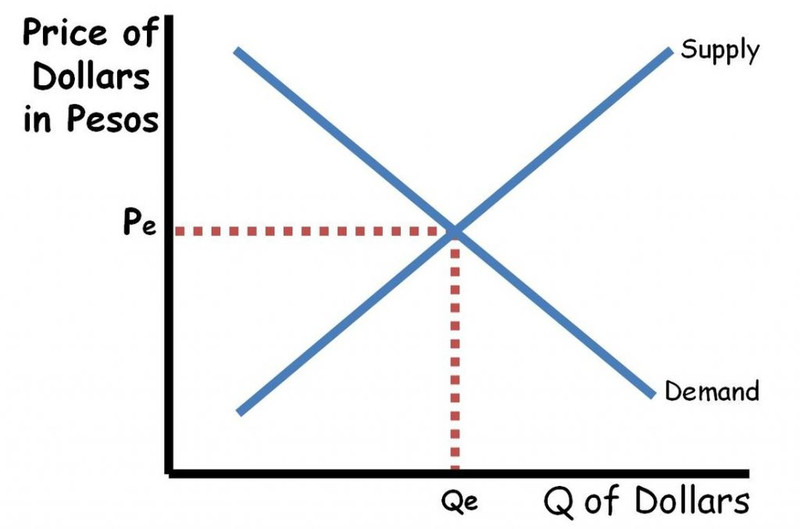
Foreign exchange market for dollars
- Y-axis: Exchange rate (price of the currency)
- X-axis: Quantity of currency
- Demand curve: downward sloping
- Supply curve: upward sloping
In this example, the vertical axis shows the price of dollars in pesos, and the horizontal axis shows the quantity of dollars. The intersection gives the equilibrium exchange rate and quantity.
This market connects to the flow of goods, services, and financial capital between countries.
2. Demand and Supply of a Currency
When you feel stuck, ask yourself one question: Who needs this currency, and why?
Demand for a Currency
Demand = foreigners wanting your currency.
Foreigners demand dollars in order to:
- Buy U.S. goods and services (U.S. exports)
- Invest in U.S. financial assets (stocks, bonds, real estate)
The demand curve is downward sloping because of an inverse relationship:
- Higher exchange rate (stronger dollar) → U.S. goods are more expensive → foreigners buy fewer dollars
- Lower exchange rate (weaker dollar) → U.S. goods are cheaper → foreigners buy more dollars
Demand increases (shifts right) when:
- Foreign income rises (they can afford more imports)
- U.S. interest rates rise (U.S. assets are more attractive)
- U.S. inflation is lower than other countries
- Tastes shift toward U.S. goods
- Speculators expect the dollar to appreciate
A rightward shift in demand causes the dollar to appreciate.
Supply of a Currency
Supply = domestic residents supplying their currency to buy foreign currency.
Americans supply dollars to:
- Buy foreign goods and services (imports)
- Invest in foreign financial assets
The supply curve is upward sloping because of a direct relationship:
- Higher exchange rate → foreign currency is cheaper per dollar → Americans buy more imports → supply of dollars increases
- Lower exchange rate → supply of dollars decreases
Supply increases (shifts right) when:
- U.S. income rises (more imports)
- Foreign interest rates rise (Americans invest abroad)
- U.S. inflation is higher than other countries
- Tastes shift toward foreign goods
- Speculators expect the dollar to depreciate
A rightward shift in supply causes the dollar to depreciate.
Students often mix this up with demand for money. This is different. It’s demand for currency in international trade and finance.
3. Exchange Rate Equilibrium
Equilibrium occurs where quantity demanded equals quantity supplied.
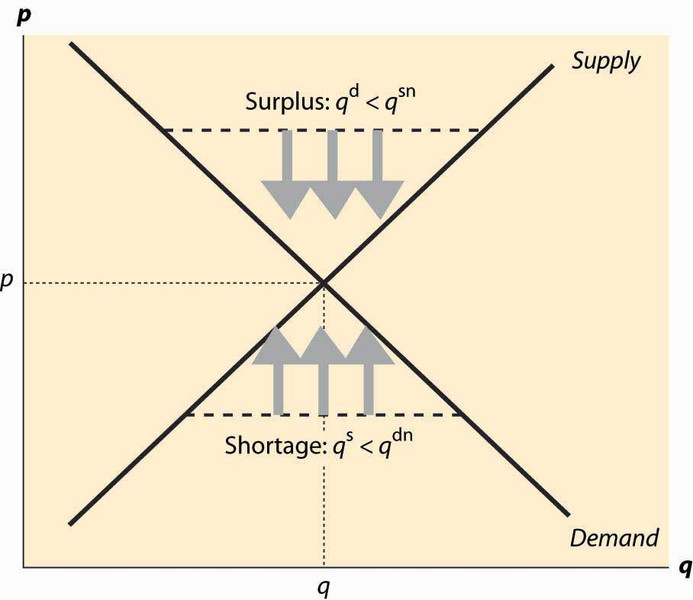
Exchange rate equilibrium with surplus and shortage
The graph shows the equilibrium exchange rate at the intersection of supply and demand.
At this exchange rate:
- No shortage
- No surplus
- The market clears
If the exchange rate is above equilibrium:
- Quantity supplied > quantity demanded
- Surplus of currency
- Currency depreciates (price falls)
If the exchange rate is below equilibrium:
- Quantity demanded > quantity supplied
- Shortage of currency
- Currency appreciates (price rises)
In a flexible system, market forces push the rate back to equilibrium automatically.
4. Appreciation, Depreciation, and Real-World Connections
Appreciation vs Depreciation
| Appreciation | Depreciation | |
|---|---|---|
| What happens? | Currency becomes stronger | Currency becomes weaker |
| Exchange rate | Rises | Falls |
| Exports | Decrease (more expensive abroad) | Increase (cheaper abroad) |
| Imports | Increase (cheaper domestically) | Decrease (more expensive domestically) |
Interest Rates and the Federal Reserve
Interest rates strongly affect currency demand.
If the Federal Reserve increases the money supply:
- Interest rates fall
- Foreign investment in U.S. assets decreases
- Demand for dollars falls
- Dollar depreciates
This happened after the 2008 financial crisis, when the Fed lowered rates to stimulate the economy.
If the Fed decreases the money supply:
- Interest rates rise
- Foreign investors buy more U.S. assets
- Demand for dollars rises
- Dollar appreciates
You saw this in 2022-2023, when the Fed raised rates to fight inflation and the dollar strengthened.
One subtle point that shows up on tests:
Higher interest rates reduce domestic borrowing and physical investment, but they increase foreign purchases of financial assets like bonds.
Key Takeaways
Foreign Exchange Market
The market where one country's currency is exchanged for another country's currency.
Equilibrium Exchange Rate
The exchange rate at which the quantity of a currency demanded equals the quantity supplied.
Exchange Rate Adjustment To Disequilibrium
Shortages raise the exchange rate and surpluses lower it until equilibrium is restored.
Flexible Exchange Rate System
A system where currency values are determined by market demand and supply.
Determinants Of Currency Demand
Tastes, foreign income, domestic prices, expected appreciation, and domestic interest rates can shift demand.
Demand And Supply Of Currency
The amounts of a currency buyers want and sellers offer at different exchange rates.
Sources Of Currency Demand And Supply
Demand comes from foreigners buying domestic goods and assets; supply comes from domestic purchases abroad.
Currency Demand And Supply Curves
Demand slopes downward and supply slopes upward as exchange rates change quantity demanded and supplied.
Currency Shortage And Surplus In The Foreign Exchange Market
A shortage means quantity demanded exceeds supplied; a surplus means quantity supplied exceeds demanded.
Currency Appreciation And Depreciation
An increase or decrease in a currency’s value relative to another currency.
Exchange Rate
The price of one currency in terms of another currency.
Notes
Foreign Exchange Market
The market where one country's currency is exchanged for another country's currency.
Equilibrium Exchange Rate
The exchange rate at which the quantity of a currency demanded equals the quantity supplied.
Exchange Rate Adjustment To Disequilibrium
Shortages raise the exchange rate and surpluses lower it until equilibrium is restored.
Flexible Exchange Rate System
A system where currency values are determined by market demand and supply.
Determinants Of Currency Demand
Tastes, foreign income, domestic prices, expected appreciation, and domestic interest rates can shift demand.
Demand And Supply Of Currency
The amounts of a currency buyers want and sellers offer at different exchange rates.
Sources Of Currency Demand And Supply
Demand comes from foreigners buying domestic goods and assets; supply comes from domestic purchases abroad.
Currency Demand And Supply Curves
Demand slopes downward and supply slopes upward as exchange rates change quantity demanded and supplied.
Currency Shortage And Surplus In The Foreign Exchange Market
A shortage means quantity demanded exceeds supplied; a surplus means quantity supplied exceeds demanded.
Currency Appreciation And Depreciation
An increase or decrease in a currency’s value relative to another currency.
Exchange Rate
The price of one currency in terms of another currency.
