Topic 2.4 Notes – Price Indices and Inflation
1. The Consumer Price Index and What It Measures
A price index measures the average change in prices over time for a fixed basket of goods and services.
Consumer Price Index (CPI)
The CPI:
- Measures the cost of a fixed market basket of goods and services bought by the typical urban household.
- Is calculated by the Bureau of Labor Statistics (BLS).
- Uses a base year where CPI = 100.
- Shows how much income would need to change to maintain the same standard of living.
If CPI = 130, prices are 30% higher than in the base year.
The market basket includes categories like:
- Food and beverages
- Housing
- Transportation
- Medical care
- Clothing and other goods/services
The key word is fixed. The quantities stay the same when comparing years.
The Producer Price Index (PPI) exists, but calculating it is outside AP scope.
Inflation, Deflation, Disinflation
- Inflation = sustained increase in the general price level.
- Deflation = sustained decrease in the general price level.
- Disinflation = inflation is still positive, but slowing.
- Example: 6% → 3% is disinflation.
Inflation is measured as the percentage change in a price index (usually CPI or GDP deflator).
The Federal Reserve aims for about 2% inflation in the U.S.
Here’s the long-run pattern of inflation in the U.S. CPI. Notice the sharp spikes in the 1970s and early 1980s, often called the “Great Inflation.”
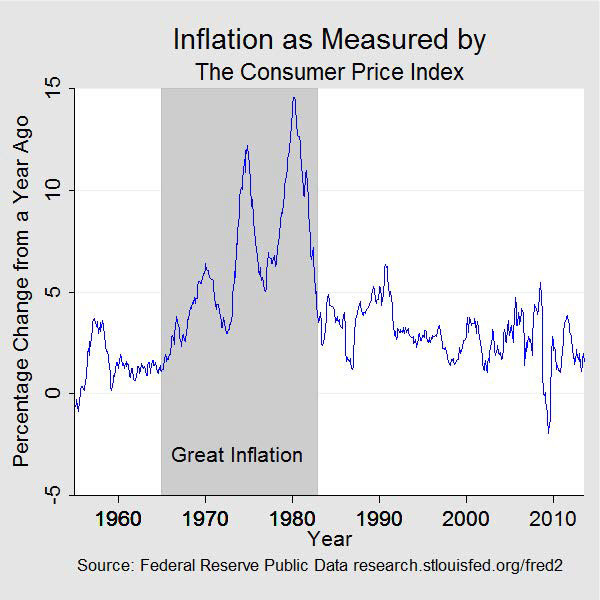
U.S. CPI inflation rate over time
Most recessions show falling inflation because demand weakens. The big exception was the 1970s, when oil shocks caused stagflation: high inflation + high unemployment + recession. That supply shock is a classic test example.
2. How to Calculate CPI and the Inflation Rate
You need to be comfortable doing this quickly.
Step 1: Calculate Market Basket Cost
Suppose the basket has:
- 4 pizzas at 8 dollars each
- 2 movie tickets at 10 dollars each
Base year cost:
Current year prices:
- Pizza = 9 dollars
- Movie ticket = 12 dollars
Current cost:
Step 2: Calculate CPI
Prices are about 15.4% higher than the base year.
Base year CPI will always equal 100.
Step 3: Calculate Inflation Rate
If CPI rises from 115 to 120:
That percent change is the inflation rate.
On multiple choice, they often skip steps and just give two CPI numbers. Go straight to percent change.
3. Nominal vs Real Values
Nominal variables are measured in current dollars.
Real variables are adjusted for inflation.
AP formula:
If your nominal wage is 50,000 dollars and CPI = 125:
Your real wage (in base-year dollars) is 40,000.
This connects directly to real GDP, which you already studied. Same idea: adjust for price level to measure true purchasing power.
If wages rise 5% but inflation is 7%, your real wage falls.
4. Problems with the CPI
The CPI is useful, but it slightly overstates inflation.
Substitution Bias (most tested)
When prices rise, consumers substitute toward cheaper goods.
Example:
- Beef prices rise.
- Consumers buy more chicken.
- CPI still assumes the old beef-heavy basket.
Result: CPI exaggerates the increase in cost of living.
Other issues:
- New products take time to enter the basket.
- Quality improvements are hard to measure.
- CPI only reflects urban consumers.
For AP, know that substitution bias causes CPI to overstate true inflation.
5. Why Inflation Measurement Matters
CPI is used to:
- Adjust Social Security payments and wages (COLAs).
- Guide Federal Reserve monetary policy.
- Compare purchasing power over time.
- Track overall economic performance with GDP and unemployment.
Inflation affects real wages, saving, borrowing, and growth. That’s why it’s one of the three core macro indicators.
Key Takeaways
Price Index
A measure showing how the overall price level changes over time relative to a base year.
Consumer Price Index (CPI)
An index measuring the cost of a fixed basket of consumer goods and services over time.
Market Basket
A fixed sample of goods and services used to track consumer price changes over time.
Base Year
The reference year for an index, assigned a value of 100.
Consumer Price Index Formula
Cost of market basket in current year divided by cost in base year, times 100.
Inflation
A sustained increase in the general price level of goods and services in an economy.
Deflation
A sustained decrease in the general price level of goods and services in an economy.
Disinflation
A decrease in the inflation rate, meaning prices rise more slowly than before.
Inflation Rate
The percentage change in a price index from one period to the next.
Inflation Rate Formula
New index minus old index, divided by old index, times 100.
Deflating a Nominal Variable
Convert a current-dollar value to a real value by adjusting with a price index.
Real Wage
Income adjusted for inflation, showing purchasing power rather than dollars received.
Substitution Bias
An upward bias in CPI caused when consumers switch to cheaper alternatives but the basket stays fixed.
CPI as a Measure of Cost of Living
It estimates how much income consumers need to maintain the same standard of living over time.
Nominal vs. Real Variables
Nominal values use current prices, while real values are adjusted for inflation.
Real Value Formula
A real value equals a nominal value divided by a price index, times 100.
Notes
Price Index
A measure showing how the overall price level changes over time relative to a base year.
Consumer Price Index (CPI)
An index measuring the cost of a fixed basket of consumer goods and services over time.
Market Basket
A fixed sample of goods and services used to track consumer price changes over time.
Base Year
The reference year for an index, assigned a value of 100.
Consumer Price Index Formula
Cost of market basket in current year divided by cost in base year, times 100.
Inflation
A sustained increase in the general price level of goods and services in an economy.
Deflation
A sustained decrease in the general price level of goods and services in an economy.
Disinflation
A decrease in the inflation rate, meaning prices rise more slowly than before.
Inflation Rate
The percentage change in a price index from one period to the next.
Inflation Rate Formula
New index minus old index, divided by old index, times 100.
Deflating a Nominal Variable
Convert a current-dollar value to a real value by adjusting with a price index.
Real Wage
Income adjusted for inflation, showing purchasing power rather than dollars received.
Substitution Bias
An upward bias in CPI caused when consumers switch to cheaper alternatives but the basket stays fixed.
CPI as a Measure of Cost of Living
It estimates how much income consumers need to maintain the same standard of living over time.
Nominal vs. Real Variables
Nominal values use current prices, while real values are adjusted for inflation.
Real Value Formula
A real value equals a nominal value divided by a price index, times 100.
