Topic 4.2 Notes – Nominal v. Real Interest Rates
1. Nominal and Real Interest Rates
Interest is the price of borrowing money and the reward for saving. When you borrow, you pay interest. When you save or buy a bond, you earn interest.
Because inflation reduces purchasing power, we separate interest into two types.
Nominal Interest Rate
The nominal interest rate is the stated rate on a loan or savings account.
- Not adjusted for inflation
- Quoted by banks, credit cards, bond issuers, and the Federal Reserve
- Tells you how many more dollars you’ll pay or receive
If a bank advertises a 7% loan, that 7% is nominal.
Real Interest Rate
The real interest rate adjusts for inflation.
- Reflects the change in purchasing power
- Tells you how many more goods and services you can actually buy
- Can be negative if inflation is higher than the nominal rate
This is just like nominal GDP vs. real GDP. Nominal is in current dollars. Real accounts for inflation.
If you earn 5% interest but inflation is 6%, your money grew in dollars but lost purchasing power. Your real return is negative.
2. The Fisher Equation and How to Calculate Interest Rates
Lenders and borrowers know inflation matters. So they build expected inflation into the interest rate. This relationship is called the Fisher equation (named after economist Irving Fisher).
The Basic Formula
After inflation actually happens, we calculate the real rate using:
On the AP exam, you almost always use simple subtraction.
Ex Ante vs. Ex Post
These terms show up in questions.
- Ex ante means “before the fact.”
- Nominal rate is set using expected inflation.
- Ex post means “after the fact.”
- Real rate is calculated using actual inflation.
Banks don’t know future inflation. They estimate it. That estimate affects the nominal rate they charge.
If expected inflation rises, nominal interest rates rise too. Lenders want to protect their real return.
Calculation Example
Suppose:
- Nominal interest rate = 9%
- Actual inflation = 4%
Now change it:
- Nominal interest rate = 6%
- Actual inflation = 8%
That −2% means lenders lost purchasing power.
On multiple choice, they often hide this in a word problem. Always subtract inflation from nominal. Then interpret who benefits.
3. Expected vs. Actual Inflation and Who Wins
Unexpected inflation redistributes wealth between borrowers and lenders.
If Actual Inflation > Expected Inflation
- Real interest rate ends up lower than planned
- Borrowers win
- Lenders lose
Borrowers repay loans with dollars that buy less than expected.
Historical anchor: In the 1970s, the U.S. experienced high and unexpected inflation during stagflation. Many lenders were hurt because inflation exceeded what they anticipated when loans were made.
If Actual Inflation < Expected Inflation
- Real interest rate ends up higher than planned
- Lenders win
- Borrowers lose
The dollars repaid are worth more than expected.
If Actual = Expected
- No surprise
- No redistribution
- Real rate equals what both sides planned
When a question says “unexpected inflation,” your brain should immediately go to redistribution effects.
4. Why Real Interest Rates Matter for the Economy
Real interest rates influence economic behavior.
For Savers
- Higher real rates → more incentive to save
- Negative real rates → saving becomes less attractive
For Borrowers and Investors
- Lower real rates → more borrowing and investment
- Higher real rates → less borrowing
Investment spending in the economy depends heavily on the real interest rate, not the nominal rate.
Connection to the Loanable Funds Market
The loanable funds market shows how the real interest rate is determined.
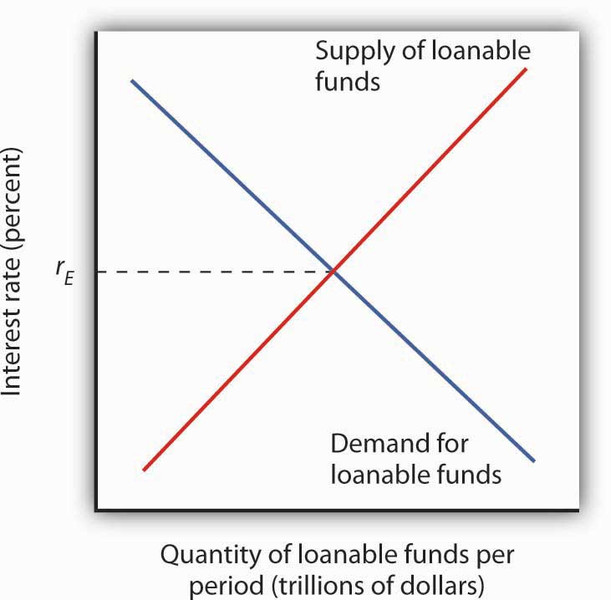
Loanable funds market equilibrium
In this market, the vertical axis shows the interest rate and the horizontal axis shows the quantity of loanable funds.
- Supply of loanable funds = savings
- Demand for loanable funds = investment
- The intersection determines the real interest rate
If expected inflation rises:
- Lenders demand a higher nominal rate
- The equilibrium nominal rate increases
The Federal Reserve controls short-term nominal rates, but what affects spending is the real rate. During periods like the early 1980s under Paul Volcker, the Fed raised nominal rates sharply to fight inflation, which pushed real rates high and slowed borrowing and investment.
Key Takeaways
Nominal And Real Interest Rate Formulas
Nominal rate = real rate + expected inflation; real rate = nominal rate - actual inflation.
Expected Inflation
The inflation rate lenders and borrowers anticipate when setting a nominal interest rate.
Nominal Vs. Real Interest Rates
The stated rate is unadjusted for inflation, while the inflation-adjusted rate shows actual borrowing cost.
Notes
Nominal And Real Interest Rate Formulas
Nominal rate = real rate + expected inflation; real rate = nominal rate - actual inflation.
Expected Inflation
The inflation rate lenders and borrowers anticipate when setting a nominal interest rate.
Nominal Vs. Real Interest Rates
The stated rate is unadjusted for inflation, while the inflation-adjusted rate shows actual borrowing cost.
