Topic 6.4 Notes – Effect of Changes in Policies and Economic Conditions on the Foreign Exchange Market
1. How the Foreign Exchange Market Works
The foreign exchange (FOREX) market is where one country’s currency is exchanged for another.
The exchange rate is the price of one currency in terms of another, like 1 U.S. dollar = 0.90 euros.
In a flexible exchange rate system, the price is determined by supply and demand.
Think of the graph below as the market for U.S. dollars measured in Mexican pesos. The vertical axis shows the price of dollars in pesos, and the horizontal axis shows the quantity of dollars.
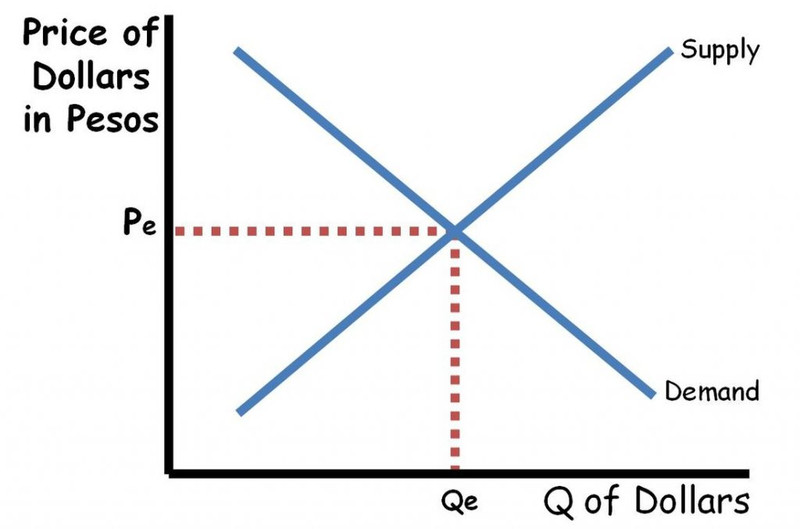
Foreign exchange market equilibrium for U.S. dollars
Who demands a currency?
Foreigners who want to buy:
- Exports (goods and services)
- Financial assets (stocks, bonds, real estate)
If Chinese consumers want U.S. iPhones, they need dollars. That increases demand for dollars, which shifts the demand curve to the right on the graph.
Who supplies a currency?
Domestic residents who want to buy:
- Imports
- Foreign assets
If Americans buy German cars, they supply dollars to get euros. On the graph, that is a rightward shift of the supply curve for dollars.
Appreciation vs. Depreciation
- Appreciation = currency becomes stronger (exchange rate rises).
- Depreciation = currency becomes weaker (exchange rate falls).
On this graph, appreciation means the price of dollars in pesos rises. Depreciation means the price of dollars in pesos falls.
- Demand ↑ → appreciation
- Supply ↑ → depreciation
On tests, you must say which curve shifts and why. “Demand for dollars increases because foreigners want U.S. bonds” earns points. Just saying “the dollar goes up” does not.
2. What Shifts Currency Demand and Supply
There are four major determinants.
A. Changes in Demand for Exports
If foreigners want more of your goods:
- Demand for your currency ↑
- Currency appreciates
Example: Global tourism to Mexico rises → demand for pesos increases → peso appreciates.
If U.S. export prices rise and foreigners buy less:
- Demand for dollars ↓
- Dollar depreciates
B. Changes in Relative Income
Income affects imports.
If U.S. income rises:
- Americans buy more imports
- Supply of dollars ↑
- Dollar depreciates
If Europe’s income rises:
- They buy more U.S. exports
- Demand for dollars ↑
- Dollar appreciates
C. Changes in Real Interest Rates
Capital flows matter as much as trade flows.
If U.S. real interest rates rise:
- Foreign investors buy U.S. bonds
- Demand for dollars ↑
- Dollar appreciates
This is what happened under Paul Volcker in the early 1980s. The Federal Reserve raised interest rates to fight inflation, and the dollar strengthened sharply.
If interest rates fall, like after the 2008 financial crisis when the Fed cut rates aggressively:
- Foreign investment falls
- Dollar demand decreases
- Dollar depreciates
D. Trade Barriers
Countries use tariffs and quotas to protect domestic jobs.
A tariff is a tax on imports.
- Revenue tariff: placed on goods not produced domestically (raises government revenue).
- Protective tariff: protects domestic producers.
A quota sets a maximum quantity of imports.
If the U.S. imposes a tariff:
- Imports fall
- Americans need less foreign currency
- Supply of dollars decreases
- Dollar appreciates
Protectionism reduces currency supply in FOREX.
3. Fiscal Policy and Exchange Rates
Fiscal policy changes aggregate demand (AD), output, and price level.
Expansionary Fiscal Policy (↑G or ↓T)
Step-by-step:
- AD increases.
- Real GDP and price level rise.
- Domestic goods become more expensive.
- Exports fall, imports rise.
- Demand for currency falls (or supply rises).
- Currency depreciates.
Large government spending, like during the Great Depression’s New Deal, increased AD. In general, higher price levels reduce export competitiveness.
Contractionary Fiscal Policy (↓G or ↑T)
- AD decreases.
- Price level falls.
- Exports rise.
- Demand for currency increases.
- Currency appreciates.
Lower domestic prices make exports more attractive.
4. Monetary Policy and Exchange Rates
Monetary policy mainly works through interest rates.
Expansionary Monetary Policy
The Federal Reserve buys bonds, lowers the reserve ratio, or lowers the discount rate.
Effects:
- Money supply ↑
- Interest rates ↓
- Foreign investment ↓
- Demand for currency ↓
- Currency depreciates
Lower rates after 2008 put downward pressure on the dollar.
Contractionary Monetary Policy
Fed sells bonds or raises rates.
Effects:
- Money supply ↓
- Interest rates ↑
- Foreign investment ↑
- Demand for currency ↑
- Currency appreciates
Again, think Volcker era and the strong dollar.
5. How to Explain FOREX Changes on Exams
Your answer should follow this chain:
- Identify determinant (income, interest rate, trade policy, fiscal policy).
- State which curve shifts.
- State direction.
- Conclude appreciation or depreciation.
Quick reference:
| Scenario | Curve Shift | Result |
|---|---|---|
| Foreign demand for exports ↑ | Demand → | Appreciation |
| Domestic income ↑ | Supply → | Depreciation |
| Domestic real interest rate ↑ | Demand → | Appreciation |
| Tariff on imports | Supply ← | Appreciation |
| Expansionary monetary policy | Demand ← | Depreciation |
Key Takeaways
Determinants Of Currency Demand And Supply
Demand shifts with foreign demand for goods, services, and assets; supply shifts with imports and trade barriers.
Currency Appreciation And Depreciation
Appreciation means a currency gains value; depreciation means it loses value relative to another currency.
Demand For Exports And Currency Demand
Greater foreign demand for a country's exports increases demand for its currency.
Domestic Price Level And Currency Demand
Higher domestic prices reduce export demand and currency demand; lower prices increase both.
Foreign Income And Currency Demand
Higher foreign income increases demand for imports and for the exporting country's currency.
Real Interest Rates And Currency Demand
Higher real interest rates attract financial capital, increasing demand for that currency.
Demand Shifts And Exchange Rates
Higher currency demand causes appreciation, while lower currency demand causes depreciation.
Supply Shifts And Exchange Rates
Higher currency supply causes depreciation, while lower currency supply causes appreciation.
Fiscal Policy And Exchange Rates
Expansionary fiscal policy tends to depreciate a currency, while contractionary fiscal policy tends to appreciate it.
Monetary Policy And Exchange Rates
Expansionary monetary policy tends to depreciate a currency, while contractionary monetary policy tends to appreciate it.
Trade Barriers And Exchange Rates
Tariffs and quotas reduce currency supply in foreign exchange markets, causing appreciation.
Notes
Determinants Of Currency Demand And Supply
Demand shifts with foreign demand for goods, services, and assets; supply shifts with imports and trade barriers.
Currency Appreciation And Depreciation
Appreciation means a currency gains value; depreciation means it loses value relative to another currency.
Demand For Exports And Currency Demand
Greater foreign demand for a country's exports increases demand for its currency.
Domestic Price Level And Currency Demand
Higher domestic prices reduce export demand and currency demand; lower prices increase both.
Foreign Income And Currency Demand
Higher foreign income increases demand for imports and for the exporting country's currency.
Real Interest Rates And Currency Demand
Higher real interest rates attract financial capital, increasing demand for that currency.
Demand Shifts And Exchange Rates
Higher currency demand causes appreciation, while lower currency demand causes depreciation.
Supply Shifts And Exchange Rates
Higher currency supply causes depreciation, while lower currency supply causes appreciation.
Fiscal Policy And Exchange Rates
Expansionary fiscal policy tends to depreciate a currency, while contractionary fiscal policy tends to appreciate it.
Monetary Policy And Exchange Rates
Expansionary monetary policy tends to depreciate a currency, while contractionary monetary policy tends to appreciate it.
Trade Barriers And Exchange Rates
Tariffs and quotas reduce currency supply in foreign exchange markets, causing appreciation.
