Topic 5.5 Notes – Crowding Out
1. What Crowding Out Is
Crowding out happens when government borrowing increases real interest rates and reduces interest-sensitive private spending, especially investment (I).
Here’s the setup:
- Expansionary fiscal policy = ↑ government spending or ↓ taxes
- This often creates a budget deficit (government spends more than it collects in taxes).
- To cover the deficit, the government borrows in the loanable funds market.
That extra borrowing competes with businesses that want loans for factories, machines, and technology.
Higher government borrowing → higher real interest rates (r) → lower private investment (and sometimes lower consumption of houses and cars).
So part of the increase in aggregate demand (AD) from fiscal policy gets offset by falling private spending.
Short run: fiscal policy is weaker than expected.
Long run: less capital accumulation → slower economic growth.
2. The Loanable Funds Model and Government Borrowing
Quick refresher on the model:
- Supply of loanable funds (S) = national saving (households, firms, foreign sector).
- Demand for loanable funds (D) = private investment + government borrowing.
- The real interest rate (r) adjusts so that S = D.
Here’s what happens when the government runs a deficit:
- Government increases spending or cuts taxes.
- Budget deficit increases.
- Government borrowing increases.
- Demand for loanable funds shifts right.
- Real interest rate rises.
- Private investment falls.
On the graph below, the demand curve shifts right from LD0 to LD1, raising the real interest rate from r0 to r1. Quantity of loanable funds increases from L0 to L1.
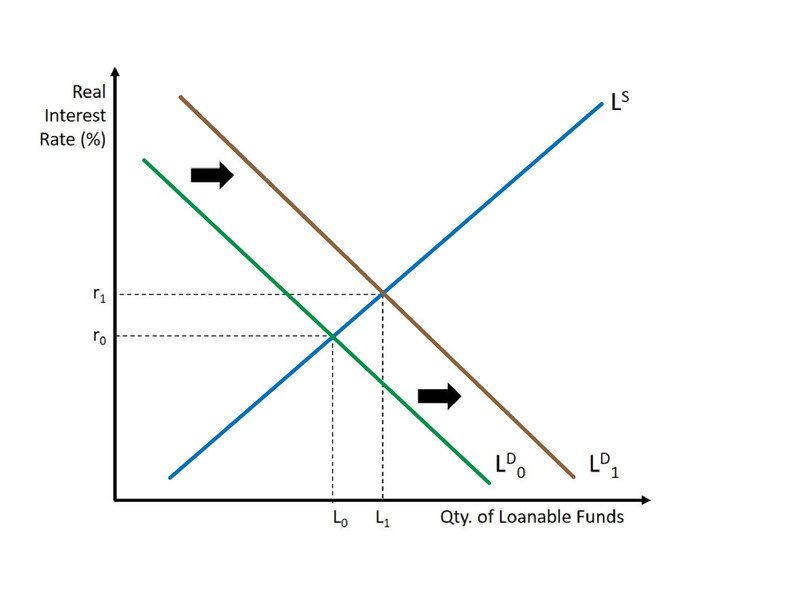
Loanable funds market with deficit-driven demand shift
You should immediately think:
Deficit → D right → r up → I down.
That chain shows up constantly in multiple choice and FRQs.
Before vs After Deficit
| Before Deficit | After Deficit | |
|---|---|---|
| Demand for Loanable Funds | LD0 | LD1 (shift right) |
| Real Interest Rate | r0 | r1 (higher) |
| Private Investment | I0 | I1 (lower) |
The government is now absorbing more of the available savings.
3. How Crowding Out Reduces the Impact of Fiscal Policy
Imagine the economy is in a recessionary gap (output below LRAS), like during the Great Recession of 2008-2009.
The Chain Reaction
- Government increases spending.
- AD shifts right.
- Output and income rise.
- Government runs a larger deficit.
- Borrowing increases.
- Real interest rates rise in the loanable funds market.
- Private investment falls.
- AD shifts left slightly from its new position.
The graphs below show both markets adjusting at the same time. Focus on the left panel for the loanable funds market and the right panel for the AD-AS model.
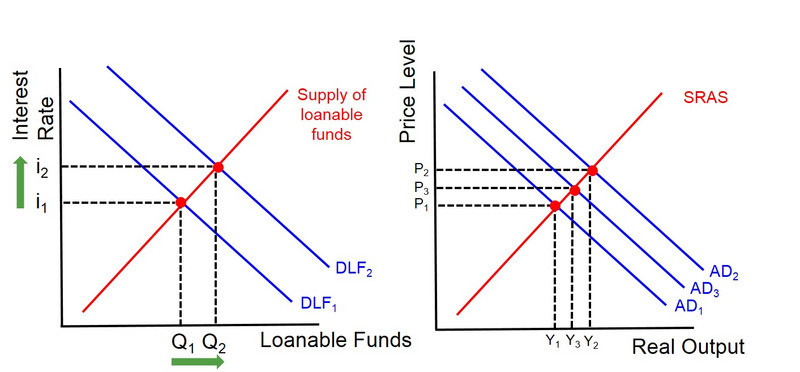
In the loanable funds market, demand shifts right and the real interest rate rises. In the AD-AS graph, AD first shifts right, then shifts slightly left as investment falls.
The economy improves, but not as much as policymakers hoped.
On exams, they love asking you to show:
- Expansionary fiscal policy shifts AD right
- Crowding out reduces investment
- The final equilibrium output is lower than it would be without crowding out
The correct answer often mentions a leftward shift of AD caused by rising interest rates.
4. Short-Run vs Long-Run Consequences
Short Run Effects
- Higher real interest rates
- Lower private investment
- Smaller multiplier effect
- Weaker stimulus
Crowding out is more severe when:
- The economy is near full employment.
- The supply of loanable funds is inelastic.
- The demand for money is high.
It is less severe when:
- The economy is in a deep recession.
- There are large unused savings.
- Interest rates are already very low.
After the 2008 financial crisis, interest rates stayed near zero for years due to Federal Reserve policy. That limited crowding out because borrowing did not push rates up much.
Long Run Effects
Investment today builds tomorrow’s capital stock.
If investment falls:
- Slower capital accumulation
- Slower productivity growth
- Slower growth of LRAS
During the large federal deficits of the 1980s under Reagan, economists debated whether persistent borrowing would crowd out investment and slow long-run growth.
The key long-run idea is simple:
Less investment → less physical capital → slower economic growth.
Key Takeaways
Crowding Out
Government borrowing raises real interest rates and reduces interest-sensitive private spending, especially investment.
Government Borrowing in a Budget Deficit
When tax revenue is below spending, the government borrows funds to finance the gap.
Long-Run Impact of Crowding Out
Less private investment slows physical capital formation and can reduce long-run economic growth.
Crowding Out and Fiscal Policy
Government borrowing raises real interest rates, reducing private investment and weakening aggregate demand.
Notes
Crowding Out
Government borrowing raises real interest rates and reduces interest-sensitive private spending, especially investment.
Government Borrowing in a Budget Deficit
When tax revenue is below spending, the government borrows funds to finance the gap.
Long-Run Impact of Crowding Out
Less private investment slows physical capital formation and can reduce long-run economic growth.
Crowding Out and Fiscal Policy
Government borrowing raises real interest rates, reducing private investment and weakening aggregate demand.
