Topic 1.3 Notes – Representing Motion
1. Position, Velocity, and Acceleration
Everything starts with position .
- Position tells you where the object is relative to a chosen origin.
- Displacement is the change in position: It includes sign. A negative displacement just means “in the negative direction.”
From position, we define velocity.
- Instantaneous velocity is the rate of change of position:
- The sign of tells you direction.
- Average velocity is .
From velocity, we define acceleration.
- Instantaneous acceleration:
- Acceleration changes velocity. That could mean:
- changing speed,
- changing direction,
- or both.
If acceleration is constant, velocity changes linearly in time.
Big chain to remember
- Position → derivative → velocity
- Velocity → derivative → acceleration
- Acceleration → integral → velocity
- Velocity → integral → displacement
That derivative-integral relationship shows up constantly on FRQs.
2. Ways to Represent Motion
All representations describe the same motion. You should be able to translate between them without hesitation.
a. Motion Diagrams
A motion diagram shows an object’s position at equal time intervals and often includes velocity arrows.
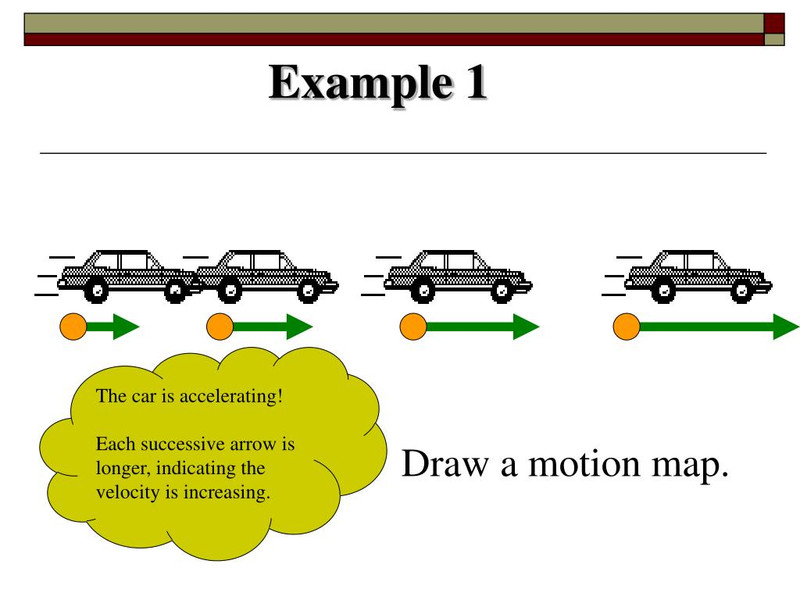
Motion diagram for an object speeding up to the right
Each dot is the object’s position at equal time intervals.
- Equal spacing → constant speed
- Increasing spacing → speeding up
- Decreasing spacing → slowing down
- Arrow direction → direction of velocity
If spacing increases to the right, velocity and acceleration are both positive.
b. Graphs of Motion
The same motion can be represented with position, velocity, and acceleration graphs that must all be consistent.
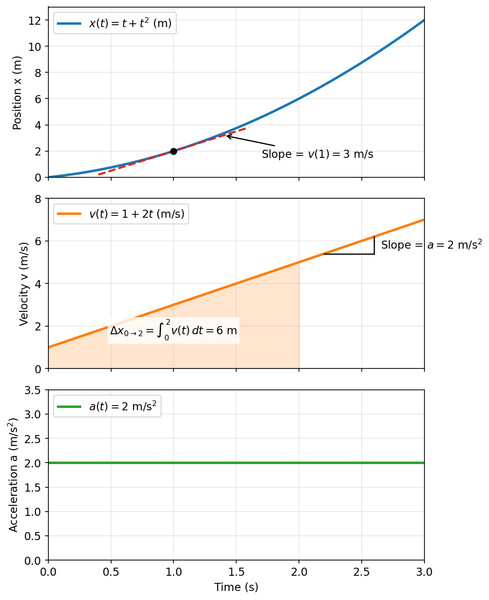
Consistent x-t, v-t, and a-t graphs for constant positive acceleration
These three graphs must “agree” with each other.
Position vs Time (x-t)
- Slope = velocity
- Tangent slope at a point = instantaneous velocity
- Curved graph → acceleration exists
- Horizontal line → at rest
Mathematically, slope means
Velocity vs Time (v-t)
- Slope = acceleration
- Area under curve = displacement
If velocity is negative, area counts negative.
Acceleration vs Time (a-t)
- Area under curve = change in velocity
- Horizontal line → constant acceleration
A common AP move is giving you one graph and asking for the other two. If you see a curved x-t graph, expect a linear v-t graph.
c. Equations
Equations are just compact versions of the same relationships.
- If acceleration varies with time, use the calculus definitions.
- If acceleration is constant, use the kinematic equations (next section).
d. Verbal Descriptions
A good motion description states:
- Direction (sign of velocity),
- Whether speed is increasing or decreasing,
- Whether acceleration is constant.
If velocity and acceleration have the same sign, the object is speeding up. Opposite signs mean slowing down. That connection is tested all the time in multiple choice.
3. Constant Acceleration Kinematics
These apply only in one dimension with constant .
Notice the structure:
- First equation has no .
- Second has no final .
- Third has no .
If time is missing from the problem, the third equation is usually the cleanest.
Choosing an equation
- Write down knowns and the unknown.
- Pick the equation that doesn’t include the extra variable.
- Keep signs consistent with your coordinate system.
These work in any single direction, including along an incline.
4. Motion Under Gravity Near Earth
Near Earth’s surface:
- Acceleration is constant.
- Direction is downward.
- Use on the AP exam. Using 9.8 or 9.81 is also fine.
If upward is positive:
Important facts:
- At the top of vertical motion, but still.
- Free fall always has acceleration , even if the object is momentarily at rest.
Just plug into the regular kinematic equations.
5. Connecting the Representations
You should be able to start anywhere.
- From x-t: slope → ; slope again → .
- From v-t: slope → ; area → .
- From a-t: area → ; then integrate again for position.
Turning points occur where . On an x-t graph, that’s where the tangent slope is zero.
Motion is one physical story told four different ways. The AP exam assumes you can switch languages instantly.
