Topic 5.5 Notes – Rotational Equilibrium and Newton’s First Law in Rotational Form
1. Rotational Equilibrium and Constant Angular Velocity
An object is in rotational equilibrium when its angular velocity is constant. That includes:
- Completely at rest ()
- Spinning at a steady rate ()
The condition is simple:
If the net external torque is zero, then the angular acceleration must be zero. From Newton’s Second Law for rotation:
So if , then , which means does not change.
This is Newton’s First Law in rotational form:
A system maintains constant angular velocity only if the net external torque acting on it is zero.
The word external matters. Internal forces don’t change the rotation of the whole system.
If instead , then , and the object’s angular velocity must be changing.
2. Translational vs Rotational Equilibrium
These two conditions are independent. That’s where a lot of students slip.
Translational equilibrium
- Linear velocity is constant.
- Could be at rest or moving at steady speed.
Rotational equilibrium
- Angular velocity is constant.
- Could be not rotating or spinning steadily.
Here’s the side-by-side comparison:
| Condition | Equation | What Stays Constant |
|---|---|---|
| Translational equilibrium | Linear velocity | |
| Rotational equilibrium | Angular velocity |
Now the important part: you can have one without the other.
- Balanced forces but unbalanced torques → object rotates (like pushing opposite sides of a door in opposite directions).
- Unbalanced forces but balanced torques → object accelerates linearly but does not change its rotation.
- Both zero → completely steady motion.
- Both nonzero → both translation and rotation change.
On AP free-response problems, they love giving you a situation where students assume “balanced forces means nothing moves.” That only guarantees no linear acceleration. You still must check torques separately.
Free-body diagrams help here. They show all forces. From those forces, you determine which produce torque about your chosen pivot.
3. Torque and How to Calculate It
Torque measures how effectively a force causes rotation about a point.
Equivalent form:
Where:
- is the distance from pivot to where the force is applied
- is the angle between and
- is the perpendicular lever arm
The diagrams below show a rod pivoted at the left end with forces applied in different directions. Focus on how changing the angle or the point of application changes the lever arm.
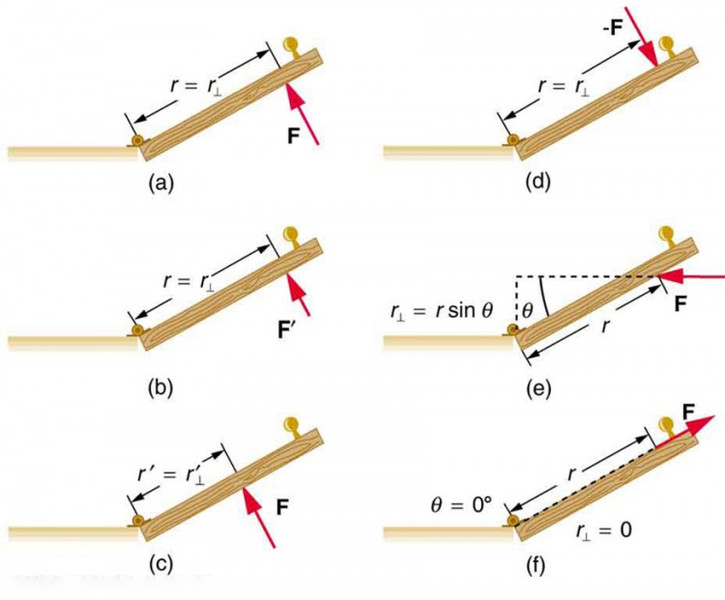
Torque depends on force, lever arm, and angle
Key ideas:
- Only the perpendicular component of the force creates torque.
- A force applied at the pivot produces zero torque.
- Bigger lever arm means bigger torque for the same force.
You must choose a sign convention. Most people use counterclockwise positive. Stay consistent throughout the problem.
4. Solving Rotational Equilibrium Problems
Typical setup is a beam, rod, or board with forces at different points.
Your process should feel mechanical:
- Draw a complete free-body diagram.
- Choose a pivot point.
- Smart choice cancels unknown forces.
- Compute each torque using lever arms.
- Assign signs.
- Set .
- Solve algebraically.
You do not need to analyze rotation in multiple planes. Everything stays in a single plane for AP Physics C.
A classic mistake is forgetting that the object’s own weight acts at its center of mass. That force often creates torque.
5. Newton’s First and Second Laws in Rotational Form
Newton’s First Law (rotational):
Newton’s Second Law (rotational):
- Larger means more resistance to changes in rotation.
- For the same torque, a larger gives a smaller .
Conceptually, torque plays the role that force plays in translation, and moment of inertia plays the role that mass plays.
When you later study angular momentum, this idea becomes powerful. No net external torque means angular momentum stays constant.
