Topic 4.3 Notes – Conservation of Linear Momentum
1. Linear Momentum and Systems
For a single particle, linear momentum is
- Vector quantity. Same direction as velocity.
- Units:
If velocity doubles, momentum doubles. If mass doubles, momentum doubles. Simple and direct.
Total Momentum of a System
For multiple objects,
- Add components in 2D.
- Momentum is additive.
If two objects move in opposite directions, their momenta can partially or completely cancel.
Center-of-Mass Velocity
Instead of tracking each object separately, you can treat the whole system as one object of total mass moving at the center-of-mass velocity:
And this connects directly to momentum:
That equation is huge. It tells you the system moves as if all mass were concentrated at one point.
If the net external force is zero, then:
- is constant.
- Total momentum is constant.
This is often the cleanest way to think about multi-object motion.
2. When Momentum Is Conserved
Here’s the deep idea.
Momentum Is Conserved in All Interactions
When two objects interact, Newton’s 3rd law says forces are equal and opposite. Since impulse is force × time:
And because ,
Internal momentum changes cancel. Momentum just moves around inside the system.
Zero Net External Force
If
then
This is when you directly apply conservation in collision problems.
Common cases:
- Frictionless surfaces
- Explosions in space
- Very short collision times where external forces are negligible
Nonzero Net External Force
If external forces act, then the system’s momentum changes by the external impulse:
Momentum isn’t destroyed. It’s transferred between system and environment.
This is why system choice matters. Include more objects in your system, and what looked like an external force may become internal.
3. Impulse and Momentum Change
Impulse connects force and momentum:
For constant force:
And always:
On a force-time graph, impulse is the area under the curve.
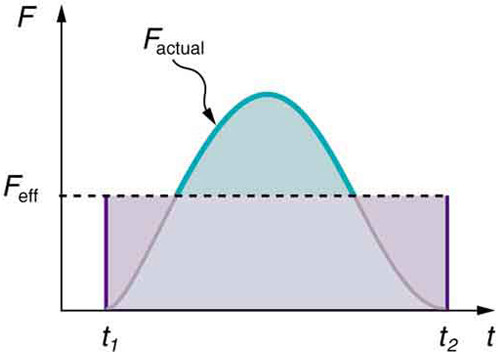
Impulse as area under a force-time graph
The curved “actual” force pulse and the rectangular pulse have the same area, so they produce the same impulse and the same change in momentum.
This explains why airbags work. Same momentum change, but larger collision time means smaller force.
In collisions:
- Each object gets equal and opposite impulse.
- If isolated, total system momentum stays constant.
4. Applying Conservation to Collisions and Explosions
AP Physics C expects quantitative analysis in 1D and 2D.
Setting Up a Momentum Problem
- Define your system.
- Check for external forces.
- Choose axes.
- Write conservation in components:
- Solve algebraically.
Never mix x and y in the same equation.
Types of Collisions
| Type | Momentum | Kinetic Energy | Key Feature |
|---|---|---|---|
| Elastic | Conserved | Conserved | Objects bounce apart |
| Inelastic | Conserved | Not conserved | Some KE → heat/sound |
| Perfectly Inelastic | Conserved | Not conserved | Objects stick together |
For perfectly inelastic collisions:
2D Collisions
Treat directions separately. In two dimensions, momentum vectors before the collision add tip to tail to equal the total momentum vector, and the same must be true after the collision.

Vector addition of momentum in a 2D collision
Write one conservation equation for x and one for y. Students often forget momentum is conserved in each direction independently.
After solving for components, find:
Explosions
If the system starts at rest, total momentum is zero.
After explosion:
So pieces fly apart with momenta that cancel. The heavier piece moves slower so that in magnitude.
