Topic 5.1 Notes – Rotational Kinematics
1. Angular Displacement, Angular Velocity, and Angular Acceleration
A rigid system keeps its shape as it rotates. Different points move in different directions, so you cannot treat it like a single particle when rotation matters.
If rotation is negligible for the question, you can treat the object as a single mass using center-of-mass motion. For example, when analyzing Earth orbiting the Sun, we ignore Earth’s daily spin.
Angular Displacement
Angular displacement measures how far something rotates about a chosen axis.
- Units: radians (rad)
- One full revolution = rad
- Defined from arc length:
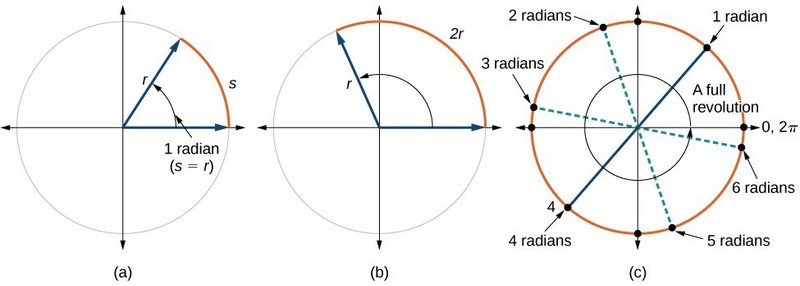
A radian is the angle that subtends an arc equal to the radius. In the left panel, the arc length equals , so the angle is 1 radian. The right panel shows how angles in radians build all the way to a full revolution of .
Sign convention
- Counterclockwise → positive
- Clockwise → negative
On the AP exam, direction is described only as clockwise or counterclockwise relative to an axis. You will not need 3D vector directions.
Angular Velocity
Angular velocity tells you how fast angular position changes:
- Units: rad/s
- Average:
- Sign gives direction of rotation
Constant means steady rotation. That is uniform circular motion.
Angular Acceleration
Angular acceleration describes how angular velocity changes:
- Units: rad/s²
- Same sign as → speeding up
- Opposite sign → slowing down
Students often mix this up. The sign comparison is what tells you speeding up vs slowing down, not the sign alone.
2. Rotational and Linear Motion Are Mathematically Identical
For motion about a single fixed axis, rotational kinematics mirrors 1D motion.
| Linear | Rotational |
|---|---|
| x (displacement) | θ (angular displacement) |
| v = dx/dt | ω = dθ/dt |
| a = dv/dt | α = dω/dt |
Every constant-acceleration equation you know from Unit 1 still works after replacing:
This analogy shows up constantly in FRQs. If you’re stuck, write the linear version first and then swap symbols.
3. Constant Angular Acceleration Equations
When is constant, the full set is:
Treat them as one package.
Quick Example
A disk starts from rest and spins with for 3 s.
Using
If they ask for revolutions, divide by :
Many students forget this final conversion.
Choosing an Equation
- List knowns:
- Identify your unknown
- Pick the equation containing only one unknown
Same logic as linear kinematics.
4. Graphs of θ, ω, and α vs Time
Everything you learned about motion graphs still applies. The example below shows an angular velocity vs time graph with a straight line decreasing from about 30 rad/s at to 0 rad/s at . That straight line means constant angular acceleration.

Angular velocity vs time with constant negative acceleration
Slopes
- Slope of θ-t →
- Slope of ω-t →
In the graph shown, the slope is negative and constant, so is negative and constant.
Areas
- Area under ω-t →
- Area under α-t →
For this ω-t graph, the area under the line from 0 to 5 s gives the total angular displacement. Because the graph forms a triangle, you could find using the area formula .
Key recognition skills:
- Constant → ω-t is linear
- Constant → θ-t is quadratic
- Direction change happens when crosses zero
On MCQs, they love giving a graph and asking for sign of acceleration or total angular displacement. Always check slope first.
5. Units, Conversions, and Sign Discipline
Radians Only
Always convert:
- Degrees → multiply by
- Revolutions → multiply by
RPM Conversion
Students lose easy points here by skipping the 60 seconds.
Sign Consistency
Pick a positive direction at the start and stick with it.
If and have opposite signs, rotation is slowing.
If same sign, it is speeding up.
