Topic 2.4 Notes – Newton’s First Law
Newton’s First Law and Constant Velocity
Newton’s First Law says:
If the net force on a system is zero, its velocity remains constant.
Constant velocity means constant speed and constant direction.
That includes:
- Sitting still ()
- Moving in a straight line at steady speed
The mathematical statement is:
From Newton’s Second Law, .
So if , then . No acceleration means no change in velocity.
Inertia
Inertia is resistance to changes in velocity.
- Measured by mass
- Larger mass → harder to change velocity
- But if net force is zero, every mass keeps constant velocity
On conceptual multiple choice, they often test whether you confuse “moving” with “net force.” Motion alone does not imply force. Only changing motion does.
Net Force and Translational Equilibrium
Net Force Is a Vector Sum
The net force is the vector sum of all forces acting on the system.
That means:
- Same direction → add
- Opposite direction → subtract
- Angled forces → resolve into components
Always think in components:
Translational Equilibrium
A system is in translational equilibrium when:
That implies:
- Velocity is constant
Equilibrium does not mean “at rest.” It means “not accelerating.”
Common equilibrium patterns:
- Object resting on table →
- Object sliding at constant speed → applied force = kinetic friction
- Hanging mass → tension = weight
Here’s what that looks like in a simple free-body diagram of a box sliding at constant speed:
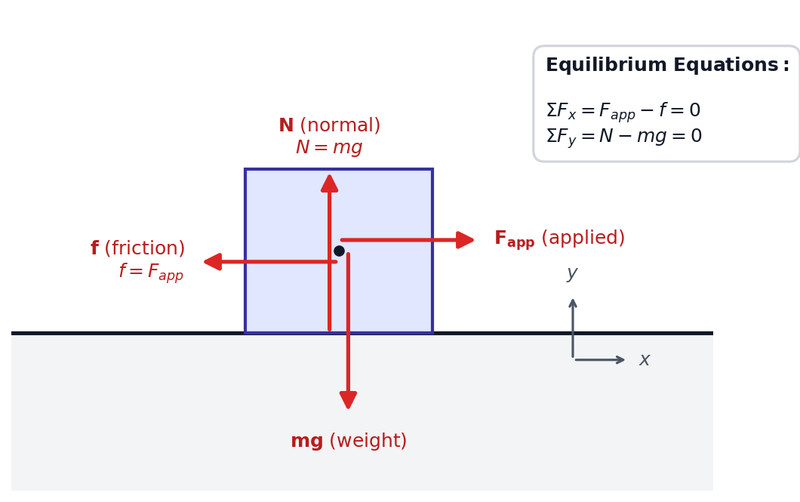
Free-body diagram of a box in translational equilibrium
Vertical forces balance so , and horizontal forces balance so . Each direction satisfies its own equilibrium condition.
Balanced vs Unbalanced Forces in Multiple Dimensions
Forces can balance in one direction but not the other.
You must check each axis separately:
Possible situations:
- Balanced in x and y → constant velocity
- Balanced in x, unbalanced in y → acceleration only vertical
- Balanced in y, unbalanced in x → acceleration only horizontal
Velocity changes only in the direction of the net force.
Example you might see on a quiz:
A puck slides across ice at constant speed.
- Vertical:
- Horizontal: no friction → no horizontal forces
So , . It keeps moving.
If friction appears, horizontal forces are no longer balanced → acceleration opposite motion.
When FRQs get tricky, they sometimes give angled forces. You must resolve into components before deciding if equilibrium exists. Students lose points by judging balance visually instead of mathematically.
Inertial Reference Frames
An inertial reference frame is one where Newton’s First Law works.
In that frame:
- If , velocity is constant.
- No extra mystery accelerations appear.
For AP Physics C, treat Earth as approximately inertial unless told otherwise.
Non-inertial Frames
A non-inertial frame is accelerating or rotating.
In these frames:
- Objects appear to accelerate even with no real net force.
- You must introduce fictitious forces to apply Newton’s laws.
Classic example:
A car accelerates forward. A loose backpack slides backward relative to the car.
From the ground (inertial frame):
- The backpack tends to stay at rest due to inertia.
- The car moves forward underneath it.
From inside the car (accelerating frame):
- It looks like a backward force acts on the backpack.
- That “force” is fictitious, added to make Newton’s laws work in that frame.
Newton’s First Law is what defines whether a frame is inertial.
How This Shows Up on Tests
When a problem says:
- “Constant velocity”
- “At rest”
- “Moving with uniform speed”
You should immediately think:
Then:
- Draw a clean free-body diagram.
- Break into components.
- Set each direction’s sum equal to zero.
- Solve for the unknown force.
If velocity changes in any way, even just direction, net force is not zero.
