Topic 2.6 Notes – Gravitational Force
1. Newton’s Law of Universal Gravitation
Every mass attracts every other mass.
- is the distance between centers of mass
- Direction : along the line connecting the centers
- The force is always attractive
Patterns you must recognize instantly
If distance doubles, force becomes .
If one mass triples, force triples.
Here’s the geometry the equation assumes. The force on each mass points along the line connecting their centers, and the two forces are equal in magnitude and opposite in direction.
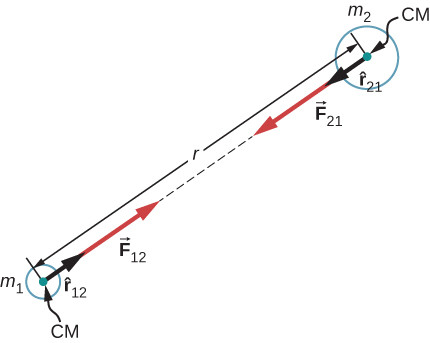
Mutual gravitational forces between two masses
For spherically symmetric objects (planets, stars), you treat them like point masses located at their centers. That shortcut becomes crucial later for orbits.
2. Gravitational Field and Weight
Instead of always thinking about two objects pulling on each other, it’s often cleaner to say a mass creates a gravitational field around it.
Gravitational Field
For a mass :
- Units:
- Direction: toward the mass
- If gravity is the only force, then
That last idea is huge. Field strength numerically equals free-fall acceleration.
Weight
Weight is the gravitational force from a large astronomical body.
- Mass stays the same everywhere.
- Weight changes with location.
- Near Earth’s surface, .
When Can You Treat Gravity as Constant?
Near Earth’s surface, changes in height are tiny compared to Earth’s radius. That means:
- barely changes
- is approximately constant
- is approximately constant
That’s why projectile motion uses constant .
This approximation breaks down for satellites or large altitude changes.
3. Apparent Weight and Noninertial Frames
What a scale reads is normal force, not .
Let upward be positive. Apply .
| Situation | Acceleration | Normal Force (Apparent Weight) |
|---|---|---|
| At rest / constant velocity | ||
| Accelerating upward | ||
| Accelerating downward | downward | |
| Free fall | downward |
If , you feel weightless.
Astronauts in orbit are weightless because gravity is the only force acting. They’re in continuous free fall.
Equivalence Principle
Inside a closed box, you cannot distinguish between:
- Being at rest in a gravitational field
- Accelerating upward in deep space
Acceleration and gravity are locally indistinguishable. This idea shows up conceptually on exams more than computationally.
4. Inertial Mass vs Gravitational Mass
Two roles for mass:
Inertial Mass
From Newton’s second law:
Measures resistance to acceleration.
Gravitational Mass
From the gravitational law:
Determines strength of gravitational attraction.
The Big Experimental Result
Because they’re equal:
- All objects fall with the same acceleration (ignoring air).
- does not depend on the object’s mass.
That equality is not assumed lightly. It’s experimentally verified.
5. Gravity from Spherical Mass Distributions
The total gravitational force from a distributed object is the vector sum of forces from tiny mass pieces. For spherical symmetry, Newton’s shell theorem simplifies everything.
No derivation required for AP.
Thin Spherical Shell
The figure below summarizes the key results for both a thin shell and a solid sphere. Focus first on the thin shell cases.
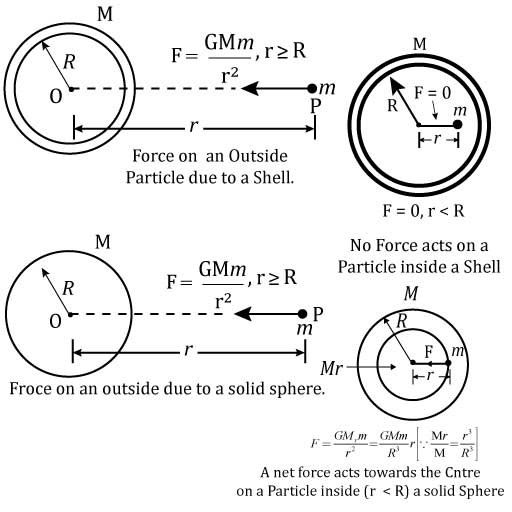
Newton’s shell theorem: shell vs. solid sphere
- Outside → behaves like all mass at center
- Inside →
Forces cancel perfectly inside.
Solid Sphere with Uniform Density
Now focus on the solid sphere cases in the same figure.
Outside behaves like a point mass.
Inside is more interesting.
Only mass at radius contributes.
Force becomes:
So inside:
- Zero at center
- Increases linearly
- Maximum at surface
That linear dependence is mathematically identical to a spring force. If you drilled through Earth (uniform density assumption), motion would be simple harmonic motion.
