Topic 4.1 Notes – Linear Momentum
1. Linear Momentum
Definition and Equation
Linear momentum measures how hard it is to stop a moving object.
- = mass (kg)
- = velocity (m/s)
- Units:
Momentum depends on both mass and velocity. A heavy truck moving slowly can have the same momentum as a tennis ball moving very fast. What matters is the product.
If velocity doubles, momentum doubles. If mass doubles, momentum doubles.
Vector Nature of Momentum
Momentum points in the same direction as velocity.
That means:
- Choose a coordinate system first.
- In 1D, treat momentum algebraically with signs.
- Right might be
- Left might be
- If an object reverses direction, its momentum changes sign.
Quick mental check:
- Two identical carts moving at equal speed in opposite directions
- same magnitude momentum
- opposite signs
- they could cancel in a system.
In 2D, break momentum into components:
You analyze x and y separately. AP graders love when students forget that and try to treat it like a scalar.
2. Momentum of a System
A system is whatever collection of objects you decide to analyze.
The total momentum is the vector sum:
That means:
- Add momenta, not velocities.
- Add by components in 2D.
For example, imagine two blocks moving in opposite directions on a frictionless track:
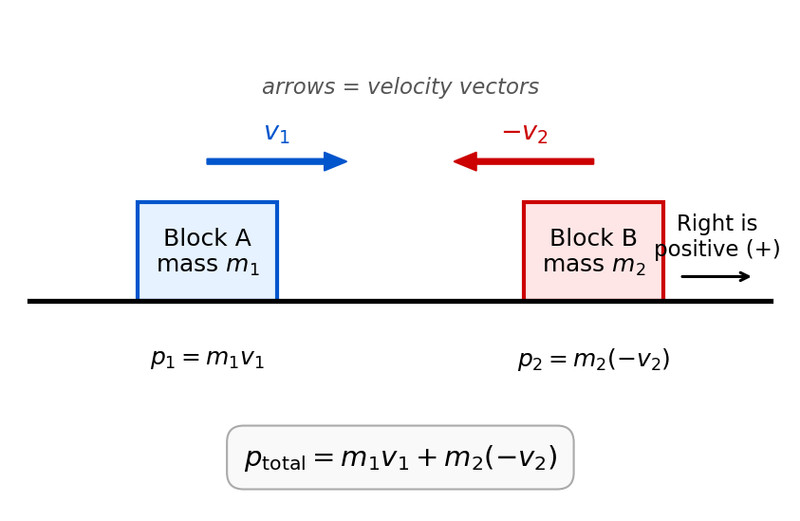
If right is positive:
Each block’s momentum keeps its own sign. One can partially or completely cancel the other depending on their masses and speeds.
Why Systems Matter
Internal forces inside the system can be huge and complicated. But when you treat objects together as a system, those internal forces don’t affect the total momentum of the system during a short interaction.
That’s why momentum becomes the tool for collisions and explosions.
3. Collisions
A collision model applies when:
- The interaction time is very short.
- Forces between objects are much larger than external forces.
- External forces (like gravity or friction) are negligible during impact.
Because the time is tiny, we ignore detailed force behavior and focus only on:
- Momentum just before
- Momentum just after
That’s the object model. Treat each object like a particle.
Examples:
- Two carts hitting
- A ball striking a bat
- A puck bouncing off a wall
If a ball “bounces back,” its velocity changes sign. That means its momentum changes sign. Students often forget to flip the sign and lose easy points.
You are never asked in this model to calculate the actual contact force during impact in this topic. Just initial and final states.
4. Explosions
An explosion model is the opposite setup.
- Objects start together.
- Internal forces push them apart.
- External forces are negligible during the short event.
Classic example: recoil.
If a system starts at rest:
Then after the explosion:
So if two pieces separate,
That means:
Heavier object → smaller speed. Equal and opposite momenta. The diagram below shows a system initially at rest breaking into two pieces that move in opposite directions, with right chosen as positive.
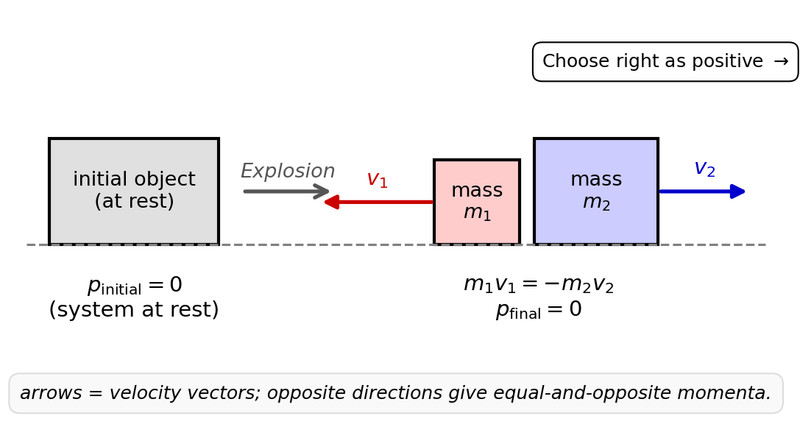
Explosion from rest: equal and opposite momenta
You’ll see this with:
- Gun recoil
- Rocket separation stages
- Person jumping off a stationary boat
5. Using Momentum to Analyze Interactions
Momentum is your go-to tool when:
- Interaction time is short.
- Forces during interaction are messy or unknown.
A clean setup looks like this:
- Define the system.
- Choose positive direction.
- Write total momentum before.
- Write total momentum after.
- Track signs carefully.
- Solve.
In 2D collisions:
- Conserve momentum in x.
- Conserve momentum in y.
- Solve the equations simultaneously.
On FRQs, most lost points come from:
- Not defining direction.
- Dropping a negative sign.
- Adding velocities instead of momenta.
