Topic 4.2 Notes – Change in Momentum and Impulse
1. Momentum and Its Rate of Change
Linear momentum
- Vector quantity. Same direction as velocity.
- Units:
- For a system: total momentum is the vector sum of each object’s momentum.
If two objects move in opposite directions, their momenta can partially cancel. Always think in components.
Net force and momentum
This is the most general form of Newton’s second law.
What it means:
- A larger net force makes momentum change faster.
- If , then momentum is constant. The object might still be moving at constant velocity.
Notice this works even if mass changes. That becomes important later.
Momentum-time graphs
Here’s what the relationship looks like graphically. In a momentum versus time graph, the slope at any point tells you the net force.
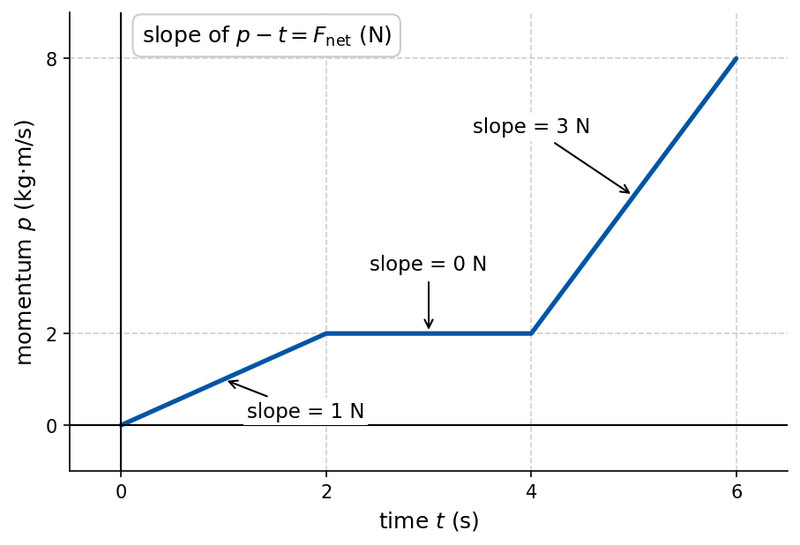
Momentum vs. time graph with varying net force
Key connection:
- Slope of a p-t graph =
- Steeper slope → larger force
- Horizontal line → zero net force
If you ever see a momentum graph on a quiz, think “take the slope.”
2. Impulse
Impulse measures the total effect of a force over time.
Definition
For constant force:
- Units:
- Vector quantity, same direction as the net force
So impulse is the total “push” delivered.
You can get the same impulse from:
- Big force, short time
- Small force, long time
That’s why airbags work. Same change in momentum, longer time, smaller force.
Force-time graphs
Impulse shows up visually as area under a force-time graph.
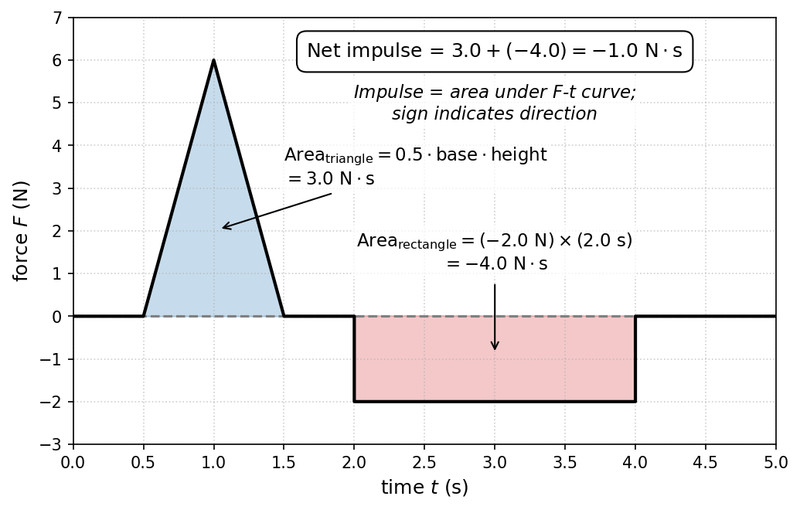
Impulse as area under an F-t graph
- Area under F-t curve = impulse
- Include sign. Area below the axis gives negative impulse.
- Break irregular shapes into triangles and rectangles.
Students often mix this up with momentum graphs. Remember:
- Area under F-t → impulse
- Slope of p-t → force
3. The Impulse-Momentum Theorem
Change in momentum
It’s vector subtraction. If velocity reverses direction, that’s a large change in momentum.
Core relationship
Full version:
This is huge for collisions and explosions. You usually don’t know the detailed force function, but you can relate impulse directly to momentum change.
Example setup you’ll see on a test:
- A 0.50 kg cart goes from to .
- .
- Impulse is .
Negative just means opposite your positive direction.
Newton’s second law as a special case
If mass is constant:
So is just the constant-mass version of the impulse-momentum theorem.
4. Variable-Mass Systems
Start from the general law:
If velocity is constant but mass changes:
So even with constant velocity, a system can have a net force if mass is flowing in or out.
This shows up in:
- Rocket propulsion
- Fuel ejection
- Systems gaining mass (like falling snow sticking to an object)
On exams, the trap is automatically writing . If mass changes, go back to .
5. Setting Up Impulse Problems
Given a force or F-t graph
- Find impulse
- Integrate
- Or compute area under graph
- Use
- Substitute if mass is constant
Given velocities
- Compute
- Set
- If needed, find
Be careful with signs. Many FRQs deduct for direction errors, not math mistakes.
