Topic 2.3 Notes – Newton’s Third Law
1. Newton’s Third Law
Newton’s Third Law describes what happens during an interaction between two objects.
Core statement
When object A interacts with object B:
- The forces are equal in magnitude
- Opposite in direction
- Act on different objects
In vector form:
That minus sign means opposite direction.
What makes a true third-law pair
A valid pair must:
- Be the same type of force (both gravitational, both normal, both tension, etc.)
- Come from the same interaction
- Be equal and opposite
- Act on two different objects
If two forces are on the same object, they are not a third-law pair.
Common mistakes
- Thinking the forces “cancel.” They do not cancel because they act on different objects.
- Pairing two forces from one free-body diagram.
- Calling “centripetal force” one side of a third-law pair. Centripetal force is just the net radial force, not a separate interaction.
Classic examples
- A book rests on a table. The table pushes up on the book (normal force), and the book pushes down on the table.
- Earth pulls a ball downward gravitationally, and the ball pulls Earth upward with the same magnitude force.
- A person pushes a skateboard backward; the skateboard pushes the person forward.
2. Representing Third-Law Pairs in Free-Body Diagrams
Here’s the key rule you must remember on tests:
Third-law forces never appear on the same free-body diagram.
Each FBD only shows forces acting on that object.
Look at the two connected blocks below. Each block has its own free-body diagram, and each diagram includes only the forces acting on that specific block.
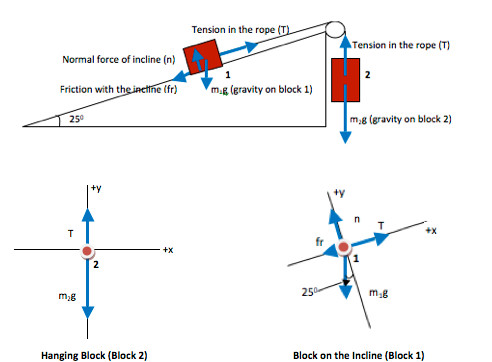
Free-body diagrams for two connected blocks
In this interaction:
- On block 1: include the force exerted by block 2 on block 1.
- On block 2: include the force exerted by block 1 on block 2.
Those two forces are a third-law pair, but they appear on different diagrams because they act on different objects.
Then apply Newton’s Second Law separately to each object:
Important: the forces are equal in magnitude, but the accelerations are not necessarily equal. If masses differ, accelerations differ.
On AP free-response questions, students often lose points by pairing forces incorrectly. If two forces are on the same diagram, they cannot be a third-law pair.
3. Internal vs External Forces and the Center of Mass
Now zoom out. Instead of looking at two objects separately, define a system.
Internal forces
Forces between objects inside the system:
- Always come in third-law pairs
- Equal and opposite
- Cancel when considering the entire system
They do not affect the motion of the system’s center of mass.
External forces
Forces from outside the system:
- Do not cancel
- Determine center-of-mass acceleration
The center of mass obeys:
The system moves as if:
- All mass were concentrated at the center of mass
- Only external forces acted
This is huge for recoil and explosion problems. If no external force acts, the center of mass cannot accelerate. Internal forces alone cannot change it.
4. Tension as a Third-Law Interaction
Tension is the pulling force transmitted through a string or cable.
At the microscopic level:
- Atoms in the string exert electromagnetic forces on neighboring atoms.
- Each tiny segment pulls on adjacent segments.
- The macroscopic result is the tension force.
Tension always:
- Pulls away from the object
- Acts along the string
It is itself part of a third-law pair. If a string pulls on a block, the block pulls back on the string.
5. Ideal Strings, Real Strings, and Ideal Pulleys
Ideal string
An ideal string:
- Has negligible mass
- Does not stretch
- Is flexible
- Transmits force instantly
Result: Tension is the same everywhere in the string.
That’s why in most AP problems you use one variable .
String with nonnegligible mass
If the string has mass:
- Each segment must support the mass below it.
- Tension changes along the length.
For a vertical hanging string:
- Maximum tension at the top
- Decreases downward
- Minimum at the bottom
So tension is not constant.
Ideal pulley
An ideal pulley:
- Has negligible mass
- Rotates about its center with negligible friction
Result:
- Tension is the same on both sides.
- The pulley only changes direction of the force.
If the pulley has mass, tensions on the two sides can differ and you must use rotational dynamics.
